
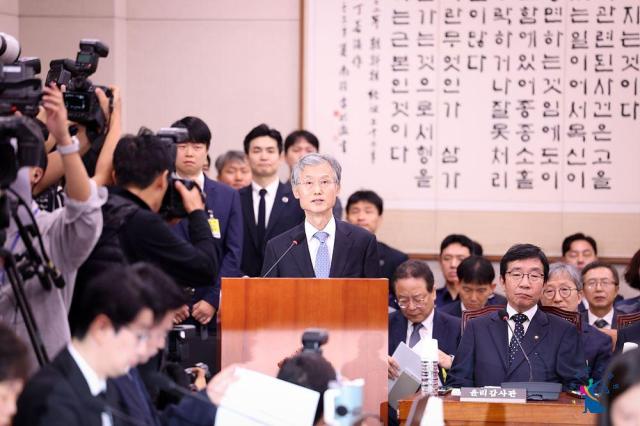
The controversy is intensifying on Thursday after newly-elected DP leader Kim Min-seok said the previous day that he had ordered the party to put up banners nationwide calling for Cho's resignation.
One of the banners says Cho, whom the DP accuses of undermining the rule of law, should step down. The move followed Kim's demand a day earlier that the chief justice resign over what he called an abuse of judicial authority.
The confrontation stems from Cho's decision last Tuesday to recommend Son Bong-gi, a senior judge at the Daegu District Court, and Kim Seong-su, a senior judge at the Seoul High Court, to President Lee Jae Myung as Supreme Court justice nominees. They were recommended to fill vacancies left by former justices Noh Tae-ak and Lee Heung-gu.
Unlike previous practice, Cho submitted the recommendations in writing without holding an in-person meeting with Lee, after Cheong Wa Dae and the Supreme Court held discussions over the nominees for months but failed to reach an agreement.
The DP has accused Cho of bypassing the president and breaking a longstanding practice under which the chief justice and president coordinate before Supreme Court nominees are formally recommended.
The Supreme Court has rejected claims that Cho acted without consultation. Noh Kyung-pil, head of the National Court Administration, told the National Assembly's Legislation and Judiciary Committee on Wednesday that the court had sought a meeting with the president but was not given an opportunity to do so. He also said the method of submitting the nominations in writing had been discussed with the presidential senior secretary for civil affairs.
Noh stressed that the Constitution gives the chief justice authority to recommend Supreme Court justices, while the National Assembly has the power to consent to their appointment and the president holds the authority to appoint them.
The dispute has now moved beyond the nomination process to Cho's political and potentially constitutional accountability.
DP lawmaker Choi Min-hee has called on the National Assembly to begin discussing Cho's future including possible impeachment. The Assembly's Legislation and Judiciary Committee also approved a motion demanding that Cho appear before the committee to explain the nomination process and the months-long delay in filling the vacancies.
The legal question, however, centers on whether breaking a political or institutional convention can itself constitute grounds for impeachment.
Article 104 of the Constitution states that Supreme Court justices are appointed by the president upon the recommendation of the chief justice and with the consent of the National Assembly. It does not explicitly require the chief justice to reach an agreement with the president before making a recommendation.
Article 65, meanwhile, allows the National Assembly to impeach judges when they have violated the Constitution or other laws in the performance of their official duties. An impeachment motion against a judge requires the support of at least one-third of all lawmakers to be introduced and a majority of all lawmakers to pass.
"Once the Democratic Party leadership election is over, I do not think the ruling party will be able to easily push ahead with impeachment without compelling grounds, as doing so could trigger public backlash," said Rep. Yoo Sang-bum of the main opposition People Power Party (PPP), a former chief prosecutor.
"The four-month delay in recommending the Supreme Court justice nominees was merely the result of the presidential office's failure to coordinate the process," Yoo said.
"I believe the impeachment call was made as a tactical move during the Democratic Party leadership race to win votes from hard-line supporters, who harbor strong antipathy toward Chief Justice Cho," he added.
Ruling party lawmakers, meanwhile, expressed a strong determination to pursue Cho’s impeachment. "If Cho does not resign, we will impeach him," said Rep. Yang Bu-nam of the DP, also a former chief prosecutor.
"Cho is not a judge but a politician," Yang said. "Regardless of whether his actions meet the legal requirements for impeachment, it would be appropriate for him to step down."
"Lawmakers including myself, have begun discussing impeachment," said another DP lawmaker Kim Yong-min, a member of the National Assembly's Legislation and Judiciary Committee.
"Cho exercised his authority to recommend Supreme Court justices through a written submission without even explaining why the process had been delayed," Kim said.
"This amounts to disregarding South Korea's constitutional order, as well as the president's authority to appoint justices and the National Assembly's power to consent to their appointments."
"I do not think it would be appropriate to discuss how we would respond in advance when impeachment has yet to take concrete shape," Rep. Kim Tae Kyu of the PPP, a former judge, told AJP when asked how the party would respond if an impeachment push against Cho moves forward.
Copyright ⓒ Aju Press All rights reserved.
