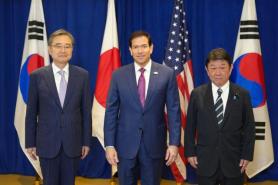
SEOUL, August 25 (AJP) - The stated goal of peace on the Korean Peninsula means the denuclearization of North Korea, South Korea's foreign ministry said Tuesday. The ministry was restating a position left out of its own account of a phone call between the two allies' top diplomats the night before.
That account said Foreign Minister Cho Hyun and U.S. Secretary of State Marco Rubio agreed to keep up close communication on peace on the peninsula and a resolution of the North Korean nuclear issue, while maintaining a firm combined defense posture. The word denuclearization did not appear.
The State Department released two sentences under spokesperson Tommy Pigott, saying only that Rubio had discussed a range of issues related to the alliance.
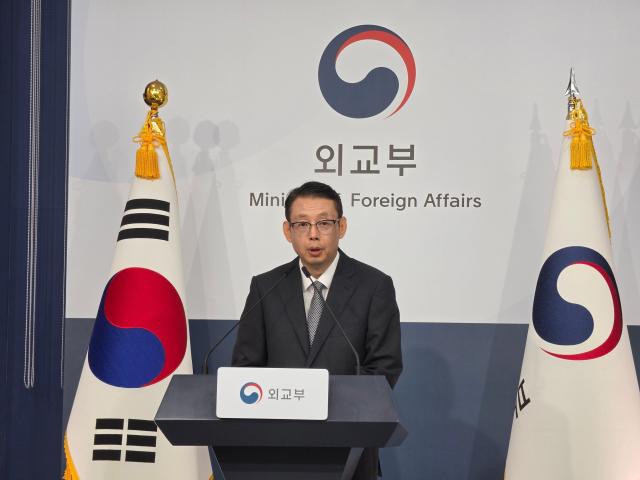
Denuclearization was discussed, Ministry of Foreign Affairs Spokesperson Park Doo-soon said Tuesday. Both governments continue to hold to the two goals set out in the joint fact sheet issued Nov. 14 after President Lee Jae-myung and President Donald Trump met in Gyeongju, it said.
That document commits the two sides to the complete denuclearization of North Korea and to peace and stability on the peninsula, and pledges cooperation on implementing the 2018 Singapore statement signed by Trump and North Korean leader Kim Jong Un.
Pressed on what peace on the peninsula refers to, the ministry said the term can be rendered as the denuclearization of North Korea.
The distinction carries weight. Denuclearization means Pyongyang giving up the weapons it has built. Peace on the peninsula, left undefined, is compatible with an arrangement that leaves them in place.
Cho and Rubio spoke late Monday evening Seoul time, their first call in five months. Rubio serves as both secretary of state and White House national security adviser.
He briefed Cho on Iran and U.S. efforts in the Middle East. Cho raised South Korea's willingness to help restore free passage through the Strait of Hormuz, which Iran has largely closed to traffic.
The two also agreed to seek gains on tariffs, an investment agreement, shipbuilding and security cooperation.
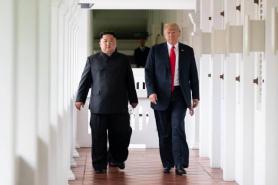
Scrutiny of the ministry's wording follows several weeks of signals from Washington that have unsettled Seoul. Trump posted a photograph of his 2019 meeting with Kim at Panmunjom to his social media account on Aug. 15.
He said the next day that he has a very good relationship with Kim, and disclosed that he had ordered a substantial reduction in combined military exercises. Cho and Defense Minister Ahn Gyu-back both said afterward that they had not been told in advance.
The ministry said the government hopes North Korea responds to steps taken by Seoul and Washington and that talks between the United States and North Korea resume. It described South Korea as a peacemaker and a party to peace on the peninsula rather than an observer of it.
The ministry did not say which side requested Monday's call, saying both had wanted it. It also declined to comment on the brevity of the U.S. readout, saying the text reflects the American side's own position.
China's language has moved in the opposite direction.
When Trump met Chinese President Xi Jinping in Beijing on May 14 and 15, the White House fact sheet issued two days later said the two leaders reaffirmed a shared goal to denuclearize North Korea.
Chinese foreign ministry spokesperson Guo Jiakun, addressing that line the following day, did not use the word. He said instead that China's position on the peninsula has remained consistent. Beijing has left the term out of a series of documents in recent years, including its most recent arms control white paper.
The South Korean ministry cited that same summit as evidence that the goal still holds, noting North Korean denuclearization was confirmed there as a joint objective. It said it continues to press China toward what it called a constructive role.
Chinese Foreign Minister Wang Yi visited Seoul last week and described the two Koreas as two states coexisting peacefully. The ministry said it would refrain from offering its own interpretation and is watching how Beijing uses the phrase. It did not say whether it had asked for a correction.
The phrasing drew notice because North Korea declared at the end of 2023 that the South is a separate and hostile state, abandoning reunification as a goal.
The ministry declined to confirm details of Trump's public remarks about North Korea's nuclear arsenal, including references to the number of weapons it holds.
Park Doo-soon, the ministry spokesperson, rejected the argument that South Korea's pragmatic diplomacy has failed as Russia deepens military ties with Pyongyang, China drops the denuclearization language and Washington softens its own.
"I do not agree with that judgment," he said, pointing to continuing contacts with all three governments.
Speculation about a Trump meeting with Kim has centered on November, when the leaders of the Asia-Pacific Economic Cooperation forum gather in Shenzhen on Nov. 18 and 19.
Copyright ⓒ Aju Press All rights reserved.