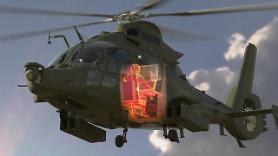
The unconventional military parade underscored how drones — rather than foot soldiers, spectacular warships or tanks — have come to define modern warfare.
For South Korea, the contrast was uncomfortable.
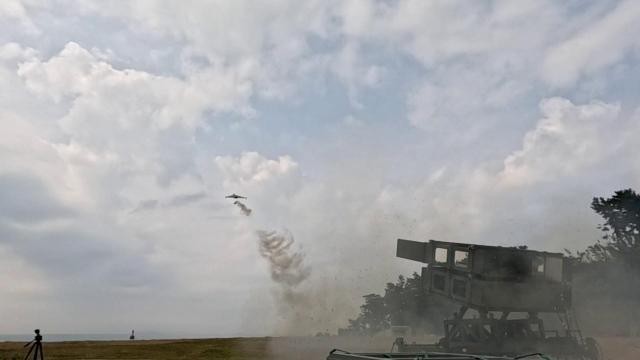
Two domestically developed suicide drones plunged into the sea within seconds of takeoff from the amphibious assault ship ROKS Marado during a publicly watched maritime combat test earlier this week, turning what was meant to showcase a new capability into an embarrassing flop.
The failure also stirred concern in a country facing nuclear-armed North Korea, which has been expanding its own drone arsenal and has gained exposure to Iranian-made drones and battlefield tactics through closer military cooperation with Russia.
A simple defect in the launcher, rather than a problem with the drones themselves, caused the two South Korean aircraft to crash during their first maritime combat test, the country's state-run defense research agency said Friday.
The Agency for Defense Development (ADD) said an initial investigation found that a misaligned door on one of the launch tubes created an imbalance as the drones were fired from the Marado on Tuesday.
"As developers, we are more disappointed than anyone that such a simple defect led to the worst possible outcome," the official said.
The launcher consisted of two levels of launch tubes. According to ADD, a door on the left side of a lower tube had been installed slightly out of alignment.
When a drone was fired from the upper tube, the force generated during launch briefly pushed the misaligned lower door inward. The resulting uneven reaction force pushed the departing aircraft to the right and destabilized it immediately after takeoff.
The drone turned sharply to the right, became unable to maintain flight and fell into the sea.
The deformation lasted only an instant before the door returned to its original position, making the problem difficult to detect during an inspection after the first crash, ADD said.
A second drone launched from the same system shortly afterward also crashed.
ADD said it had conducted dozens of previous launches without encountering the same problem.
"We believe the misalignment may have occurred while moving the launcher, loading cargo or during the assembly process," the official said, adding that investigators were still trying to determine exactly when the launcher became distorted.
The finding shifts attention away from initial questions over whether maritime conditions, ship movement or problems with the drones' flight-control systems had caused the accident.
Still, shipboard operations pose challenges that do not arise during launches from land.
"Launching drones from a ship is fundamentally different from doing so on land, given factors such as weather conditions and the limited space aboard a vessel," said Chae Woo-seok, chairman of the Korea Defense Industry Association.
Both aircraft crashed within seconds of launch, before they could begin the main part of the demonstration, which was intended to test their ability to identify and strike a high-speed unmanned surface target about two kilometers away.
ADD said it does not plan another maritime launch before the research project ends next month.
The agency said the project's core technologies have already been demonstrated through dozens of successful ground launches, while the shipboard test was an additional experiment aimed at assessing the possibility of maritime operation.
The accident has also drawn attention to what South Korea is trying to build as suicide drones increasingly shape wars from Ukraine to the Middle East.
Broadly, suicide drones are unmanned aircraft carrying explosives that are destroyed along with their targets. They are also commonly described as one-way attack drones or, in systems capable of searching an area before striking, loitering munitions.
The category covers weapons with dramatically different costs and capabilities.
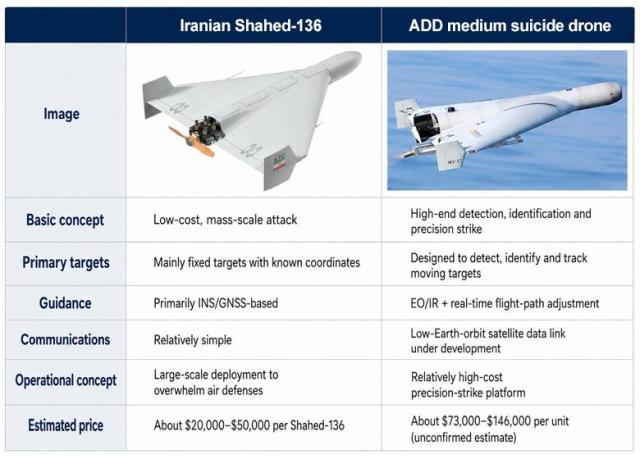
Iran's Shahed-136 represents one end of that spectrum.
The roughly 200-kilogram aircraft is designed primarily as a relatively inexpensive, long-range one-way attack weapon. The system has an estimated range of between 1,000 and 2,500 kilometers and carries roughly 20 to 50 kilograms of payload, according to the Center for Strategic and International Studies.
Its main advantage is affordability and scale rather than technological sophistication.
Analysts estimate a Shahed costs roughly $20,000 to $50,000, allowing large numbers to be launched simultaneously to exhaust or overwhelm much more expensive air defenses.
Russia has demonstrated the concept extensively in Ukraine, using thousands of Shahed-type drones in repeated waves against infrastructure and other targets.
The Center for Strategic and International Studies described their operational logic as one of attrition, in which even a relatively low individual success rate can be offset by low cost and mass deployment.
Russia launched more than 14,700 one-way attack drones against Ukraine between September 2022 and the end of 2024, according to a CSIS analysis.
Although roughly 90 percent of Shahed-type drones in the dataset were intercepted or otherwise failed to reach their targets, CSIS estimated that their relatively low unit cost of about $35,000 still made them Russia's most cost-effective long-range strike weapon.
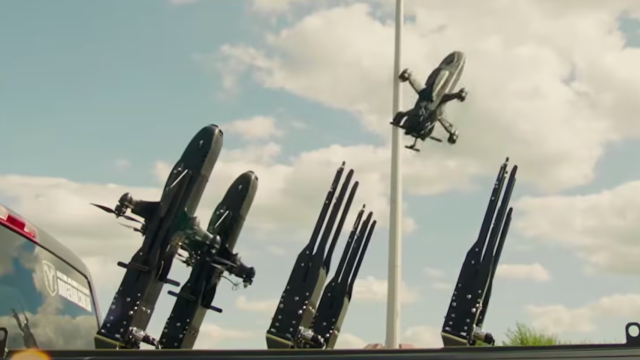
The medium-sized drone tested aboard the Marado is intended to fill a different role.
Defense officials have characterized the Korean system as a more "high-end" suicide drone.
The ADD research program, launched in 2024, is aimed at securing technologies including integrated communications with low-Earth-orbit satellites and automatic target recognition.
Those capabilities are intended to allow the drone to operate as part of a more sophisticated network, identify targets and alter its mission rather than simply fly toward a predetermined coordinate.
Tuesday's planned experiment illustrated that distinction.
Instead of attacking a fixed target whose location was already known, the drones were supposed to launch from a moving ship, identify a fast-moving unmanned vessel at sea and strike it.
The project's stated goals include automatic target recognition and data exchange through low-Earth-orbit satellites.
A direct comparison with the Shahed is therefore difficult.
The Iranian drone is optimized largely around low cost, range and mass, while the Korean medium-sized system emphasizes sensors, communications, target recognition and precision.
The added sophistication also raises the cost of a suicide drone designed to be destroyed after a single mission.
The experience of the war in Ukraine suggests cost can directly affect combat power by determining how many drones a military can afford to expend and replace.
The U.S. Defense Department has emphasized what it calls "attritable" autonomous systems, platforms built affordably enough that commanders can accept a greater risk of losing them, while pursuing deployment in large numbers.
That does not necessarily mean every suicide drone should be built as cheaply as possible.
A Defense Acquisition Program Administration (DAPA) official said the drone tested aboard the Marado falls toward the more sophisticated end of that spectrum.
"The drone was developed with the goal of directly identifying targets using electro-optical and infrared cameras and changing its flight path in real time while in flight before striking," the official said.
"That requires a number of different components to operate together, and integrating them into a single system inevitably adds considerable cost."
The official stressed that South Korea is developing unmanned systems across a range of prices and capabilities rather than pursuing only high-end weapons.
"We are not developing just a single type, but dozens of different types," the official said. "Just as there are low-cost cars and high-end, expensive cars on the market, it would be helpful to understand our drone development in the same way."
AJP Takeaways
• Two South Korean suicide drones crashed into the sea during a shipboard combat test after a misaligned launch-tube door destabilized them seconds after takeoff, according to ADD.
• The failure came as Ukraine publicly showcased aerial, ground and maritime drones during its Independence Day military display, underscoring the growing role of unmanned weapons in modern warfare.
• South Korea's medium-sized attack drone is designed with satellite communications, automatic target recognition and real-time course adjustment, placing it at the more sophisticated end of the one-way attack drone spectrum.
• Seoul is developing unmanned weapons across a range of prices and capabilities as cheaper mass-produced drones and more advanced networked systems take on growing roles in modern conflicts.

Copyright ⓒ Aju Press All rights reserved.