

SEOUL, September 01 (AJP) - AI literacy is becoming the latest addition to the long list of so-called "specs" young South Koreans need to compete for already-scarce entry-level jobs. The problem is that employers themselves are still figuring out what they want.
SK hynix is removing its traditional personal-statement questions from applications in the second half of this year. Instead, applicants will be asked to describe how they have used AI in projects, research and problem-solving.
During interviews in November, candidates will use a large language model, or LLM, on a computer to work through an assigned problem and then present how they reached their answer.
The chipmaker is less interested in AI proficiency itself than in how candidates use the technology to solve problems and explain their reasoning.
The change also reflects how generative AI has eroded the value of the written personal statement, long a staple of South Korean recruitment. As more applicants use AI to draft their essays, employers have less reason to rely on the writing alone to distinguish among candidates.
Jinyoung Kim, an economics professor at Korea University, said the shift was largely inevitable.
"Self-introduction essays have lost much of their value as a way to tell candidates apart because most people are using AI to write them these days," Kim said. "Basing interviews on them no longer makes much sense. Testing how applicants use AI is a way to gauge productivity, and I see it as a change that is hard to avoid."
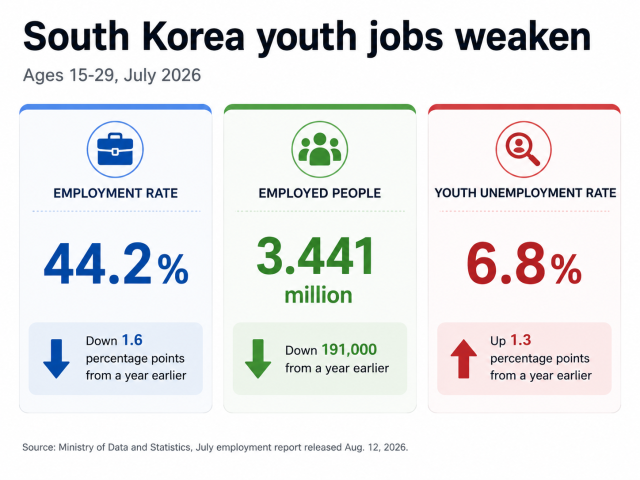
The employment rate for South Koreans aged 15 to 29 fell 1.6 percentage points from a year earlier to 44.2 percent in July, extending its decline to 27 consecutive months, according to the Ministry of Data and Statistics' July employment report released Aug. 12.
The number of employed young people fell by 191,000 to 3.441 million, marking the 45th straight month of decline, while the youth unemployment rate rose 1.3 percentage points to 6.8 percent.
The squeeze is also evident at major companies.
Leaders Index, a South Korean corporate research firm, found that new hires at 113 large companies that disclosed hiring figures fell 15.3 percent to 92,680 in 2025 from 109,456 in 2023. Across 132 companies, employment of workers aged 30 and under dropped 13.8 percent to 230,434 over the same period.
The outlook for the second half is somewhat brighter, although companies remain cautious about the scale of recruitment.
Incruit, a South Korean human resources technology company, surveyed 600 companies between July 1 and Aug. 3 and found that 74.3 percent of large companies had decided to hire in the second half, up 14.6 percentage points from a year earlier.
Among those with confirmed hiring plans, however, only 14.5 percent expected to recruit 100 or more employees, down 6.4 percentage points from last year.
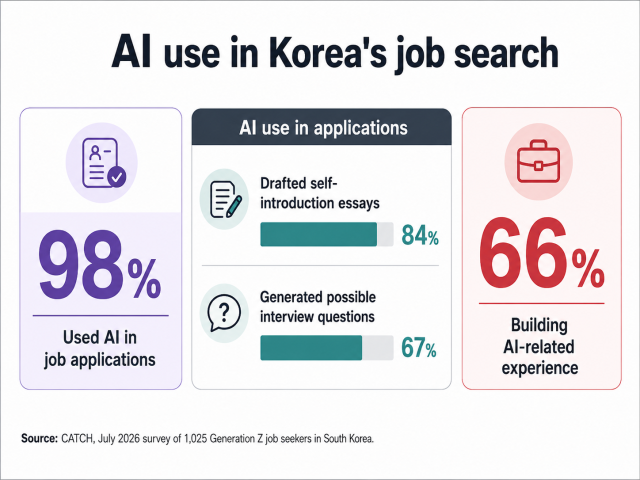
For job seekers, AI is already deeply embedded in the application process.
A July survey by South Korean recruitment platform CATCH found that 98 percent of 1,025 Generation Z job seekers were using AI when applying for jobs. Some 84 percent used it to draft self-introduction essays and 67 percent to generate possible interview questions. Yet only 66 percent said they were building AI-related experience.
The gap suggests that while AI has become routine for preparing applications, fewer job seekers have experience demonstrating how they can use it in actual work.
Simply saying they have used AI may therefore no longer be enough. Increasingly, applicants are being asked to show what they can do with it.
That pressure is also feeding demand for AI-related credentials. South Korea's Private Qualification Information Service, a government-run database for privately issued qualifications, listed 1,292 registered private qualifications with "AI" in their names as of Tuesday.
Yet there is no common standard for determining which of those credentials reflect the skills employers actually want.
In the absence of one, companies are developing their own tests.
KT, a major South Korean telecommunications company, opened applications Aug. 25 for college graduates in network infrastructure operations, business consulting and sales, and consumer marketing and sales.
Rather than testing AI knowledge alone, KT said it will give applicants work-related situations and assess how they use AI during the problem-solving process.
The approach resembles that of SK hynix. Both are focusing less on familiarity with a particular AI tool than on how applicants apply the technology to a problem.
But there is no single method for measuring that ability.
Employers are experimenting with everything from job simulations and AI aptitude tests to project-based assessments, effectively leaving each company to decide which elements of AI use matter most.

At the same time, AI appears to be raising expectations for entry-level workers.
PwC's 2026 Global AI Jobs Barometer found that U.S. entry-level jobs most exposed to AI were seven times more likely to require skills such as leadership, creativity and face-to-face communication — capabilities traditionally associated with more experienced workers.
For applicants, the absence of a clear standard can add another layer of pressure to an already demanding hiring process. Alongside foreign-language scores, internships and certificates, they may now feel compelled to build AI projects or take AI courses without knowing which experiences employers will ultimately value.
Kim acknowledged that learning another skill could add to the burden but viewed the shift as difficult to avoid if AI becomes a basic workplace tool.
"I think it can be fair because AI is already widely used among young people," he said.
Fairness, however, is only part of the problem. A more fundamental question is what AI literacy should mean in the first place.
The issue is being debated globally.
On June 18, the OECD and European Commission released an AI Literacy Framework for primary and secondary education, offering a common reference for the knowledge, skills and attitudes students need to understand and use AI responsibly.
The framework treats AI literacy as more than the ability to operate AI tools. Learners are expected to understand how AI works, critically evaluate its output and make informed judgments about its risks and limitations.
It sets out 19 competencies across four areas covering how learners engage with, create with, manage and shape AI.
The framework was designed for education rather than recruitment, but it illustrates how broadly AI literacy can be defined — and why it is difficult to reduce to a single certificate or test score.
Kim cautioned against treating overseas frameworks as a benchmark for Korean hiring while the technology itself continues to evolve rapidly.
"I do not think we can treat that as an established standard yet," he said. "Nor do I see much reason to benchmark overseas frameworks at this point. No one really knows where AI is headed, whom it will replace or whom it will assist."

That leaves employers with a contradiction: AI skills are becoming more important in hiring even as the criteria for judging them remain unsettled.
If using an LLM eventually becomes as routine as working with a spreadsheet or searching the internet, knowing how to use AI alone may cease to distinguish one candidate from another.
Recent hiring practices suggest the emphasis may instead move toward what workers do after AI generates an answer — whether they can verify the result, detect errors and make the final judgment rather than simply accept what the technology produces.
"I think this will continue to evolve," Kim said. "Even the people who built AI are not certain how widely it will be used or where it is headed."
The standard is still taking shape. For Korean graduates, the test has already begun.
AJP Takeaways
• SK hynix is replacing traditional personal-statement questions in its second-half 2026 recruitment with assessments of how applicants use AI to solve problems, including an LLM-based task and presentation during November interviews.
• AI is becoming a new hiring requirement as South Korea's youth job market weakens, with the employment rate for people aged 15 to 29 falling to 44.2 percent in July and major companies reducing recruitment from 2023 levels.
• South Korean employers including SK hynix and KT are developing their own AI-based hiring assessments because there is no common standard for determining what AI literacy means or which AI qualifications matter.
• The OECD and European Commission's AI Literacy Framework defines AI literacy broadly to include understanding, critical evaluation and judgment, suggesting employers may increasingly value candidates' ability to verify and interpret AI output rather than simply operate AI tools.
Copyright ⓒ Aju Press All rights reserved.
