SEOUL, September 2 (AJP) - South Korea's consumer inflation accelerated above 3 percent in August, but would have eased to around 2.5 percent excluding a one-off base effect, as policymakers turn their attention to rising wage costs and strengthening demand as more persistent sources of price pressure.
The consumer price index stood at 120.05 in August, up 3.1 percent from a year earlier and 0.2 percent from the previous month, the Ministry of Data and Statistics said Wednesday.
Inflation accelerated from 2.8 percent in July after a one-month dip.
Lee Doo-won, deputy commissioner for short-term economic statistics at the ministry, said last year's temporary mobile fee discount added about 0.58 percentage point to August inflation. Excluding the effect, inflation would have been around 2.5 percent.
The unusually low comparison base stemmed from a cybersecurity incident at SK Telecom in April 2025. The carrier later introduced a 500 billion won ($365 million) customer appreciation package covering about 24 million customers.
The package included an automatic 50 percent discount on August 2025 mobile bills for SKT customers and users of budget carriers operating on its network.
As that discount dropped out of the annual comparison, mobile phone charges surged 26.7 percent from a year earlier and overall communication prices climbed 16.6 percent.
The impact was concentrated in public services rather than broader personal services. Public service inflation jumped to 6.5 percent from 1.4 percent in July, while personal service inflation held at 3.5 percent.
Core inflation excluding food and energy rose to 3.4 percent from 2.6 percent a month earlier. A separate measure excluding agricultural and petroleum products increased to 3.1 percent from 2.5 percent.
Lee said the telecom base effect had a larger impact on the food-and-energy-excluded measure because its narrower basket gives mobile phone charges a greater relative weight.
Financial markets were more focused on the risks ahead, with oil prices and bond yields rising sharply on renewed Middle East tensions and growing concerns over heavy government spending and mounting debt worldwide.
The KOSPI lost 3 percent, while the Korean won strengthened 1,371.4 won. Bond prices edged toward multi-year lows. The three-year government yield added 3.6 basis points to 3.914 percent and the 10-year note 3.7 basis points to 4.408 percent by midday.
The central bank said core inflation also reflected continued increases in personal services and durable goods, alongside the telecom base effect.
More importantly for the inflation outlook, the BOK expects underlying price pressures to remain elevated as earlier cost shocks continue to pass through and demand strengthens.
Petroleum products added further upward pressure, although their pace of increase slowed.
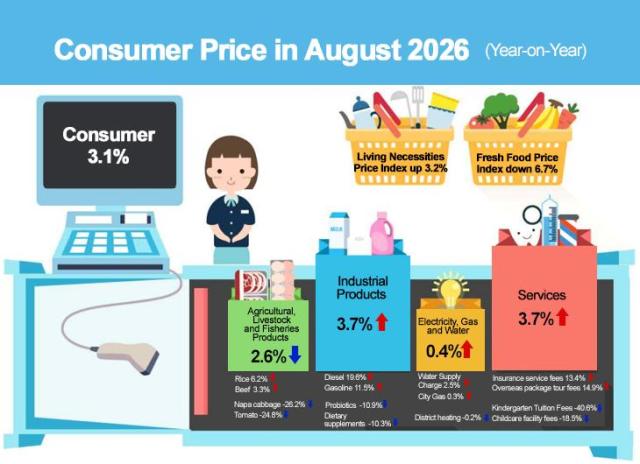
Industrial goods prices rose 3.7 percent from a year earlier, while petroleum product prices increased 14.2 percent.
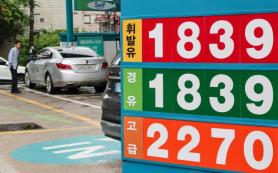
Diesel prices climbed 19.6 percent and gasoline prices rose 11.5 percent. Petroleum inflation eased from 15.5 percent in July.
The government estimated that its fuel price ceiling lowered August inflation by about 0.5 percentage point. Without the measure, headline inflation could have reached around 3.6 percent.
Food prices offered some relief on a year-on-year basis.
Agricultural, livestock and fisheries prices fell 2.6 percent after rising 0.9 percent in July, while the fresh food index dropped 6.7 percent.
The month-on-month picture, however, showed renewed pressure in vegetables ahead of Chuseok.
Fresh vegetable prices jumped 12.5 percent from July. Spinach surged 68.2 percent, chives 64.7 percent, cucumbers 40.4 percent and cabbage 37.0 percent.
Lee said summer vegetable prices tend to rise as weather conditions disrupt shipments and increase farming costs, including expenses related to pest control and rainfall.
Despite the overall decline in farm prices, several staples remained more expensive than a year earlier.
Rice prices rose 6.2 percent and domestic beef gained 3.3 percent. Imported beef climbed 7.4 percent and eggs 5.2 percent, while mackerel and hairtail prices increased 6.5 percent and 7.5 percent, respectively.
Headline inflation is expected to ease in September as the telecom base effect drops out.
The BOK, however, expects underlying inflation to retain upward momentum, led by core items, as accumulated cost pressures filter through and domestic demand strengthens.
The central bank also pointed to renewed uncertainty surrounding the conflict in the Middle East as an additional inflation risk.
Ahead of Chuseok, the government plans to release a record 183,000 tons of 19 key holiday food items, about 1.6 times normal supply, and provide discounts of up to 50 percent on major agricultural and fisheries products.
Supplies of cabbage and radish will be raised to 1.9 times normal levels, while supplies of apples and pears will be more than tripled.
AJP Takeaways
- South Korea's consumer inflation accelerated to 3.1 percent in August from 2.8 percent in July, but the Ministry of Data and Statistics estimated it would have been around 2.5 percent without a one-off telecom base effect.
- Mobile phone charges surged 26.7 percent from a year earlier as SK Telecom's 50 percent bill discount from August 2025 dropped out of the comparison, adding about 0.58 percentage point to headline inflation.
- Core inflation excluding food and energy rose to 3.4 percent, while the Bank of Korea warned that stronger domestic demand and accumulated cost pressures could keep underlying inflation elevated even after the telecom effect fades in September.
- Food prices eased year on year, but fresh vegetable prices jumped 12.5 percent from July ahead of Chuseok, prompting the government to release a record 183,000 tons of key holiday food items and offer discounts of up to 50 percent.

Copyright ⓒ Aju Press All rights reserved.