SEOUL, September 02 (AJP) - A wearable LED mask that conforms to the face's contours has made a common dermatology injection about four times more effective at restoring skin elasticity in a clinical trial. This result points to home beauty devices as a way to carry the benefit of a clinic visit into daily use, the Korea Advanced Institute of Science said Wednesday.
According to the Korea Advanced Institute of Science and Technology (KAIST), the project was led by Lee Keon-jae, a professor in the Department of Materials Science and Engineering, and was carried out with researchers at the cosmetics group Amorepacific.
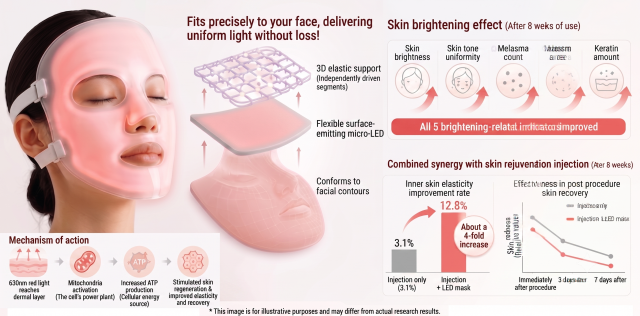
The researchers found that deep skin elasticity improved by 12.8 percent on the side of the face that received both the injection and the mask, compared with 3.1 percent on the side treated with the injection alone. Thirty-three people took part, using the mask on one side of the face for eight weeks.
Home skin care devices have sold well in South Korea and abroad, but the rigid LED masks on the market cannot press against the nose and the hollows under the eyes at the same time. Wherever a gap opens between the light and the skin, more of the light reflects away, and heat that pools in one spot raises the risk of a low-temperature burn.
The mask tested here has two parts. Thousands of tiny LEDs sit under a diffusing layer so that light leaves the device as an even sheet rather than a scatter of bright points, and the whole panel rests on a three-dimensional elastic frame whose sections move independently to follow the nose, the cheeks and the jaw.
That frame lifted the share of the mask in contact with skin to 78.1 percent from 46.9 percent and cut the distance between the light source and the skin to 1.8 millimeters. Across eight measurement points on the face, the red light arrived at 93.83 percent uniformity.
In a 2024 study, a KAIST team reported that the same class of mask improved deep skin elasticity by as much as 340 percent compared with conventional LED masks. The new trial extends the work to skin brightening and to what happens after a needle procedure.
The injection used in the trial delivers polynucleotide, a DNA-derived material, into the dermis, the layer beneath the skin's surface that holds the collagen and elastic fibers responsible for firmness. Dermatologists use it to prompt regeneration, and it has become one of the more popular treatments in South Korean clinics. On its own it has no established effect on skin tone.
Every participant received the injection across the entire face. The mask went on one side only, a design known as a split-face trial, which lets researchers compare two treatments on the same person and remove differences in individual skin type from the result. No group used the mask without the injection, so the trial measures what the light adds rather than what it does alone.
The mask side scored better on all five brightening measures the team tracked, covering skin brightness, evenness of tone, dead skin buildup, and the number and area of melasma patches, the brown discoloration that spreads across cheeks and foreheads with sun exposure and hormonal change.
Skin tissue taken from human donors and treated in the laboratory showed the same pattern. Expression of MITF and TYR, two markers that govern how much melanin skin cells produce, fell in the tissue exposed to the LEDs, and new collagen formation ran about 15 percent higher than with the injection alone.
The light itself was red, at a wavelength of 630 nanometers, or 630 billionths of a meter. The researchers attribute the effect to mitochondria, the structures inside cells that generate energy, which respond to red light by producing more ATP, the compound cells burn to repair and rebuild tissue.
Recovery after the needle went faster as well. Three days on, water loss through the skin had dropped 20.8 percent on the mask side against 12.4 percent on the other, a sign that the skin barrier had rebuilt more quickly, and redness was lower.
"This study confirms clinically that a home LED mask can go beyond regeneration to deliver a brightening effect, and it shows how much it matters to press the light against the skin," Lee said. He added that he expects the approach to grow into a platform linking clinic treatment to home care.
Amorepacific, whose researcher is a co-corresponding author on the paper, plans to bring a product based on the technology to Japan in the fourth quarter of this year and the United States in the first quarter of 2027.
[Reference Information]
Journal/Source: Nano Energy
Title: Clinical validation of skin brightening and rejuvenation enabled by a skin-conformable surface-emitting micro-LED mask with injection
Link/DOI: 10.1016/j.nanoen.2026.112288

Copyright ⓒ Aju Press All rights reserved.