
SEOUL, September 02 (AJP) - South Korea can reach the top tier of physical artificial intelligence by pairing its factory base with the data those factories generate, Prime Minister Han Seong-sook told a technology forum in Seoul on Wednesday.
Physical AI refers to systems that act in the world rather than on a screen, driving robots, machines and vehicles through real space. It is the industry's next frontier after generative AI, and the competition for it has pulled in national governments.
"If semiconductors are the brain of AI, physical AI is the body that moves in the real world, and the heart supporting all of it is the AI data center," Han said. The government intends to link the three through a set of mega-projects so that each one feeds the others.
She pointed to the San Francisco AI Declaration that President Lee Jae Myung issued in July during a trip to the United States and South America, which set out a plan to make South Korea a global production base for AI and a core link in the AI supply chain. Movement and process data logged on Korean factory floors, combined with the manufacturers already using it, is the government's answer to the question of what South Korea brings that its rivals do not.
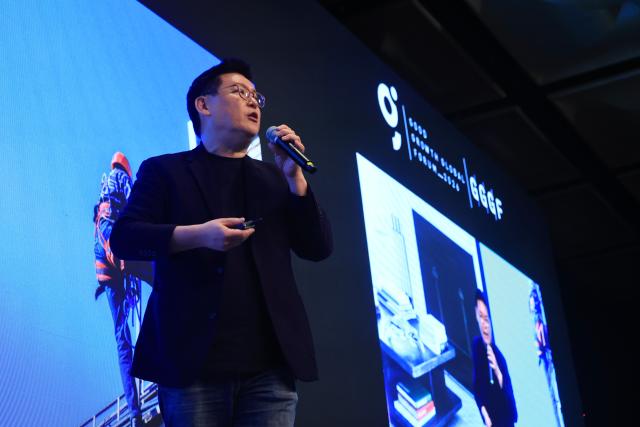
The forum, the 2026 GGGF, opened Wednesday at The Plaza in central Seoul and runs through Friday under the theme "KOREA, State of AI." Aju News Corporation hosts it with the Global Economic and Financial Research Institute. Roughly 200 lawmakers, academics, students and industry executives attended the opening, where National Assembly Speaker Cho Jung-sik also spoke.
The keynote went to Dennis Hong, a professor at the University of California, Los Angeles and director of its Robotics and Mechanisms Laboratory, known as RoMeLa, on whether AI civilization arrives at all without physical AI competitiveness.
Hong had made his case days earlier in an interview ahead of the forum, and it cuts against the ambition the government laid out from the same stage. The United States holds the software ecosystem and the capital. China holds supply chain scale, price and the speed to mass-produce. South Korea loses if it competes on either.
"What matters in physical AI is iteration speed, actually building robots, deploying them, getting data, learning, then building better robots," he said. Not who designs the best brain or body, he added, but who evolves fastest.
He named semiconductors, automobiles, batteries, electronics and precision manufacturing as the base South Korea already has, and warned against the alternative.
"We should not get into a numbers race, building the same humanoids just because the United States and China are building humanoids," Hong said. Samsung, Hyundai Motor and LG hold something the internet cannot supply, which is data from real production sites, and the companies best placed to use it are the ones that already own the plants, the products and the customers.
Two problems sit in the way. Workers asked to teach their skills to a machine have no guarantee the job survives the lesson, and no country has settled who owns the resulting data or how its value gets shared. Hong said rules on ownership, consent and compensation need to come first.
He was also blunt about the gap between what physical AI demonstrates and what it delivers.
"Succeeding once in a demonstration and running reliably in the field all day are completely different problems," he said. "Technological progress and a bubble exist at the same time."
Copyright ⓒ Aju Press All rights reserved.
