
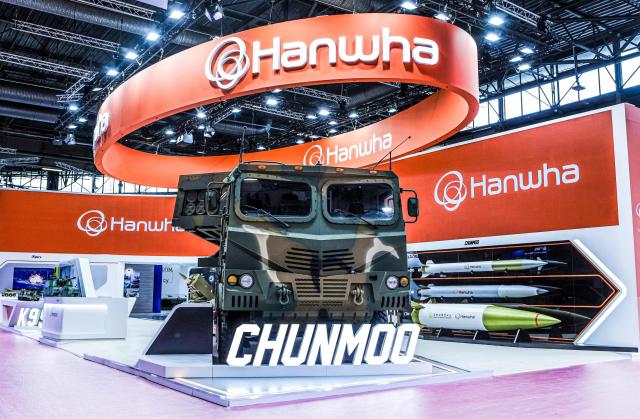
SEOUL, September 04 (AJP) - Eighteen truck-mounted rocket launchers able to strike targets more than 300 kilometers away are set to enter Croatian service, bought from South Korea after the United States suspended deliveries of the long-range rockets Zagreb had already contracted for.
The Croatian government was scheduled to approve the purchase of 18 K239 Chunmoo self-propelled multiple rocket launchers (MRLS) and their munitions at a cabinet session on Friday, the Zagreb daily Jutarnji list reported on Thursday (local time). The price is 435.2 million euros ($505.9 million) excluding value-added tax.
Croatia contracted with the U.S. in late 2024 for eight HIMARS launchers. Washington has since halted deliveries to allies of rockets capable of reaching 300 kilometers because of its own stockpile requirements, and rockets capable of reaching 500 kilometers are barred from sale. That left Croatia holding launchers without access to the deep-strike ammunition that justified buying them.
According to Croatia's Defense Minister Ivan Anušić, a deal with Hanwha Aerospace is expected to be signed shortly. A separate agreement covers Poland's WB Group, which will install the command and control system on the Croatian launchers. 85 percent of the order is due for delivery by 2028, with payments spread across 2026 to 2029. Talks between the Croatian defense ministry and its South Korean counterpart began about a year ago.
The Chunmoo also fires a larger salvo than the American system, carrying two pods holding 12 rockets against one pod holding six. Approval would make Croatia the fourth European buyer, after Poland, Estonia and Norway.
Both Prime Minister Andrej Plenković and President Zoran Milanović backed the purchase. Milanović announced new arms buying two months ago in Ankara, after a NATO summit, framing it as an answer to Serbia's acquisition of PULS, an Israeli rocket artillery system built by Elbit Systems. Croatia and Serbia fought a war between 1991 and 1995 and have both expanded their arsenals in recent years.
"As a state we will have to counter that in some way, by equipping ourselves with something similar," Milanović said at the time, according to Jutarnji list's report.
The K239 Chunmoo entered South Korean service in 2015 as a replacement for the K136 Kooryong, a 130mm rocket system fielded in 1986. Development began in 2009 under a program funded by the Defense Acquisition Program Administration (DAPA), South Korea's arms procurement agency, and finished in 2013, with production starting the following year. More than 350 have been built.
What sets the launcher apart is how it loads. Each vehicle carries two sealed pods on an eight-wheel truck chassis, and the two pods can hold different calibers at the same time. A commander can fire an area-saturation rocket and a precision-guided rocket from the same launcher without swapping hardware or returning to a depot. A typical Chunmoo vehicle carries a mixed load of four 280mm rockets in one pod and six guided 239mm rockets in the other.
The 239mm rocket, steered by satellite and inertial navigation, reaches about 80 kilometers. A full load of 12 can be fired in under a minute. Unguided 130mm rockets pack 20 to a pod and reach roughly 36 kilometers, designed to blanket an area rather than hit a single point.
The longest reach comes from one missile at a time. The CTM-290, a 600mm ballistic missile derived from the Korean Tactical Surface-to-Surface Missile (KTSSM) family, fills an entire pod on its own. After launch, it climbs to between 25 and 40 kilometers of altitude before diving on the target. The KTSSM's range is estimated to be more than 300 kilometers. Hanwha Aerospace and open technical references list it at about 290 kilometers, the figure its designation reflects. Newer guided rockets for the system have reportedly been offered at ranges up to 500 kilometers.
The launcher weighs about 31 tons, travels at up to 80 kilometers per hour on road, and is run by a crew of three. Each launcher is paired with an ammunition resupply vehicle built on the same chassis.
Poland opened the export run in 2022, signing a framework agreement for 288 systems in October of that year and a firm contract for 218 in November worth about $3.5 billion. Polish launchers ride on domestic Jelcz trucks and carry the Topaz fire control and Fonet communications systems made by WB Group, the same company now contracted for Croatia's command and control fit. Hanwha Aerospace has since set up a joint venture in Poland to build Chunmoo rockets in Europe.
Estonia signed a defense cooperation agreement in Seoul in October 2025 to field the system alongside the American HIMARS it already operates. Norway signed in Oslo on Jan. 30 for 16 launch vehicles, a precision-guided missile package and logistics support, a contract Hanwha Aerospace valued at about $922 million inside a long-range fires program budgeted at roughly $2 billion. Saudi Arabia and the United Arab Emirates bought earlier and smaller batches.
The Croatian contract covers launchers, rockets, logistics support, and six weeks of training. Operating all 18 launchers will take about 100 soldiers. Where they will be based within the Croatian Army has not been disclosed.
AJP Takeaways
- The Croatian government was set to approve the purchase of 18 K239 Chunmoo self-propelled multiple rocket launchers and munitions from Hanwha Aerospace for 435.2 million euros excluding VAT at a cabinet session Friday, Jutarnji list reported.
- The United States has suspended deliveries to allies of rockets reaching 300 kilometers and barred sale of those reaching 500 kilometers, leaving Croatia with eight HIMARS launchers it contracted in late 2024 and no access to the deep-strike munitions behind the purchase.
- President Zoran Milanović framed the new buy as an answer to Serbia's acquisition of the Israeli PULS system, announcing it in Ankara two months ago after a NATO summit.
- Hanwha Aerospace signed a separate Chunmoo contract with Norway in Oslo on Jan. 30 covering 16 launch vehicles for about $922 million, following earlier orders from Poland and Estonia that would make Croatia the fourth European operator.

Copyright ⓒ Aju Press All rights reserved.

