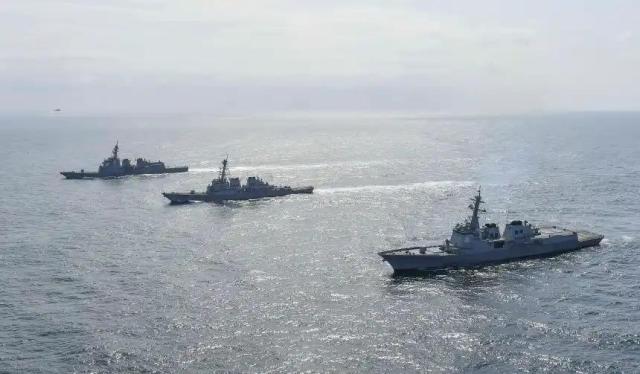
The five-day exercise, which runs through Sept. 11, involves major naval and air assets from the three countries, South Korea's Joint Chiefs of Staff said.
Six warships, including Aegis destroyers, as well as maritime patrol aircraft, fighter jets and aerial refueling aircraft are expected to take part.
South Korea is participating with two 7,600-ton Aegis destroyers, the ROKS Seoae Ryu Seong-ryong and ROKS Yulgok Yi I.
Japan has deployed the 7,700-ton Aegis destroyer JS Atago, the 5,100-ton destroyer JS Asahi, a P-1 maritime patrol aircraft, an SH-60K helicopter and F-15 fighter jets, according to Japan's Joint Staff.
The U.S. Navy's 7th Fleet said Sept. 3 that the Aegis destroyer USS Benfold had arrived in Busan, raising expectations that the 6,900-ton warship could also participate in the exercise.
Maritime missile defense involving Aegis-equipped warships from all three countries has traditionally been a central component of Freedom Edge.
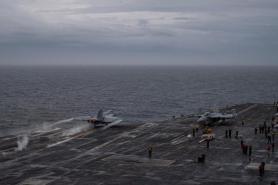
A U.S. aircraft carrier, however, is unlikely to participate for a second consecutive year.
U.S. carriers joined the first two Freedom Edge exercises in June and November 2024, but Washington's carrier deployments in the region have been constrained as the prolonged war with Iran draws more U.S. military assets toward the Middle East.
The nuclear-powered USS George Washington, previously based in Japan, has been sent to the Middle East under the Trump administration. The USS Abraham Lincoln, which had been operating in the region for an extended period, is returning to its home port in San Diego after being relieved by the George Washington.
"The three countries will strengthen their operational capabilities and joint response capabilities across various domains, including maritime, air and cyber, and maintain a robust and stable cooperative relationship through the exercise," South Korea's JCS said.
Freedom Edge was launched after the leaders of South Korea, the United States and Japan agreed at their 2023 Camp David summit to conduct regular multidomain exercises. This week's exercise marks the fourth iteration and is aimed at improving interoperability among the three militaries across multiple domains.
"This exercise is an annual defensive exercise conducted in accordance with international law and norms to enhance deterrence and response capabilities against North Korea's nuclear and missile threats and to safeguard regional peace and stability," the JCS said.
Japan and the United States, however, have framed the exercise in broader regional terms, including security challenges across the Indo-Pacific.
Japan's Joint Staff said last month that the exercise is intended to demonstrate the three countries' "unwavering commitment to peace and stability in the Indo-Pacific region," while the United States has similarly said Freedom Edge and continued trilateral cooperation underscore their commitment to safeguarding a free and open Indo-Pacific.
AJP Takeaways
- South Korea, the U.S. and Japan launched their annual Freedom Edge multidomain exercise near Jeju Island.
- The drill includes Aegis destroyers, aircraft and missile-defense training, but no U.S. aircraft carrier for a second straight year.
- Seoul emphasizes North Korean threats, while Washington and Tokyo frame the exercise around broader Indo-Pacific security.

Copyright ⓒ Aju Press All rights reserved.