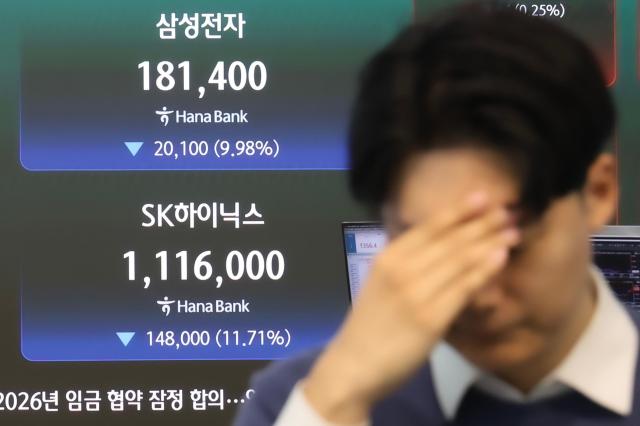
The benchmark KOSPI closed at 5,021.97, down 0.75 percent from Friday's 5,059.69. The index briefly slipped below 5,000 in early trading before climbing as high as 5,172.94. It surrendered those gains in the afternoon as selling pressure intensified, finishing near the day's lows.
Foreign investors sold a net 864.7 billion won (US$636 million) of KOSPI shares, while retail investors unloaded 461.7 billion won. Institutions bought a net 863.7 billion won, helping prevent a steeper decline. Decliners outnumbered advancers 548 to 333.
Monday's retreat followed a bruising week in which the KOSPI lost 11.7 percent. The index plunged more than 8 percent during Friday's session, triggering a 20-minute trading halt amid fears that tighter U.S. regulation of artificial intelligence (AI) data centers could slow investment and weaken demand for Korean chips.
Despite the broader market's decline, semiconductor heavyweights finished higher Monday, though they gave up much of their morning gains of 3 to 4 percent.
Samsung Electronics rose 0.64 percent to 189,900 won, while SK hynix, a major supplier of high-bandwidth memory (HBM) chips used in AI processors, gained 0.35 percent to 1,136,000 won. Samsung Electronics' preferred shares advanced 0.40 percent to 150,900 won.
Other semiconductor-related stocks remained under pressure. SK Square, an investment holding company with a major stake in SK hynix, slipped 0.28 percent to 722,000 won. Samsung Electro-Mechanics, which supplies electronic components and semiconductor substrates, also declined 3.10 percent to 843,000 won.
LG Energy Solution, a major electric-vehicle battery maker, fell 5.78 percent to 318,000 won, while automaker Hyundai Motor lost 2.86 percent to 271,500 won. Samsung Biologics, a contract manufacturer of biopharmaceuticals, edged down 0.40 percent to 1,510,000 won.
The cautious mood persisted even as a three-month government measure to ease forced-selling pressure took effect Monday.
Under the measure announced Friday, South Korean brokerages are temporarily exempt from the requirement to maintain collateral worth at least 140 percent of loans used to purchase stocks. The relief allows them to lower collateral thresholds or postpone forced liquidations as share prices fall.
The measure does not ban forced selling outright but is designed to prevent margin-related liquidations from triggering further declines.
The selloff has also reopened the debate over whether Korean stocks have become too cheap to ignore.
The KOSPI's 12-month forward price-to-earnings ratio fell to 3.54 times, its lowest since 2001, according to Daishin Securities. The brokerage also reported that the index's forward price-to-book ratio had fallen below one, meaning its valuation was below expected net asset value.
The brokerage recommended gradually increasing stock holdings when the KOSPI falls below 5,300, particularly in semiconductor shares, citing improving earnings forecasts.
Overseas developments brought both a glimmer of hope and fresh uncertainty for South Korean chip stocks.
On Wall Street, the Philadelphia Semiconductor Index jumped 4.21 percent Friday after plunging 12.25 percent the previous session. Advanced Micro Devices surged 11.04 percent, memory-chip maker Micron Technology gained 5.12 percent and Nvidia advanced 2.78 percent.
A new controversy surrounding Nvidia chief executive Jensen Huang, however, complicated the outlook for the world's leading AI chipmaker.
Nvidia announced the previous day that its board had launched an independent investigation following reports that Huang had been targeted by a foreign intelligence effort. Huang admitted having been unfaithful to his wife.
The company said it had no reason to believe its trade secrets or U.S. national security had been compromised and expressed confidence in Huang's leadership. Its shares fell about 3.4 percent to $180.30 in after-hours trading following the announcement.
In Seoul, selling pressure was more pronounced on the smaller-cap market. The junior KOSDAQ fell 0.76 percent to 639.36, reversing an earlier advance as losses in biotechnology and battery-related stocks outweighed gains among semiconductor equipment makers.
Foreign investors sold a net 80.3 billion won of KOSDAQ shares, while retail investors unloaded 35.6 billion won. Institutions purchased a net 109.2 billion won. Decliners outnumbered advancers 813 to 874.
Semiconductor-related stocks provided pockets of strength. Jusung Engineering, a manufacturer of thin-film deposition equipment used in chip production, jumped 6.70 percent to 141,700 won, while Simmtech, which produces semiconductor packaging substrates, gained 6.84 percent to 99,900 won.
Lablup, an AI infrastructure management software developer, climbed 10.75 percent to 12,160 won, extending gains among selected smaller technology shares.
Biotechnology stocks moved in the opposite direction. Alteogen, which develops technology to convert intravenous medicines into under-the-skin injections, plunged 16.01 percent to 168,400 won.
The decline followed new U.S. Medicare drug-pricing rules that raised concerns about the commercial benefits of converting existing intravenous medicines into injectable formulations. The changes could limit the ability of some reformulated drugs to delay government price negotiations.
Elice, a provider of AI cloud infrastructure and education services, fell 4.30 percent to 66,800 won, while EcoPro, a holding company with investments in the rechargeable-battery supply chain, dropped 8.46 percent to 60,600 won.
The South Korean won, meanwhile, strengthened to 1,346.9 per dollar from 1,356.6 last Friday.
Across the region, stocks mostly advanced as bargain hunters returned after last week's selloff, supported in part by Friday's rebound on Wall Street. Japan's Nikkei 225 rose 2.51 percent to 58,874.00, while China's Shanghai Composite edged up 0.35 percent to 3,662.03. Hong Kong's Hang Seng Index gained just 0.05 percent to 24,494.00.
Attention now turns to upcoming AI earnings, including those of U.S. cloud computing firm CoreWeave, for signs that surging demand can translate into sustainable profits.
Upcoming U.S. inflation data and earnings from semiconductor equipment maker Applied Materials will also be watched for clues about interest rates and technology investment.

Copyright ⓒ Aju Press All rights reserved.