The framework could offer Seoul a middle ground between mounting U.S. pressure for support and Iran's warnings against military involvement.
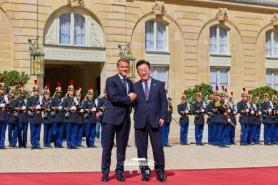
“The broad direction for international cooperation has been set, but details are still under review and nothing has been decided,” a presidential official said Tuesday following Lee's summit with French President Emmanuel Macron in Paris.
The official stressed that the discussion should not be interpreted as a decision to send South Korean forces to the region.
Lee, however, made clear that Seoul sees stability in the strategic waterway as an important national interest.
“South Korea and France will continue close cooperation to restore freedom of navigation in the Strait of Hormuz and stabilize global supply chains,” Lee said after the summit.
The presidential office said Lee approached the talks on the principle that South Korea's contribution should be determined based on national interests and public consensus.
Macron raised the prospect of cooperation under a broader international framework.
“The multinational mission is peaceful,” Macron said, adding that France and South Korea could cooperate once the necessary agreements are in place.
France and Britain have been leading efforts to establish an independent, defensive multinational mission aimed at restoring safe navigation through Hormuz.
South Korea has already backed that framework politically. It endorsed an April leaders' statement establishing the initiative and was among the countries supporting a subsequent multinational mission statement in May. Neither commitment, however, amounted to a decision to deploy South Korean forces or military assets.
France has maintained a cautious line since the early months of the Iran war, supporting diplomatic efforts to end the conflict while keeping the proposed Hormuz mission separate from direct U.S. military operations against Tehran.
Such stance has at times put Paris and London at odds with Washington, with Trump publicly criticizing NATO allies including France and Britain for failing to provide greater support for the U.S. war effort against Iran.
Macron and British Prime Minister Keir Starmer in April co-hosted a Paris conference bringing together around 50 non-belligerent countries and backing a strictly defensive multinational mission once security conditions allowed.
The proposed force was designed to protect commercial vessels, restore confidence among shipowners and insurers and conduct mine-clearing operations rather than take part in combat against Iran.
Macron reiterated that approach at the G7 summit in June, describing the French-British initiative as “multinational, independent and defensive” and saying around 20 countries had expressed a firm commitment to contribute. France has said the mission could protect merchant shipping and support mine-clearing once conditions in the strait permit.
The government recently sent a Defense Ministry fact-finding team to the United Arab Emirates to assess conditions in and around the strait, but the presidential office said the move was only “part of the review process” and did not presuppose a deployment.
Asked whether the issue could be discussed at a National Security Council standing committee meeting on Sept. 17, the official said it was difficult to discuss a schedule because “nothing has been decided.”
Seoul's caution comes as pressure intensifies from both Washington and Tehran.
A White House official said Sunday that the United States was “still waiting” for South Korea to commit resources to the region, after U.S. President Donald Trump repeatedly singled out Seoul over its reluctance to support U.S. efforts surrounding Hormuz.
Trump has pressed countries heavily dependent on Middle Eastern energy, including South Korea and Japan, to contribute to securing the waterway since the war with Iran began on Feb. 28.
Iran, meanwhile, has warned Seoul against military involvement.
“Military presence or participation in operations in the Persian Gulf and Strait of Hormuz would inevitably be seen as directly supporting the aggressor,” Iranian Foreign Ministry spokesperson Esmail Baghaei said, warning of “serious consequences.”
“We told them that the matter is under review and nothing has been decided,” the presidential official said.
The competing pressure leaves the Lee administration with a difficult calculation: how far to support its U.S. ally and help secure a waterway vital to South Korea's energy supplies without becoming directly entangled in the Iran war.
Defense experts say months of caution may have brought Seoul to the point where a limited contribution deserves serious consideration.
“We have reached a point where it is time to consider a deployment,” Choi Ki-il, a professor of military studies at Sangji University and head of the Korea Defense Industry Research Institute, told AJP.
Choi said any mission should focus on protecting South Korean vessels and crews and supporting freedom of navigation rather than taking part in direct combat against Iran.
“Even if we deploy, our role should be limited to protecting our own ships,” Choi said.
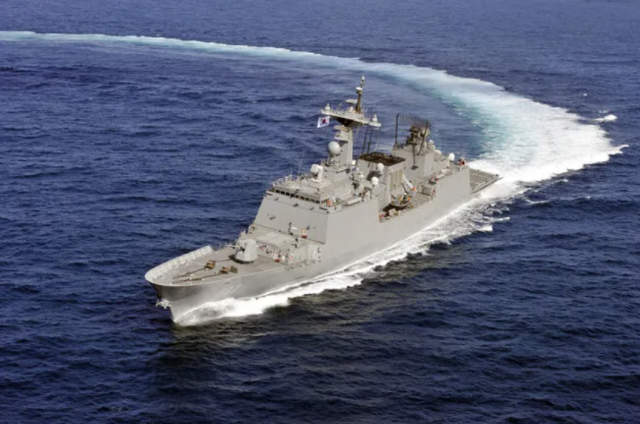
Possible assets reported in recent days have included P-8A Poseidon maritime patrol aircraft, the Navy's 11,000-ton ROKS Soyang fast combat support ship and mine-clearing capabilities. The government has stressed that none has been selected.
One potential middle ground would be participation in the French-British multinational mission rather than an independent South Korean operation.
“If South Korea participates, it should not do so independently, but as part of a coalition force,” Kim Hong-yoo, a professor at Kyung Hee University and a policy committee member of the Korea Defense Industry Association, told AJP.
Kim said such a framework could allow Seoul to take on logistics or other support functions rather than lead a separate Korean operation.
He also argued that Washington's requests are difficult for Seoul to ignore because the United States, South Korea's treaty ally, is directly involved in the conflict.
“For the government, this is a very difficult decision,” Kim said.
Kim said an NSC discussion would become more relevant if the government decides to deploy forces, as Seoul would then have to determine which military assets could be spared without weakening its defense posture on the Korean Peninsula.
For now, the presidential office is drawing a line between supporting international efforts to secure Hormuz and committing South Korean forces to them.
Seoul's eventual choice will have to balance its U.S. alliance and the economic importance of keeping Hormuz open against military readiness on the Korean Peninsula, relations with Iran and domestic public opinion.
AJP Takeaways
- Seoul says no decision has been made on deploying military assets despite deeper talks with France and other partners.
- French-British defensive mission offers potential middle ground between U.S. demands and Iran's warnings.
- South Korea has already backed the multinational framework politically, leaving the scale and form of any operational contribution unresolved.

Copyright ⓒ Aju Press All rights reserved.