
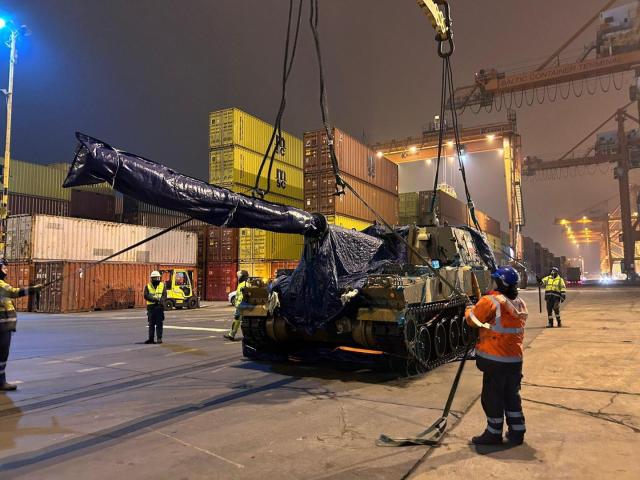
SEOUL, September 09 (AJP) - Defense industrial cooperation between South Korea and the United States largely ran one way for decades, with Seoul buying American weapons and relying heavily on U.S. military technology.
The once-skewed relationship is becoming more reciprocal as Washington increasingly looks to Korean artillery, shipbuilding expertise and manufacturing capacity to fill gaps of its own.
Hanwha Defense USA's entry into a U.S. Army artillery program has provided the clearest example yet of the shift, while growing U.S. interest in Korean shipbuilding is opening another avenue for the two allies to move from a traditional buyer-seller relationship toward joint development and production.
"We now need to think about what Korea and the United States can develop and build together," Rep. Yu Yong Weon of the main opposition People Power Party said Wednesday, calling for a model in which the allies "develop together, produce together and maintain together."
Yu, a member of the National Assembly's National Defense Committee and a longtime defense specialist, said South Korea has transformed from a major importer of U.S. weapons technology into a global defense exporter supplying countries including Poland and increasingly seeking a role in the U.S. market.
"There are an enormous number of areas where the two countries can work together," he said.
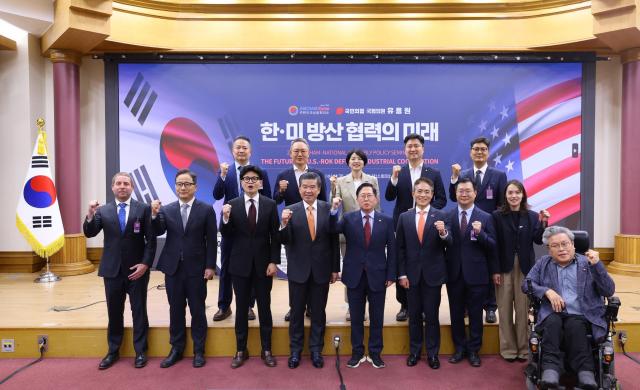
The comments came at the 2026 AMCHAM-National Assembly Policy Seminar, titled "The Future of U.S.-ROK Defense Industrial Cooperation," hosted by the American Chamber of Commerce in Korea and Yu's office at the National Assembly in Seoul on Wednesday.
The seminar focused on moving bilateral defense ties beyond arms sales into co-development, co-production, maintenance, repair and overhaul, or MRO, sustainment and integrated supply chains. It was AMCHAM's first National Assembly policy seminar dedicated to bilateral defense industrial cooperation.
The shift has gained momentum since the U.S. Army selected Hanwha Defense USA last month to supply prototypes for its Mobile Tactical Cannon program.
The $100.3 million initial agreement covers six K9-based wheeled self-propelled howitzer prototypes. Options could expand the program to as many as 18 systems and raise its cumulative value to $262.9 million.
The contract marked the first time a domestically developed South Korean weapons system entered a U.S. military acquisition program.
Kim Il-dong, vice minister of the Defense Acquisition Program Administration, said the significance was difficult to overstate after more than three decades in the defense industry.
"In more than 30 years working in the defense industry, this is the first time I have seen a completed Korean weapons system enter the U.S. market," Kim said.
Brent Ingraham, the U.S. Army's top acquisition official, visited Hanwha Aerospace's production facility in Changwon on Aug. 26, inspecting the K9 production line and discussing cooperation related to U.S. Army modernization, according to the company.
The development represents a reversal from the earlier decades of the alliance, when South Korea depended heavily on imported U.S. weapons and technology as it built its domestic defense industry.
Korean companies are now seeking not simply to sell finished weapons to the United States but to become part of its defense production base.
AMCHAM Chairman and CEO James Kim said the alliance, built over more than seven decades, is increasingly extending into defense, aerospace and industrial cooperation.
"By combining Korea's manufacturing strength and growing global reach with American technology and innovation, our two countries can strengthen readiness, unlock investment and enhance shared economic security," Kim said.
He said AMCHAM would seek to serve as a "trusted bridge" between policymakers and industry.
Shipbuilding puts U.S. needs in sharper focus
If the K9 represents the changing relationship on land, shipbuilding could prove a much larger test of how far the new industrial partnership can go.
The United States is seeking to rebuild naval capacity while confronting shortages in domestic shipbuilding infrastructure, workforce and production capacity.
South Korea, home to some of the world's largest and most technologically advanced shipyards, has increasingly emerged as a potential partner.
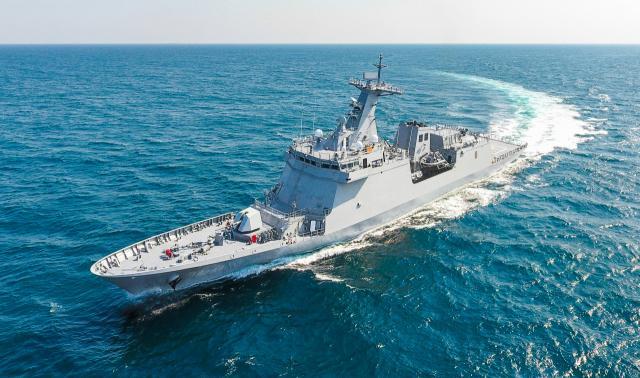
Kim Il-dong cited the MASGA, or "Make American Shipbuilding Great Again," initiative, Korea's U.S. investment framework and the Korea-U.S. Shipbuilding Partnership Center as platforms that could turn political support for cooperation into concrete projects.
South Korea and the United States opened the Korea-U.S. Shipbuilding Partnership Center in Washington on July 23 to support Seoul's planned $150 billion investment in the U.S. shipbuilding sector. The two sides also signed 15 memoranda of understanding covering supply chains, workforce development, joint research and other areas.
Korean shipbuilders are already performing MRO work on U.S. naval vessels.
HD Hyundai Heavy Industries completed maintenance on the U.S. Navy logistics vessel USNS Alan Shepard and secured another MRO contract this year involving the USNS Cesar Chavez.
The opportunity is growing as Washington looks for ways to overcome constraints in its domestic yards.
The U.S. Navy said in May that it operated 291 battle-force ships, below the 355 ships required under U.S. law. Earlier force-structure plans have called for 381 crewed battle-force ships and 134 large unmanned surface and underwater vessels, bringing the total to 515 naval platforms.
The Trump administration has also created a potential route for foreign shipbuilders to participate more directly.
President Donald Trump on Aug. 13 directed the Pentagon to apply what the administration calls the "Finland Model" to as many as three ship classes.
Under the approach, a foreign shipbuilder making substantial investment in U.S. yards, training American workers and transferring shipbuilding techniques can temporarily build the first two vessels at its overseas parent yard before subsequent ships are constructed in the United States.
The policy is aimed at addressing near-term U.S. capacity shortages while rebuilding the domestic shipbuilding industry.
For South Korean shipbuilders, the model potentially creates a role that goes considerably further than repairing U.S. vessels or exporting ships.
It could allow Korean companies to bring their production methods, workforce training and supply-chain expertise directly into the rebuilding of America's maritime industrial base.
Aerospace looks toward propulsion
Aerospace executives at the seminar pointed to another area where the relationship could become more deeply integrated.
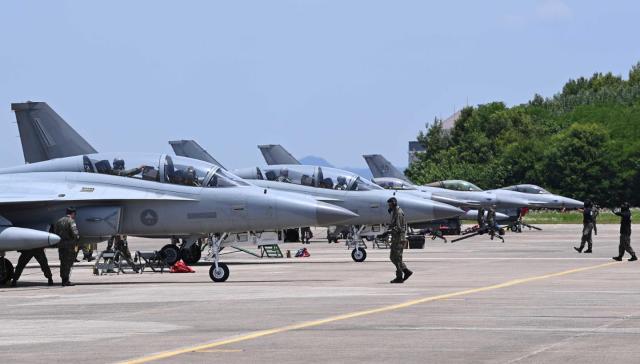
Kim Young-je, president of GE Aerospace Korea and general manager for Asia Pacific Defense & Systems, said South Korea is one of the company's key markets in the Asia-Pacific region.
According to Kim, GE Aerospace works with more than 70 Korean companies and procures about $130 million worth of parts and components from Korean suppliers.
He identified advanced propulsion as a potential area for the next stage of Korea's aerospace industry.
Developing advanced engines requires capabilities spanning materials, thermal management, power systems, manufacturing, testing and validation, Kim said.
GE Aerospace invests about $3 billion annually in research and development and has supplied more than 30,000 military engines to roughly 300 customers worldwide, including the U.S. Air Force, Army and Navy, according to his presentation.
"Korea's aerospace industry has reached an important inflection point," Kim said, adding that GE could combine its technology and global experience with Korea's engineering and manufacturing capabilities.
Lee Won-ik, country executive for Korea at Lockheed Martin, traced the company's relationship with South Korea from U.S.-built aircraft used during and after the Korean War to more recent industrial programs.
He cited the KF-16, T-50 advanced trainer, KF-21 fighter, UH-60 helicopter and Aegis destroyers as examples of how bilateral defense cooperation has evolved.
"Going forward, we will continue leveraging Korea's exceptional industrial capabilities and Lockheed Martin's technological leadership to create new opportunities for the defense sectors of both nations," Lee said.
Sikorsky's Dylan Landis also outlined potential cooperation involving the X2 next-generation helicopter, including co-development, production and possible exports to third countries.
The next step, participants said, will require overcoming barriers that remain between the two defense industries, including procurement rules, export controls, technology security, certification, access to technical data, skilled labor and the need for predictable long-term demand.
They also discussed developing South Korea into a regional hub for MRO and military sustainment in the Indo-Pacific.
Such a role would push the alliance further beyond the model that defined it for much of the past seven decades: one country supplying weapons and technology and the other buying them.
Increasingly, both sides are looking at what each can build for — and with — the other.
AJP Takeaways
- Korea-U.S. defense industrial ties are becoming more reciprocal after decades dominated by U.S. weapons and technology transfers to Seoul
- Hanwha's K9-based artillery system becomes the first domestically developed Korean weapon to enter a U.S. military acquisition program
- U.S. shipbuilding constraints are opening another major avenue for Korean yards, investment and manufacturing know-how
Copyright ⓒ Aju Press All rights reserved.
