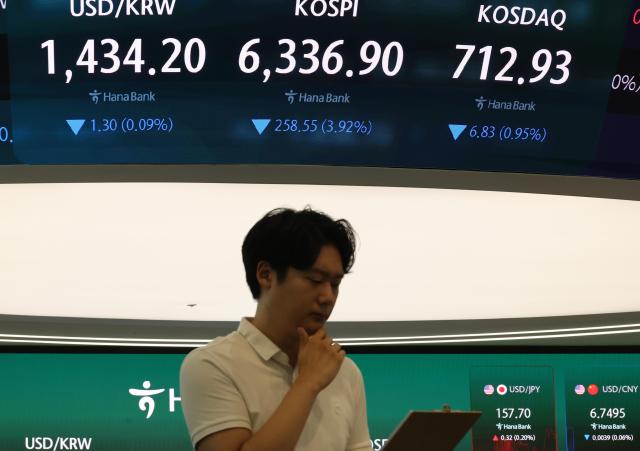
The benchmark KOSPI fell 1.66 percent to 6,934.42 as of 10:07 a.m., extending its decline after briefly climbing to an intraday high of 7,072.79 earlier in the session. The index later fell as low as 6,929.13, dropping back below the 7,000 mark.
Selling by foreign and institutional investors drove the pullback. Foreign investors sold a net 273.7 billion won ($204.5 million) of KOSPI shares and institutions unloaded 411.0 billion won, while retail investors bought a net 380.1 billion won.
Market breadth weakened further, with 686 stocks falling and 170 rising, while 55 were unchanged.
Retail investors stepped in to buy during the morning decline, reversing their broader selling trend so far this month. Korean retail investors sold a net 15.56 trillion won of KOSPI-related securities from Sept. 1 through Wednesday, according to the Korea Exchange (KRX), as many used recent rebounds as opportunities to take profits after months of sharp market swings.
External pressure added to the cautious mood. Overnight losses on Wall Street as renewed military tensions between the United States and Iran pushed crude prices sharply higher and revived concerns that energy-driven inflation could keep U.S. interest rates elevated.
The Dow Jones Industrial Average fell 0.77 percent Wednesday. The S&P 500 lost 0.48 percent and the Nasdaq Composite dropped 0.64 percent.
The losses came as the conflict intensified around key oil shipping routes. U.S. forces sank five Iranian oil tankers, while Iran said it attacked 10 ships near the Strait of Hormuz.
The escalation raised concerns over further disruption to global energy supplies, pushing Brent crude back above $100 a barrel. November Brent crude rose 3.36 percent to $101.21 a barrel, while October West Texas Intermediate gained 3.25 percent to $96.05 a barrel.
The prospect of a prolonged conflict added to pressure over energy markets. U.S. President Donald Trump said Wednesday that he expected the Iran war to end immediately after the Nov. 3 midterm elections and that oil prices would fall once the war was over.
Higher oil prices have, in turn, sharpened the market's focus on inflation and the Federal Reserve. The Fed kept its benchmark rate unchanged at 3.50 percent to 3.75 percent in July. Markets see around a 60 percent chance of a rate increase at next week's policy meeting.
Bond yields added another source of pressure. The U.S. 10-year Treasury yield briefly rose above 4.85 percent, its highest level since November 2023, after the Treasury Department's planned buyback of long-term debt fell short of market expectations.
Against that backdrop, heavyweight shares in Seoul were mixed, with chip stocks losing momentum after leading the previous session's rebound.
Samsung Electronics fell 0.74 percent to 267,500 won, while SK hynix slipped 0.11 percent to 1,854,000 won. Samsung Electronics preferred shares edged up 0.05 percent to 197,600 won.
Elsewhere, gains were concentrated in financial and selected large-cap shares. Samsung Life rose 1.32 percent to 307,500 won. KB Financial gained 1.10 percent to 173,900 won, while Shinhan Financial advanced 0.81 percent to 111,500 won.
LG Energy Solution added 0.40 percent to 372,500 won. Hanwha Aerospace rose 0.38 percent to 1,051,000 won. Hyundai Motor edged up 0.06 percent to 388,250 won and Kia gained 0.08 percent to 126,900 won.
On the downside, Doosan Enerbility fell 2.40 percent to 89,500 won. Samsung Electro-Mechanics dropped 1.78 percent to 1,379,000 won. Samsung Biologics declined 1.24 percent to 1,434,000 won. Samsung C&T slipped 0.53 percent to 374,000 won.
SK Square was little changed, rising 0.09 percent to 1,139,000 won.
The junior KOSDAQ came under heavier pressure, falling 1.06 percent to 821.57. Foreign investors sold a net 120.1 billion won and institutions unloaded 44.5 billion won, while retail investors bought a net 167.1 billion won.
Biotechnology and battery shares were among the main decliners. Alteogen, a biotechnology company developing drug-delivery platforms, fell 2.50 percent to 272,500 won. Battery-materials companies EcoPro and EcoPro BM dropped 2.30 percent to 84,800 won and 1.39 percent to 113,300 won, respectively.
Semiconductor-related shares also weakened. Jusung Engineering fell 1.69 percent to 203,000 won, while Wonik IPS lost 2.00 percent to 117,700 won. EO Technics slipped 0.74 percent to 466,500 won.
Among the major junior shares shown, only robot makers Rainbow Robotics and ROBOTIS advanced. Rainbow Robotics rose 1.80 percent to 453,500 won, while ROBOTIS jumped 6.13 percent to 329,000 won.
In the currency market, the Korean won weakened to 1,339.20 per dollar from 1,336.1 a day earlier.
AJP Takeaways
- South Korea's KOSPI fell 1.66 percent to 6,934.42 as of 10:07 a.m. on Sept. 10, 2026, dropping back below 7,000 after touching an intraday high of 7,072.79. Foreign investors sold a net 273.7 billion won of KOSPI shares and institutions sold 411.0 billion won, while retail investors bought 380.1 billion won during the morning decline.
- Oil above $100 and rising U.S. Treasury yields weighed on South Korean stocks after Wall Street fell on Sept. 9, 2026. November Brent crude rose 3.36 percent to $101.21 a barrel and October West Texas Intermediate gained 3.25 percent to $96.05 as renewed U.S.-Iran fighting raised concerns over energy supply disruptions and inflation.
- Rate expectations added to market pressure ahead of the U.S. Federal Reserve's September 2026 policy meeting. The Federal Reserve kept its benchmark rate at 3.50 percent to 3.75 percent in July, while markets were pricing in about a 60 percent chance of a rate increase. The U.S. 10-year Treasury yield also briefly moved above 4.85 percent, adding pressure to risk assets including South Korean equities.

Copyright ⓒ Aju Press All rights reserved.