The team, which departed for the United Arab Emirates over the weekend, completed its assessment and is expected to return through Incheon International Airport, according to sources familiar with the matter.
The delegation is understood to have inspected military bases and ports that could be used by South Korean forces, along with local conditions for maintenance, logistics and other operational support.
The UAE, located close to the Strait of Hormuz, hosts Al Dhafra Air Base, one of the major U.S. military installations in the Middle East.
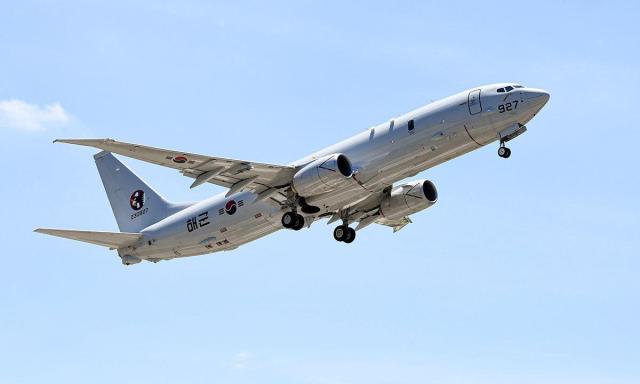
With Seoul considering the P-8A Poseidon maritime patrol aircraft as one of the most likely assets for a possible contribution, the team is believed to have examined conditions for operating and supporting the aircraft from facilities in the UAE.
Officials from the Ministry of National Defense as well as working-level officials from the Foreign Ministry were reportedly part of the delegation.
Under the Defense Ministry's guidelines governing overseas military deployments, a fact-finding team sent to a potential deployment area is required to prepare a report on its activities after returning and submit the findings to the National Security Council.
That process, however, does not mean Seoul is moving immediately toward a decision to deploy forces.
"The fact-finding team was dispatched to assess the regional situation and security conditions, and this assessment does not assume that an actual deployment will take place," a Defense Ministry official said earlier.
If discussions advance, the issue could be raised at the NSC as early as next week, but the government continues to take a cautious approach.
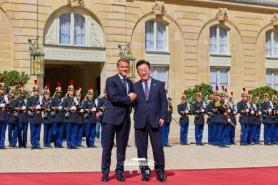
President Lee Jae Myung's return from a state visit to France could also help clarify the government's position on a possible deployment.
The deliberations come as U.S. President Donald Trump has stepped up public pressure on South Korea over its level of contribution to U.S.-led efforts related to Iran and the Strait of Hormuz.
In a Truth Social post on Aug. 16, Trump claimed he had asked Lee whether South Korea would join U.S. efforts to denuclearize Iran and received a "No thanks!" response.
Requests from Washington for South Korean involvement in the Hormuz mission are understood to have increased through multiple diplomatic and defense channels following Trump's remarks.
But the increased U.S. pressure has not necessarily pushed Seoul closer to deployment.
The Defense Ministry has also rejected speculation that Washington asked Seoul to send forces before the U.S. midterm elections in November.
A ministry official previously said reports that the United States had set a deadline for South Korea to deploy military assets to the Strait of Hormuz were "not true."
The issue could surface again during upcoming high-level talks between the allies.
South Korean and U.S. defense officials are discussing holding their second-half Korea-U.S. Integrated Defense Dialogue, or KIDD, in Busan next week.
While a South Korean contribution to the Strait of Hormuz is not traditionally an alliance issue handled through the KIDD, the possibility that Washington could raise the matter during the talks cannot be ruled out.
AJP Takeaways
- South Korean team returns from UAE after assessing a possible Hormuz deployment.
- Seoul is considering P-8A Poseidon aircraft, but no deployment decision has been made.
- The issue could reach the NSC and next week’s Korea-U.S. defense talks.

Copyright ⓒ Aju Press All rights reserved.