
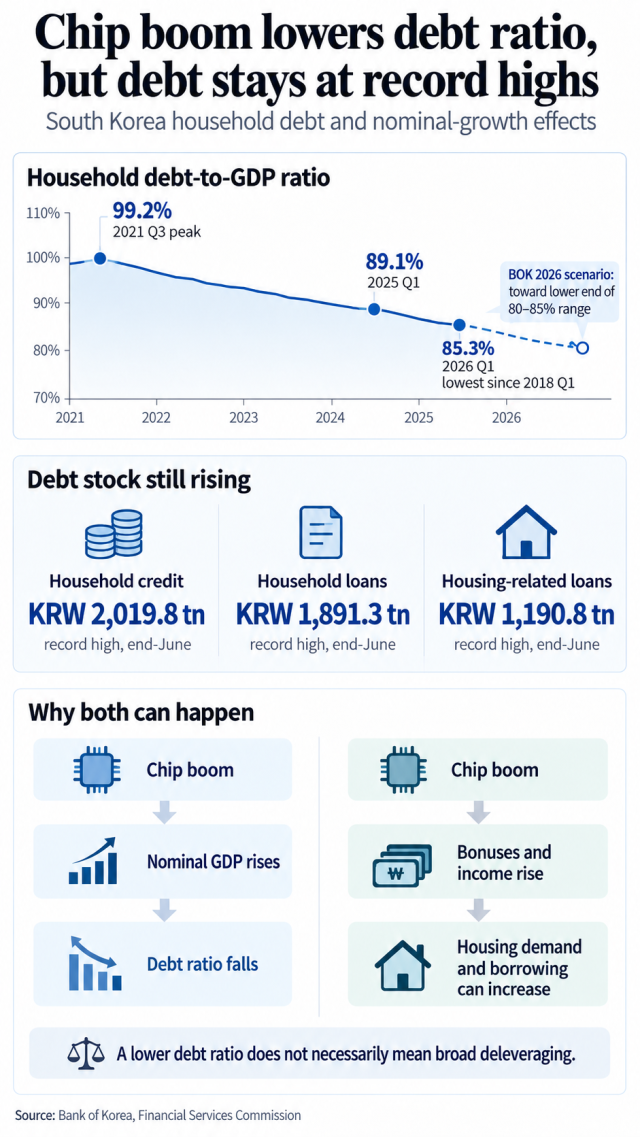
The household debt-to-GDP ratio could fall toward 80 percent this year - or the lowest level since 79.2 percent in 2015 - if double-digit nominal growth of 15 to 20 percent is sustained in the second half.
The ratio had already fallen to 85.3 percent in the first quarter from 89.1 percent a year earlier and 88.1 percent at the end of 2025. It has dropped sharply from its pandemic-era peak of 99.2 percent in the third quarter of 2021.
The lower ratio, however, does not mean Korean households have begun deleveraging with the extra income generated by the economic boom.
Household credit remains swelling to historic level, reaching KRW 2,019.8 trillion ($1.50 trillion) at the end of June, breaching the KRW 2,000 trillion mark for the first time. Household loans accounted for KRW 1,891.3 trillion, including KRW 1,190.8 trillion in housing-related loans – all record highs.
At a financial stability briefing in June, BOK Deputy Governor Chang Jung-soo said stronger nominal GDP growth helps lower the relative household debt burden and ease aggregate debt risks.
Vulnerabilities nevertheless remain as the absolute level of debt is still high by international standards and debt-service burdens persist among vulnerable borrowers, he said.
Moreover, gains from the current boom are concentrated in semiconductors, making it difficult to conclude that indebted households have seen a broad improvement in income.
Rising property prices and renewed household borrowing also warrant continued vigilance, Chang said.
The distinction has become increasingly important as the semiconductor boom drives an unusually wide gap between nominal and real growth.
Nominal GDP grew about 22 percent in the first half, with improved terms of trade contributing roughly 15 percentage points to the increase, compared with 3.8 percentage points from real growth.
Since the household debt ratio measures outstanding debt against nominal GDP, a surge in the denominator can drive the ratio lower even without a comparable reduction in what households owe.
The effect is not purely statistical. Higher nominal income can improve borrowers' capacity to service debt.
But the same income gains could eventually work in the opposite direction by increasing purchasing power, housing demand and the capacity to borrow.
The BOK estimated that bonuses at major semiconductor companies could lift overall nominal wage growth by about 3 percentage points next year if the current earnings boom continues.
Stronger income could increase home-buying demand in areas benefiting directly from the chip boom and add upward pressure to housing prices in the Seoul metropolitan area, the central bank said.
The report pointed to Hwaseong's Dongtan district and other areas in the country's "semiconductor belt," where expectations for large bonuses and expanded employee housing loans have coincided with sharp gains in home prices.
Household loans across South Korea's financial sector increased by KRW 2.6 trillion in August, down from KRW 6.4 trillion in July, according to the Financial Services Commission (FSC).
Mortgage lending, however, accelerated to KRW 4.3 trillion from KRW 3.6 trillion, while other household loans declined by KRW 1.7 trillion. Bank mortgage lending alone increased to KRW 4.0 trillion from KRW 3.5 trillion.
The FSC attributed the increase in mortgages partly to settlements on earlier housing transactions and increased apartment completions in July and August rather than to the semiconductor boom itself.
The risks are also unevenly distributed.
The BOK said gains from the semiconductor boom could remain concentrated among large exporters, related companies and households directly benefiting from the industry, limiting how widely the improvement spreads through household income and consumption.
A falling household debt-to-GDP ratio could therefore coexist with borrowers whose incomes and debt-service capacity have improved little.
Korea also remained sixth-highest among 44 economies tracked by the Bank for International Settlements in household debt relative to GDP at the end of 2025.
The FSC said Wednesday that financial institutions should continue meeting household-loan management targets despite the slowdown in overall lending growth and called for stronger safeguards against future interest-rate risks.
The semiconductor boom may make Korea's headline household leverage ratio healthier by rapidly expanding the economy's nominal income base.
Whether that improvement lasts will partly depend on how much of the windfall ultimately flows back into housing and credit markets.
AJP Takeaways
- South Korea's household debt-to-GDP ratio fell to 85.3 percent in the first quarter from 89.1 percent a year earlier, helped by the chip-driven surge in nominal GDP.
- Household credit still reached a record KRW 2,019.8 trillion at the end of June, showing the lower ratio reflects a bigger economy rather than outright deleveraging.
- Chip-sector bonuses could lift nominal wage growth by about 3 percentage points next year, supporting repayment capacity but also potentially fueling housing demand and fresh borrowing.

Copyright ⓒ Aju Press All rights reserved.