

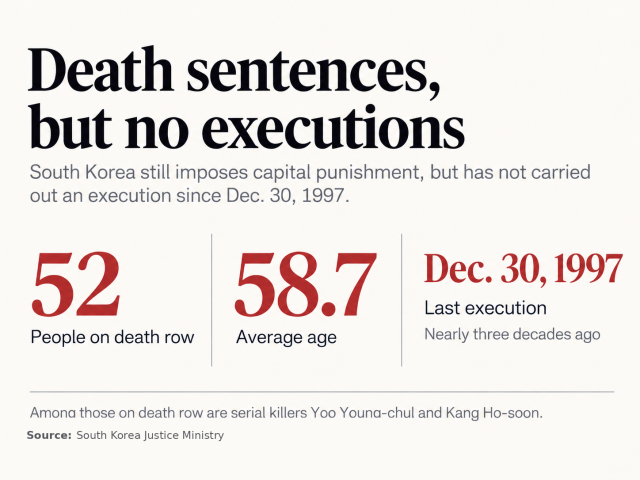
SEOUL, October 07 (AJP) - Fifty-two people remain on death row, growing old under sentences the state has left unfulfilled for nearly three decades. Their average age is 58.7. Among them are serial killers Yoo Young-chul and Kang Ho-soon, who killed 20 and 10 people, respectively.
As the World Day Against the Death Penalty approaches on Oct. 10, South Korea remains caught between its long suspension of executions and a public largely unwilling to abandon them.
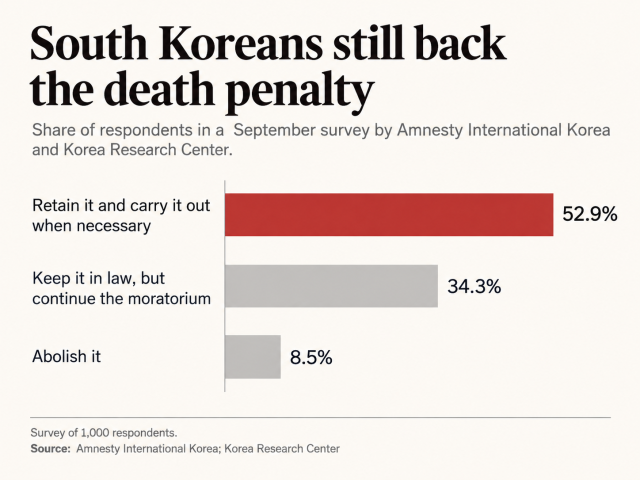
A September survey commissioned by Amnesty International Korea and conducted by Korea Research Center found that 52.9 percent of 1,000 respondents supported retaining the death penalty and carrying it out when necessary.
Another 34.3 percent wanted to keep capital punishment in law while continuing the moratorium. Just 8.5 percent favored abolition.
Yet 70.9 percent knew that most countries had abolished executions in law or practice. The divide appears to reflect more than unfamiliarity with the international abolition movement. Many South Koreans understand that shift but remain unconvinced they should follow it.
A series of brutal crimes has sharpened that tension, including the killing of 17-year-old Lee Chae-won in Gwangju.
Prosecutors sought the death penalty for Jang Yoon-gi, 23, citing a high risk of further violent or sexual offenses if he returned to society. A Gwangju court instead sentenced him to life imprisonment on Sept. 30, stressing that the sentence should not be understood as leniency and that he should remain behind bars without parole.
The case revived a related debate: whether South Korea needs a formal sentence of life imprisonment without parole as an alternative to execution.
For many supporters of capital punishment, the central concern is what would replace it.
In the Amnesty survey, 26.6 percent identified the need to punish heinous crimes as the most important factor shaping their position. Asked what should take priority in any discussion of abolition, respondents’ leading concerns included preventing serious crime and protecting public safety, followed by alternative punishments such as life without parole.
International human rights standards ranked much lower.
The findings suggest a debate rooted as much in punishment and public confidence as in principle. If execution disappears, can society be certain that someone who commits an exceptionally brutal crime will never walk free? And would imprisonment alone satisfy the demands of justice for victims and their families?
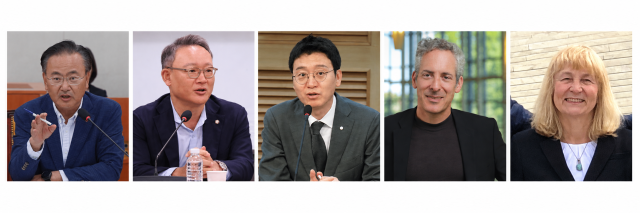
Rep. Yoo Sang-bum of the conservative People Power Party, a former senior prosecutor, said the public’s sense of justice remained a compelling reason to retain capital punishment.
“I believe retaining the death penalty is reasonable,” Yoo told AJP. “The public still strongly believes that the state must respond forcefully to brutal murders. Punishment is based on the realities of the times and public perceptions, and I therefore believe the death penalty should be retained in South Korea today.”
Rep. Ahn Sang-hoon, also of the People Power Party, went further.
“For clearly established heinous criminals, I believe retaining the death penalty is right,” Ahn said. “Despite the importance of respecting life, there are cases where punishment is necessary to make an example. The death penalty is a necessary evil.”
Their position rests on an enduring argument: some crimes are so destructive that the state must retain its most severe punishment.
Opponents question whether any justice system can impose an irreversible sentence with sufficient certainty and impartiality.
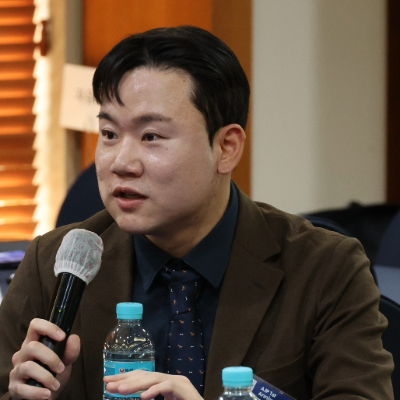
Kim Woong, a lawyer, former prosecutor and author of the bestselling Diary of a Prosecutor, said studying the history of criminal law changed his position.
“I initially supported retaining the death penalty, but after studying the history of criminal law, I came to believe abolition is somewhat better for society,” Kim told AJP.
He identified three concerns: capital punishment can be politically abused; wrongful executions cannot be corrected; and the punishment can encourage society to place responsibility for crime entirely on individuals while overlooking social conditions that may contribute to it.
The possibility of error is central to the abolitionist argument.
Brandon L. Garrett, the David W. Ichel Distinguished Professor of Law at Duke University School of Law, told AJP that murder investigations can be particularly vulnerable. Witnesses may be unavailable, confessions false or coerced, and forensic findings misleading.
Garrett cited nearly 200 people exonerated after being sentenced to death in the United States, including more than 20 whose cases involved post-conviction DNA testing. He also pointed to the prevalence of severe mental illness, brain injuries and childhood abuse among defendants in capital cases.
The American experience does not translate directly to South Korea, which has a different legal system and history. But Sheri Lynn Johnson, a Cornell Law School professor who has studied capital punishment and racial bias for decades, said the underlying vulnerabilities extend beyond any one country.
The American death penalty falls disproportionately on racial minorities, the poor, people with little education and those with mental illnesses, she said.
“These are problems that beset every society,” Johnson told AJP. “Everywhere there are outcasts with whom most people do not identify, and cannot feel compassion for.”
“The process of sentencing someone to death ultimately is deciding that they are less than human, and I don't think that decision can be made without bias.”
Johnson described how discretion and bias can compound each other throughout a criminal case. In the United States, prosecutors decide which cases warrant seeking death and which prospective jurors to exclude. People categorically opposed to capital punishment can be barred from serving on capital juries.
Such “death-qualified” juries tend to be more likely to convict, she said, while the selection process can disproportionately exclude racial minorities.
South Korea does not share that history of racial discrimination in jury selection. The broader question, however, is relevant wherever prosecutors and judges exercise discretion: how far can a justice system prevent poverty, education, mental health, social status or public outrage from influencing who receives its harshest sentence?
For nearly three decades, South Korea has accommodated both sides through an uneasy compromise.
The death penalty remains legal. Prosecutors can seek it, courts can impose it and politicians can invoke it after shocking crimes. But the state has carried out no executions since Dec. 30, 1997. Amnesty International has classified the country as “abolitionist in practice” since 2007.
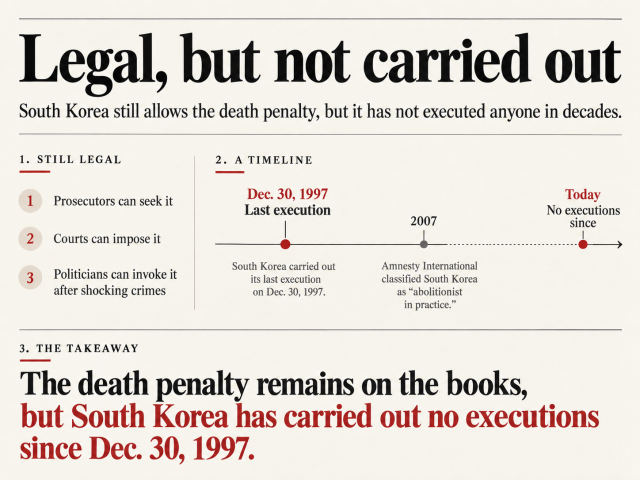
Supporters can point to the punishment’s continued existence. Opponents can point to the absence of executions. Successive governments have avoided the politically costly choice between formal abolition and a return to the gallows.
That accommodation leaves a question unresolved: what purpose does a death sentence serve if the state indefinitely declines to carry it out?
For those who regard execution as indispensable to justice and public safety, almost 30 years without it require an explanation. For those who consider it too fallible or inhumane to use, keeping it in law leaves open the possibility that a future government could resume executions.
The polling suggests that any path toward abolition will depend heavily on public confidence in the alternative.
Life imprisonment without parole speaks directly to the fear that a convicted murderer could eventually return to society. The Jang case illustrates the distinction: prosecutors sought execution, while the court imposed life imprisonment and emphasized permanent isolation. Its stated intention, however, also highlights the question of whether existing sentencing provisions can guarantee that outcome.
Public anger after a horrifying crime is real, as is the suffering of victims and their families. An argument for abolition that fails to address punishment and safety is unlikely to persuade those whose support for capital punishment rests on both.
The risks raised by opponents are equally difficult to set aside. Evidence can be wrong, confessions false and decision-makers biased. Political circumstances can change. An execution forecloses any possibility of correcting the outcome.
South Korea’s debate therefore turns on more than whether a crime can be terrible enough to deserve death. It also turns on whether the public trusts the state to make that irreversible decision — and whether it trusts the alternatives enough to relinquish it.
AJP Takeaways
- South Korea has not carried out an execution since 1997, but the death penalty remains legal and 52 people are still on death row.
- A September survey found 52.9 percent support retaining and using capital punishment, while just 8.5 percent favor abolition.
- The debate increasingly centers on whether life without parole can protect public safety while avoiding the irreversible risks of execution.
Copyright ⓒ Aju Press All rights reserved.
