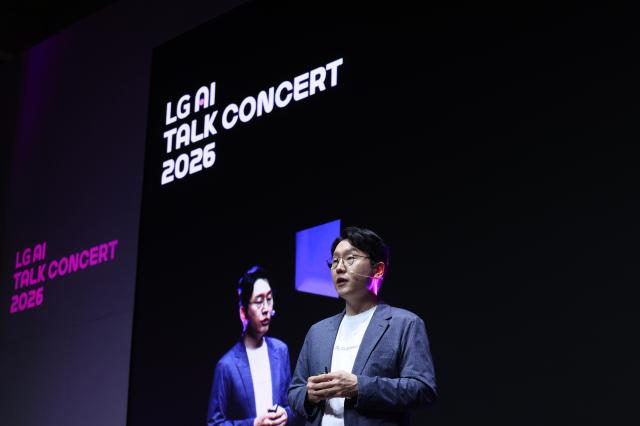
SEOUL, September 14 (AJP) - South Korea's LG Group is preparing to put its homegrown artificial intelligence to work across production lines stretching from hair-loss materials research to home appliances, betting that industrial know-how can matter as much as sheer computing power.
Its AI control tower, LG AI Research, has built the EXAONE ecosystem around models that can be tailored to specific industries, run at lower computing costs and, when necessary, operate inside corporate networks using proprietary data that general-purpose models cannot easily access.
The strategy puts real-world deployment at the center of LG's AI push, targeting manufacturers, hospitals, financial institutions and research labs where security, speed and domain expertise can matter as much as raw intelligence.
At the LG AI Talk Concert 2026 held Monday at LG Science Park in Seoul, the research arm put what it calls “Expert AI” at the center of that strategy, showcasing industry-specific models and applications spanning manufacturing, finance and scientific research.
“The fundamental difference in the Expert AI we pursue is that the actual field and AI technology meet,” Lim Woo-hyung, co-president of LG AI Research, said.
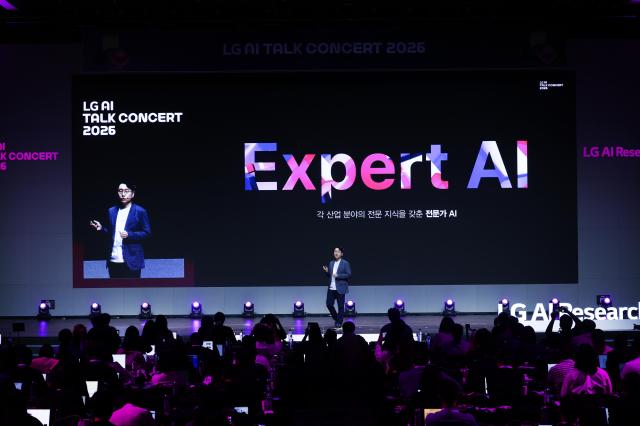
LG's argument is that industrial AI confronts problems fundamentally different from those faced by general-purpose chatbots.
Factories generate vast amounts of proprietary data on production conditions, equipment and product quality. Hospitals and financial institutions handle highly sensitive information. In such settings, producing a plausible answer is not enough.
“To solve problems in the field, we needed AI capable of understanding and making judgments on countless variables and even the 1 percent of exceptional cases,” Lim said.
LG says its advantage lies in combining foundation-model technology with data and expertise accumulated at actual industrial sites.
Across businesses ranging from electronics and components to chemicals and manufacturing, the group has access to domain-specific data, documents and know-how rarely available in public datasets. Models can be applied to those problems, refined with feedback from the field and deployed again, creating a loop between AI development and industrial operations.
Since its establishment in December 2020, LG AI Research said it has tackled more than 100 industrial problems, including battery-life and capacity prediction, product-quality inspection and production and materials planning.
The institute has also had 368 papers accepted by major global AI conferences and filed 1,080 patents at home and abroad.
Built for the factory, not just the benchmark
One of the clearest examples is EXAONE Tabular, a foundation model designed to understand relationships in structured data and make predictions from the kinds of tables widely used in industry.
The model can analyze variables such as production conditions and quality measurements and make predictions even when relatively little data are available for a new task.
LG says the more important distinction lies in how the model was built.
Rather than simply scaling it up to maximize benchmark scores, LG focused on cutting the computing resources needed to run it while preserving enough performance for industrial use.
The company said a competing tabular model from Google near the top of the same benchmark can take two to three minutes to return a result because of heavier computing requirements.
EXAONE Tabular, by comparison, was designed to run on relatively modest GPU infrastructure and return results within seconds when installed on a company's own servers, although performance varies by task.
The model ranked first in classification and multiclass prediction and second overall on TabArena, a global benchmark for tabular models, according to LG.
For companies trying to move AI from pilot projects into everyday factory operations, those differences can translate directly into infrastructure costs and response times.
The calculation is becoming more important as advanced GPUs remain scarce and costly and companies look to deploy AI at scale.
George Cameron, co-founder of independent AI benchmarking firm Artificial Analysis, said the market is already moving beyond a race based solely on intelligence.
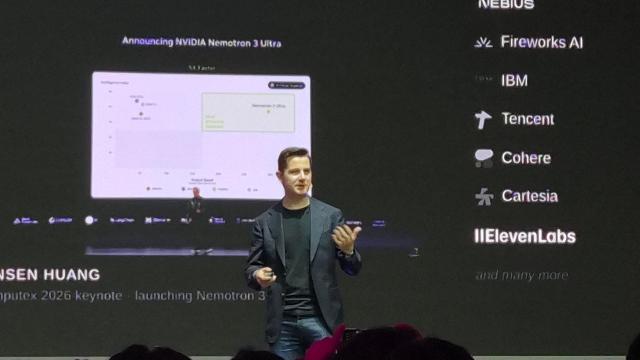
“You don't just have to have the most intelligent frontier Model in the world to be useful in contributing to the ecosystem,” Cameron said.
As AI moves into large-scale commercial use, efficiency is becoming increasingly important alongside intelligence, he said.
LG is betting that equation will matter particularly in manufacturing, where companies may also be reluctant to send sensitive production data to outside cloud services.
For security-sensitive customers, LG plans to offer on-premise deployment, allowing models to run within a company's own infrastructure. Customers prioritizing easier access can instead use cloud-based application programming interfaces, or APIs.
LG said Korean companies have shown stronger interest in on-premise systems, while overseas customers tend to prefer cloud-based access.
From LG factories to outside customers
LG is now preparing to take its industrial AI beyond its own affiliates.
EXAONE Tabular was first applied at LG Innotek, but LG AI Research said it has since drawn interest from unnamed global companies as well as pharmaceutical companies, hospitals and energy businesses.
One possible use is analyzing streams of vital-sign data from intensive-care patients to predict what could happen next. Pharmaceutical manufacturers could similarly use production data to anticipate changes in drug-manufacturing processes.
LG said even domestic rivals could become customers.
“If Samsung wants it, we are of course willing to provide it,” Lee Hwa-young, head of AI business development at LG AI Research, said during a press briefing.
Lee said LG wants the technology used more widely across Korean industry, with domain knowledge generated through broader adoption ultimately feeding back into improvements in the underlying AI.
At LG Innotek, the company said its AI technology has already sharply reduced the time needed to adapt models to changing manufacturing conditions.
A process that previously required more than 300 hours, or about 14 days, of retraining was cut to roughly 50 hours, an 85 percent reduction.
LG is also developing EXAONE Omni-Inspect, a visual-inspection foundation model designed to cope with changes in products and manufacturing environments without requiring a new model to be trained from scratch each time.
The company plans to apply the technology to an actual inspection process this year and eventually develop AI agents capable of adapting more autonomously to changing factory conditions.
An AI scientist that cuts months to a day
LG is applying the same domain-focused approach to scientific research.
EXAONE Discovery, its AI-for-science platform, screened more than 420,000 candidate substances and identified Rhamsydil, a potential hair-care ingredient, in a single day through a project with LG Household & Health Care.
LG said the conventional process of developing a new cosmetics material can take around 22 months.
The company is also working with D&D Pharmatech on next-generation oral peptide drugs, while research with Vanderbilt University Medical Center is using AI to analyze pathology images, genetic information and drug-response data for cancer research.
LG ultimately wants to build autonomous laboratories where AI predicts and designs new materials, robotic systems conduct experiments and the resulting data are fed back into AI to decide what experiment should come next.
The same cycle — prediction, action, data collection and improvement — underpins LG's longer-term physical AI strategy.
AI that reads the market
In finance, LG is using EXAONE Business Intelligence to analyze both structured information such as market data and unstructured information including text.
The platform analyzes roughly 8,000 listed companies in South Korea and the United States each day and generates scores predicting their share-price direction over the following four weeks, along with commentary explaining the reasoning behind the forecasts.
LG launched a U.S. equity forecasting service with London Stock Exchange Group earlier this year and later expanded the technology to the Korean market with Koscom.
Arman Sahovic, APAC head of Data Platform Solutions at LSEG, said one distinction is the ability to combine types of financial data investors have traditionally analyzed separately.
“So this is the first time that our customers can mix both and get actionable insight,” Sahovic said.
Finance, however, also raises the bar for accountability as AI becomes more deeply embedded in investment decisions.
“Now as the financial world does it more and more the difference is that it has to be auditable It has to be traceable There can be no hallucinations,” Sahovic said. “If there is an insight about a particular investment you have to be able to trace back where the data is coming from.”
'Sufficiently intelligent' AI
LG is not abandoning the race to build increasingly powerful general-purpose models.
Its K-EXAONE series is aimed at developing frontier-level intelligence and reasoning capabilities, and executives acknowledged Monday that gaps remain between LG's current models and leading global Big Tech systems on some performance measures.
But Honglak Lee, co-president and chief AI scientist at LG AI Research, said building the world's smartest model first is not LG's sole objective.
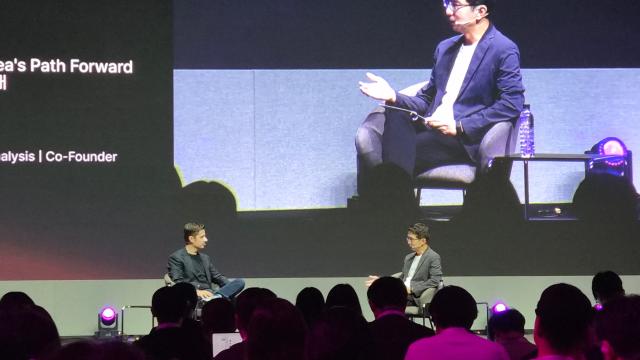
The more practical question, he said, is whether AI can be sufficiently intelligent, affordable to operate and customizable for the work its users actually need done.
That distinction goes to the heart of LG's strategy.
The world's largest AI companies can spend billions of dollars training frontier models. LG's potential advantage lies somewhere else: decades of industrial data, manufacturing processes and specialized knowledge that cannot simply be scraped from the internet.
The approach also carries a strategic dimension for South Korea, which has world-class manufacturing and semiconductor capabilities but remains dependent on foreign AI technology in many areas.
Lee said the continued availability of overseas open models, including those from China, cannot be taken for granted as AI capabilities advance and cybersecurity concerns grow.
Maintaining domestic AI capabilities therefore matters not only for companies but also for areas tied to national strategic interests, he said.
LG's longer-term ambition is to carry that industrial intelligence into the physical world.
The company is developing robot foundation models capable of understanding physical environments, making decisions and taking action, with the eventual goal of moving beyond the automation of individual machines toward factories that operate as integrated intelligent systems.
In such a factory, a human could set production and quality targets while AI coordinates robots, inspection equipment and optimization systems across the plant.
LG is betting that years of manufacturing data and industrial know-how can give EXAONE something even the world's largest general-purpose models cannot easily replicate: experience from the factory floor.
For LG, the next stage of the AI race may therefore be less about who builds the biggest brain than whose AI can actually get the job done.
AJP Takeaways
- LG is betting that industrial data and domain expertise can give its EXAONE AI an edge over larger general-purpose models.
- Its Expert AI strategy focuses on real-world deployment, with industry-specific models designed for computing efficiency, customization and secure on-premise use.
- LG is expanding EXAONE beyond its own affiliates into manufacturing, healthcare, finance and scientific research, while remaining open to outside customers — including Samsung.

Copyright ⓒ Aju Press All rights reserved.