SEOUL, Sept. 15 (AJP) —Eight out of 10 new jobs created through the rise of artificial intelligence were in South Korea’s capital region, suggesting the AI-driven economy could worsen capital overconcentration, a Bank of Korea study found Tuesday.
Occupations highly exposed to generative AI added 247,000 jobs over the period, with the Seoul metropolitan area accounting for 80.8 percent of the increase, according to a study published on the latest Bank of Korea (BOK) Issue Note.
The concentration was even greater in occupations highly exposed to agentic AI, which can plan and carry out workflows with limited human intervention.
Of the 105,000 jobs added in those occupations in 2025, 88.3 percent were in the capital region.
The capital region, comprising Seoul, Incheon and Gyeonggi Province, accounts for more than half of South Korea's employment.
The researchers divided AI into generative, agentic and physical types and measured occupational and regional exposure to each. AI exposure refers to the extent to which tasks within an occupation can use or be automated by the technology.
Exposure to generative AI was highest in Seoul, followed by Sejong, Gyeonggi Province and Incheon.
Agentic AI exposure was also concentrated in Seoul, Sejong and Gyeonggi Province, while physical AI showed the opposite pattern.
Exposure to physical AI was highest in North Gyeongsang, South Jeolla, North Chungcheong and Ulsan, where manufacturing and manual occupations make up larger shares of employment.
The divide largely reflected differences in local employment and industrial structures.
Office, sales, managerial and professional occupations with greater exposure to generative and agentic AI account for larger shares of employment in the capital region. Machine-operation, elementary and service occupations more exposed to physical AI are relatively more common outside it.
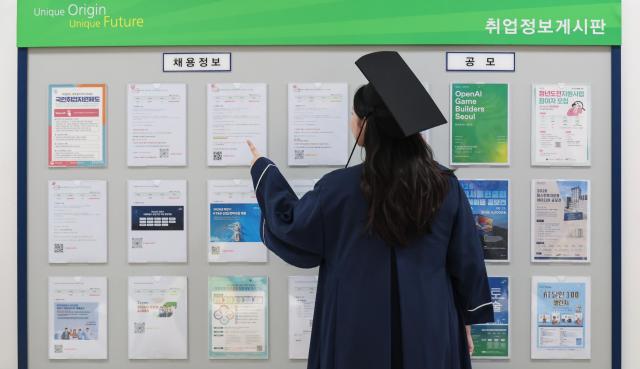
The employment gains did not extend to younger workers.
Among people in their 20s, employment in occupations highly exposed to generative and agentic AI declined in both the capital and non-capital regions.
The researchers said university education remained focused on traditional knowledge accumulation, making it difficult for recent graduates to build the expertise and experience increasingly demanded by employers.
Existing industrial concentration could widen the gap further.
The capital region already accounts for 71.9 percent of employment in knowledge-intensive services and 74.4 percent in semiconductor manufacturing, according to the study.
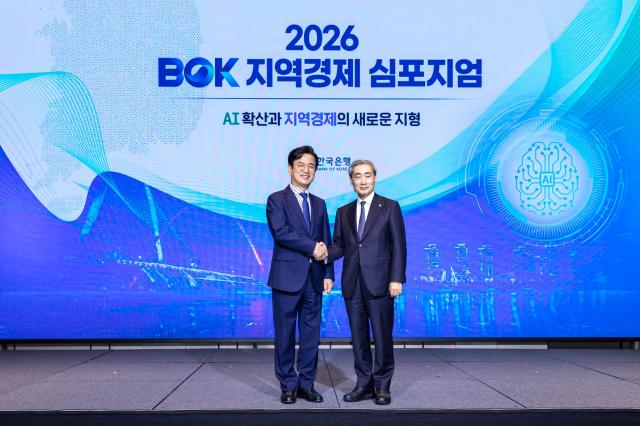
The findings were presented Tuesday at the BOK's 2026 Regional Economy Symposium in Daejeon, where separate research examined whether companies and regions were equipped to turn AI adoption into productivity gains.
Companies with larger shares of workers in their 30s showed clearer productivity improvements after adopting AI, while the effect was limited at firms with higher shares of employees aged 50 or older.
Firms that spent more on employee training also recorded stronger gains.
Companies outside the capital region tended to have older workforces and spend less on training than firms around Seoul, leaving them at a relative disadvantage in the AI transition.
AI adoption did not reduce overall employment at the firms studied, but it had a negative effect on employment of workers aged 29 and younger.
Eom called for retraining older employees and stronger employment support for young workers during the transition.
Another study presented at the symposium examined how AI infrastructure could affect regional economies.
Kim Young-sik, professor of economics at Seoul National University, found that AI data centers could raise total factor productivity, attract workers and increase gross regional domestic product in host areas.
The gains could be partly offset if limited supplies of land and buildings raised rents and created congestion.
Productivity gains concentrated in one region could also draw labor and other resources away from other areas and weaken production elsewhere, according to the study.
Kim found that the effects depended not only on the size of a data center but also on local supply chains, trade links and labor-market conditions.
The BOK issue note also identified opportunities for areas outside the capital region.
AI could produce larger productivity gains in regions where human capital is scarce, while physical AI could help manufacturing regions expand into product development, process improvement and other knowledge-intensive services.
The researchers called for stronger regional AI training systems, greater specialization in knowledge services linked to local manufacturing and concentrated investment to turn regional universities into AI hubs.
The studies suggest that South Korea's regional AI gap will depend not only on where the technology is adopted, but also on whether local economies have the workers, training systems and industrial base needed to use it productively.
AJP Takeaways
- Bank of Korea researchers found that South Korea's capital region accounted for 80.8 percent of job gains in occupations highly exposed to generative AI between 2023 and 2025.
- Bank of Korea research showed that South Korea's capital region is more exposed to generative and agentic AI, while non-capital regions face greater exposure to physical AI linked to manufacturing and manual work.
- Research presented at the Bank of Korea's 2026 Regional Economy Symposium found that companies outside the capital region face weaker conditions for AI-driven productivity gains because they tend to have older workforces and lower training investment.
- Bank of Korea researchers said regional AI training, manufacturing-linked knowledge services and stronger university-based AI hubs could help non-capital regions capture more of the technology's economic gains.
Copyright ⓒ Aju Press All rights reserved.