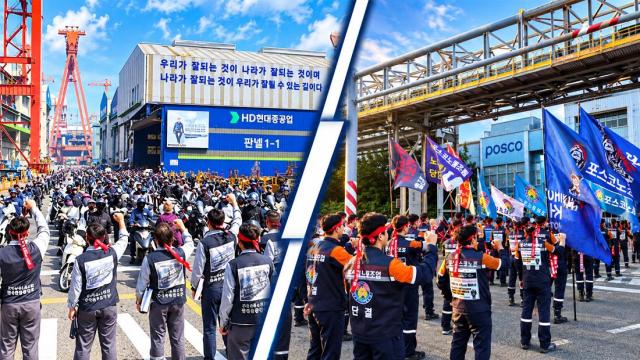
Strikes and strike threats have become a recurring scene this year, spreading from chipmakers and shipbuilders to digital platforms such as Kakao.
A weak Korean won and soaring semiconductor prices fattened the top and bottom lines of major exporters in the first half, encouraging workers to press for a greater share of the windfall while it lasts.
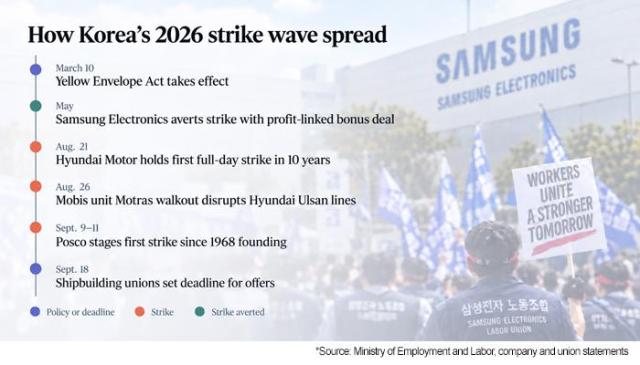
A revised labor law that took effect in March has also changed the bargaining terrain, triggering a rush of industrial actions.
The latest to join the wave was POSCO, the privatized steel giant long known for labor peace.
POSCO's union launched a 120-hour partial strike at hot-rolling mills in Pohang and Gwangyang on Wednesday, just a week after its first walkout ended a 58-year record without a strike dating back to the steelmaker's founding in 1968.
HD Hyundai Heavy Industries' union extended its all-member walkouts to seven hours a day through Friday. The union, representing about 8,100 workers, will have staged a combined 33 hours of walkouts since Sept. 11.
At the heart of the disputes is no longer simply how much wages should rise.
Increasingly, unions want a fixed claim on corporate profits.
HD Hyundai Heavy's union is seeking at least 30 percent of operating profit. POSCO says its union's demands would cost about 1.4 trillion won ($1.02 billion), equivalent to roughly 80 percent of the company's operating profit last year.
"Companies with technological prowess can now reap enormous profits as AI reshapes industry, and sharing them has become hard through traditional collective bargaining alone," Jung Heung-jun, a business administration professor at Seoul National University of Science and Technology, said at the forum.
"AI and digital transformation create enormous added value, but they are a double-edged sword that accelerates labor market polarization," said Yoon Dong-yeol, a business professor at Konkuk University.
The current wave gained momentum at Samsung Electronics, whose chip union threatened a strike in May as it demanded a fixed share of booming semiconductor profits.
The union stood down after a government-mediated agreement created a special semiconductor performance bonus tied to 10.5 percent of business performance. Based on profit forecasts, the formula could translate into total bonuses of up to 600 million won for some memory-chip employees.
The settlement did not end the argument over who should benefit from Samsung's windfall.
A shareholder group said Sept. 7 that it would file an additional breach-of-trust complaint over the bonuses against Samsung Electronics' entire board and the leaders of its largest union.
Unions at Hyundai Motor, HD Hyundai Heavy, LG Uplus and Kakao soon pressed similar demands. Hyundai Motor workers staged their first full-day strike in a decade on Aug. 21.
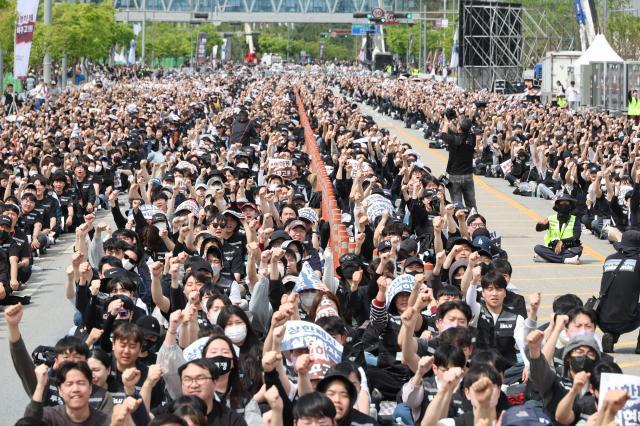
Business groups say the so-called Yellow Envelope Act, which took effect March 10, has emboldened unions by giving workers greater legal room to pursue industrial action.
The revised Trade Union Act recognizes companies that effectively control subcontracted workers' conditions as employers, opening the door for those workers to demand direct bargaining with prime contractors.
It also broadens the scope of disputes that can qualify for legal strikes and restricts companies' ability to seek damages from workers involved in industrial action.
The law takes its name from a 2014 campaign in which citizens mailed small donations in yellow envelopes to workers at SsangYong Motor, now KG Mobility, who faced massive court-ordered damage claims after a strike.
The impact was immediate. Within a month of the law taking effect, 1,011 subcontractor unions had sought negotiations with 372 prime contractors, according to the Labor Ministry.
Hyundai Mobis was among them. Walkouts at its subsidiaries idled Hyundai Motor production lines in Ulsan on Aug. 26, showing how a labor dispute deep in a supply chain can quickly reach the final assembly floor.
The risks are equally visible at POSCO.
Its hot-rolled steel feeds carmakers, shipyards and appliance manufacturers across the country. During a 16-day nationwide truckers' strike in 2022, the Trade Ministry estimated disruptions across five industries at about 3.5 trillion won, with more than 1 trillion won of the losses in steel.
POSCO has called the union's demands excessive at a time when its own earnings are deteriorating. First-half operating profit fell 43 percent as the steelmaker grappled with Chinese oversupply and rising trade protectionism.
HD Hyundai Heavy faces a different calculation.
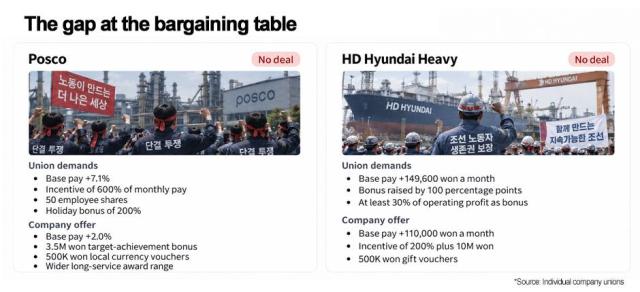
A coalition of eight shipbuilding unions has warned of joint action, including a strike, after next week's Chuseok autumn harvest holiday if companies fail to present acceptable offers by Friday.
To critics of the wage push, unions are "rowing while the tide is in," as a Korean saying for capitalizing on favorable conditions goes.
Yet the tide may be narrower than the headline numbers suggest.
The AI-driven semiconductor boom has become so powerful that it increasingly masks weaker conditions across other parts of the economy.
"The economy looks good only because Samsung Electronics and SK hynix are pulling it along together," said Cho Dong-geun, professor emeritus of economics at Myongji University. "Take those two out, and things are not so good."
Financial markets offer some evidence of that divergence.
Hyundai Motor shares, which climbed to 712,000 won in May amid excitement over humanoid robots, have since retreated to trade at 361,500 won on Wednesday.
Samsung Biologics, hit by the first strike since its founding in May, has fallen to about 1.4 million won from 1.965 million won in mid-January.
The flood of chip dollars has created another complication by lifting the Korean won, eroding some of the currency advantage enjoyed by traditional exporters.
The dollar, which touched 1,559.2 won on July 1, traded at 1,365.2 won on Wednesday. The appreciation came as semiconductor exports reached $281.2 billion in the first eight months of the year, accounting for more than 40 percent of South Korea's total exports.
"When the won strengthens this much, traditional exporters could see their exports shrink sharply," Cho said. "Put it all together, and the economy is in crisis. It's just hidden, so no one sees it."
Cho urged unions to exercise restraint and shore up their fundamentals before pressing for more.
"This is no time to strike," he said.
As labor action spread across industries, the government moved to draw a line around how far profit-sharing demands could go under the revised labor law.
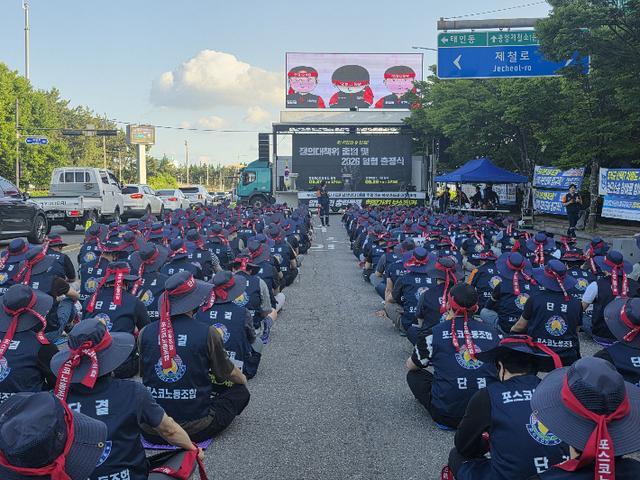
The Federation of Korean Trade Unions called the move an infringement on constitutional labor rights.
"Not being a mandatory bargaining item does not mean unions cannot make the demand," Vice Labor Minister Kwon Chang-joon said.
The Yellow Envelope Act took its name from envelopes that once carried small donations to striking workers facing financial ruin.
Twelve years on, South Korea's labor fight is increasingly about how much goes into the pay envelope.
AJP Takeaways
- POSCO's union began a 120-hour partial strike on Sept. 16, ending decades of labor peace, while HD Hyundai Heavy Industries' roughly 8,100 union members extended walkouts to seven hours a day.
- Profit-linked compensation has emerged as a defining demand of the 2026 bargaining season, with HD Hyundai Heavy's union seeking at least 30 percent of operating profit after Samsung Electronics agreed to a new semiconductor bonus formula in May.
- The Yellow Envelope Act, effective March 10, expanded subcontracted workers' bargaining rights, broadened the scope of labor disputes and limited some damage claims against strikers, changing the terrain for industrial action.

Copyright ⓒ Aju Press All rights reserved.