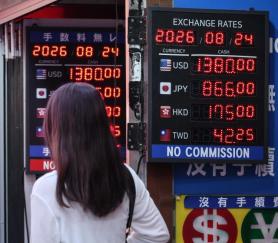
The dollar stood at 1,359.4 won on Sept. 15, leaving the Korean currency 4.8 percent stronger than the end-July level of 1,424.0 won and 8.6 percent stronger than its first-half average of 1,486.79 won, showed the Bank of Korea (BOK) third-quarter market report Thursday.
The dollar shot back up to 1,380.7 won by 1 p.m. Thursday following the Federal Reserve's overnight rate hike, which widened the gap between the U.S. and Korean benchmark rates to 1 percentage point at the upper end.
The won's strength through Sept. 15 was notable against a 0.3 percent decline in the dollar index against a basket of six major currencies. The Japanese yen gained 1.9 percent against the dollar, the Taiwan dollar 1.4 percent and the Indonesian rupiah 1.8 percent over the same period.
The BOK attributed the won's advance to improved domestic foreign exchange supply and demand, helped by a widening current-account surplus and expectations for solid economic growth despite continued geopolitical uncertainty in the Middle East.
Volatility also eased sharply. The won-dollar rate's average daily fluctuation fell to 0.31 percent in August from 0.53 percent in July and 0.50 percent in June. The average daily trading range narrowed to 4.4 won from 8.0 won in July.
Foreign investor flows also improved overall in August, although the underlying picture differed sharply between stocks and bonds.
Net foreign investment in South Korean securities recorded an outflow of $4.50 billion in August on a settlement basis, narrowing from $21.65 billion in July and $30.72 billion in June.
Stock investment swung to a modest $40 million inflow from a $20.70 billion outflow in July, while bond outflows widened to $4.53 billion from $960 million a month earlier.
The BOK attributed the heavier bond outflow to rising market rates and worsening incentives for short-term arbitrage trades. On a trading-date basis, meanwhile, foreign stock outflows widened to $8.66 billion in August from $5.46 billion in July.
Foreign exchange trading became more active even as day-to-day volatility declined.
Average daily interbank foreign exchange trading increased to $57.23 billion in August from $54.55 billion in July, led by stronger spot-market activity. Spot transactions rose to $25.31 billion a day from $21.89 billion, while foreign exchange swaps declined to $25.36 billion from $26.83 billion.
The picture for securities also reversed entering the second half, with bond yields rising sharply while the pace of equity gains moderated.
South Korea's 10-year government bond yield climbed 34 basis points from end-July to 4.60 percent as of Sept. 15, outpacing increases of 27 basis points in the corresponding U.S. Treasury yield and 23 basis points in Japan's 10-year government bond yield.
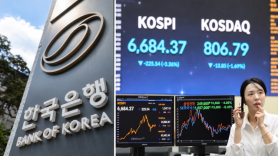
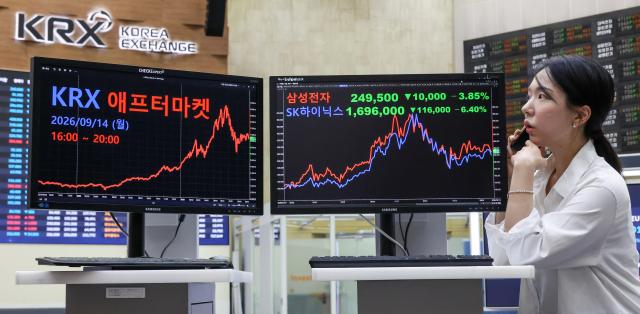
The KOSPI, which had driven South Korean asset gains in the first half, was up just 0.5 percent from end-July through Sept. 15. By comparison, the U.S. S&P 500 gained 1.3 percent, while Taiwan's TAIEX rose 5.5 percent.
South Korean banks' overseas borrowing conditions remained broadly favorable despite some rise in funding spreads.
The country's five-year credit default swap premium edged down to 22 basis points in August from 23 basis points in July. Short-term overseas borrowing spreads rose to 26 basis points from 17 basis points, while medium- to long-term spreads increased to 45 basis points from 41 basis points.
AJP Takeaways
- The won strengthened 4.8 percent against the dollar from end-July through Sept. 15, outpacing gains in the Japanese yen, Taiwan dollar and Indonesian rupiah over the same period.
- The dollar-won rate rebounded to 1,380.7 won by 1 p.m. Thursday from 1,359.4 won on Sept. 15 following the Federal Reserve's overnight rate hike.
- The KOSPI gained just 0.5 percent from end-July through Sept. 15, compared with the won's 4.8 percent advance, while South Korea's 10-year government bond yield rose 34 basis points.
- Foreign securities outflows narrowed to $4.50 billion in August from $21.65 billion in July, while average daily foreign exchange volatility fell and interbank trading volume increased.

Copyright ⓒ Aju Press All rights reserved.