

SEOUL, September 17 (AJP) - South Korea is a super-aged society, with people 65 and older making up more than 22 percent of the population and the country aging among the fastest in the world.
That may partly explain the surprise appeal of a movie about a man in his 70s landing an entry-level office job rather than the cleaning or security work more commonly available to Koreans his age.
The Korean remake of the 2015 Hollywood movie of the same title opened Wednesday and immediately topped the box office, knocking Christopher Nolan's "The Odyssey" out of first place after a roughly six-week run.
Real life for older Koreans is considerably harsher.
South Korea's elderly poverty rate is close to 40 percent, the highest in the OECD and about 2.7 times the organization's average.
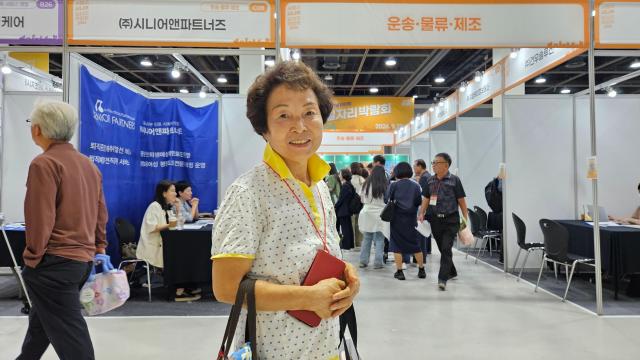
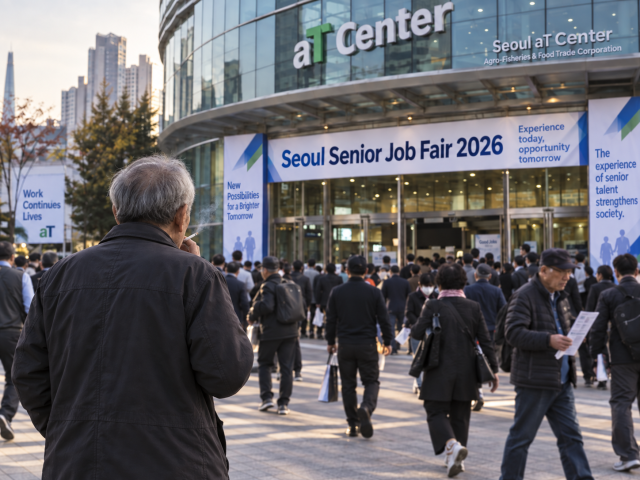
The aT Center in Seocho-gu, southern Seoul, was packed with gray-haired job seekers Thursday as the Seoul Senior Job Fair 2026 opened its doors.
The city had brought together 81 employers offering positions in caregiving, logistics, education, services, transportation and office administration, among other fields.
Organizers expected about 3,500 people at the fair, which was open to job seekers age 60 and older.
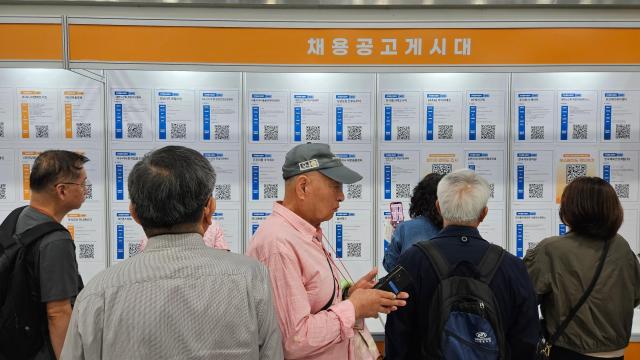
But for many people in their 70s wandering the exhibition hall, the choices were hardly abundant or varied.
Security guard. Cleaner. Then another security guard.
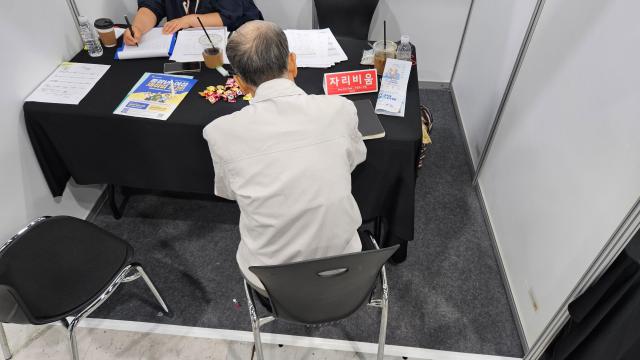
Yu Joo-chan, 79, had traveled from Guro-gu on the other side of Seoul with only a few possibilities on his checklist.
"What kind of work did you do before?" an employment counselor asked him. "What certificates do you have?" "Can you drive?"
Then came the polite letdown.
"Because of your age, it could take a very long time," she told him.
Yu had worked for telecommunications companies when he was younger. Two of them went bankrupt.
"Since then, nothing has really gone the way I wanted it to," he said.
He later found work managing apartment buildings. The company that employed him recently went bankrupt, too.
These days, Yu survives partly through what he calls "security-guard part-time work."
"I'm barely getting by," he said.
He had hoped to find another building-management job, but came to the fair with a sober understanding that few employers would hire him.
Even apartment security, long one of the most visible sources of work for elderly Korean men, is becoming more competitive, he said.
"There are a lot of 'young' security guards in their 50s and 60s now," Yu said. "I have to compete with them. Who is going to hire someone who is almost 80?"
Koreans live a long time and work to unusually advanced ages. Yet many reach those years with too little income and find that the jobs available to them bear little resemblance to the careers they spent decades building.
By August, 11.28 million of South Korea's 51.08 million registered residents were 65 or older, or about 22.1 percent of the population, according to Interior Ministry data. The country crossed the 20 percent threshold associated with a "super-aged" society in 2025.
They are also likely to live for years after conventional retirement.
South Korea's life expectancy reached 83.7 years in 2024. A Korean who reaches 65 could expect, based on 2023 data, to live another 21.5 years on average.
Financing those decades is a different matter.
South Korea has the highest old-age relative poverty rate in the OECD. About 40 percent of Koreans over 65 live on incomes below half the national median, compared with an OECD average of about 15 percent, according to the OECD's latest pension comparison. Among Koreans over 75, the rate rises to 54 percent.
Older Koreans' disposable income averages just 68 percent of that of the overall population, compared with 87 percent across the OECD. Korea's old-age safety-net benefits were equivalent to only about 7 percent of average earnings in 2024, versus an OECD average of 21 percent.
The result is that retirement often doesn't mean retirement.
In 2024, 57 percent of Koreans ages 65 to 69 were employed, more than double the OECD average of 26 percent and, alongside Japan, the highest rate in the organization.
Post-retirement work has become more necessity than choice.
Statistics Korea found that 57.6 percent of people ages 65 to 79 wanted to continue working in 2025. More than half, 51.3 percent, said they needed the money for living expenses.
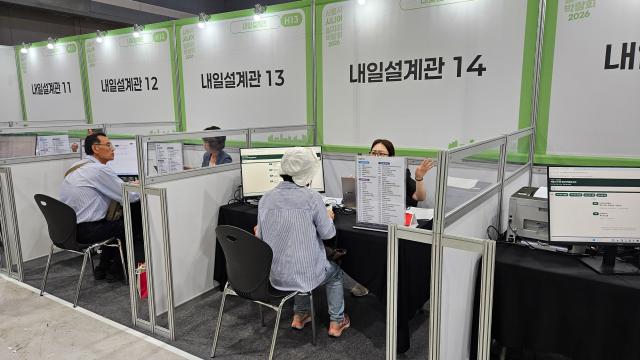
Yu Byung-sun, 69, who spent 24 years running a raw-fish restaurant, was looking for custodial or cleaning work so he could have some extra money to give his grandchildren.
"What I felt after coming here and getting counseling today is that finding a job when you're old is difficult," he said.
His wish was simple.
"If I can get a job, I want to save the money and give some spending money to my grandchildren," Yu said.
The fair itself offered a broader spectrum of work.
Seoul officials highlighted positions in caregiving, transportation, logistics, education, services and administration, and provided résumé clinics, one-on-one consultations and artificial-intelligence demonstrations.
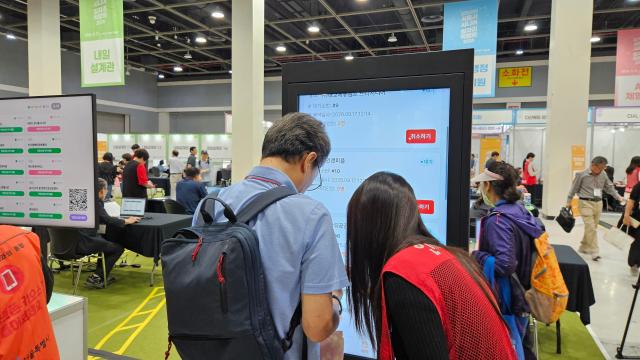
"Digital helpers" were stationed around the venue to assist older visitors with registration, kiosks, smartphones and interview reservations.
At a booth operated by Cleaning Lab, a company that dispatches workers to clean homes and offices, an employee said many older visitors liked the idea of cleaning work — until they heard that getting assignments required using a smartphone.
The company operates somewhat like Uber, the employee said: Customers who need cleaning are connected through a digital platform with people willing to do the work. The average hourly wage is about 13,500 won ($9.77).
"Many elderly people tell us that the jobs available to them are limited to things like cleaning and janitorial work," the employee said.
But when staff explained that the work required using a smartphone, another reaction often followed.
"A lot of them say, 'I don't think I can do this job.'"
Technology is spreading through precisely the kinds of flexible jobs that could otherwise accommodate an aging workforce.
Internet use among South Koreans 65 and older reached 76.9 percent in 2024, but comfort with digital tools varies widely, particularly among people well into their 70s and 80s.
Not everyone left discouraged.
Jeon Sun-ok, 74, had spent much of her working life running a small business and had been out of work for a little over a year. She said the fair had shown her possibilities she had not considered.
"This is such a good system," she said. "You can look for jobs at so many booths, and you learn about work you hadn't thought of before."
She had trained as a caregiver but had not fully understood how she might turn that qualification into employment.
"I learned more concretely today that I could work as a caregiver and help other people," Jeon said.
Her experience was the optimistic case Seoul officials hoped to replicate: matching accumulated experience and overlooked skills with a labor market increasingly short of younger workers.
For others, the arithmetic of age remained harder to overcome.
Outside the aT Center, Kim, a 75-year-old man who asked to be identified only by his surname, smoked one cigarette after another.
Until recently, he operated a screen-golf business near COEX, the sprawling convention center in southern Seoul. Business weakened as fewer people came to play, he said, and he eventually handed the operation over to someone else.
He came to the fair hoping to find something he could still do responsibly for eight hours a day.
No luck.
"Jobs for elderly people are all either security or cleaning," Kim said. "I'm not saying I can do extremely hard physical work. But I would like a job where I can work eight hours a day and take responsibility for what I do. I came here and found there really isn't much like that."
Security work brought its own problem.
Apartment guards often work rotating shifts. Under a two-shift system, Kim said, that can mean 12-hour stretches and regular overnight work.
"How are old people physically supposed to do that?" he said. "There should at least be three shifts."
Then there is the technology gap.
"What do old people know how to do on computers?" he said. "You have to take their physical strength and health into consideration."
Policy discussions often bundle everyone above 60 into a single category. Kim said that made little sense from where he stood.
"Sixty and 70 are completely different," he said.
He had just spoken with another man looking for work at the fair.
"He told me he was 64," Kim said. "I thought, 64? At my age, that sounds practically young."
Kim gave a short laugh.
Then he remembered what the younger man had told him.
"He said he couldn't find anywhere to work either."
Outside the building where thousands of older Koreans had come looking for their next job, Kim took a long drag from his cigarette.
Copyright ⓒ Aju Press All rights reserved.
