
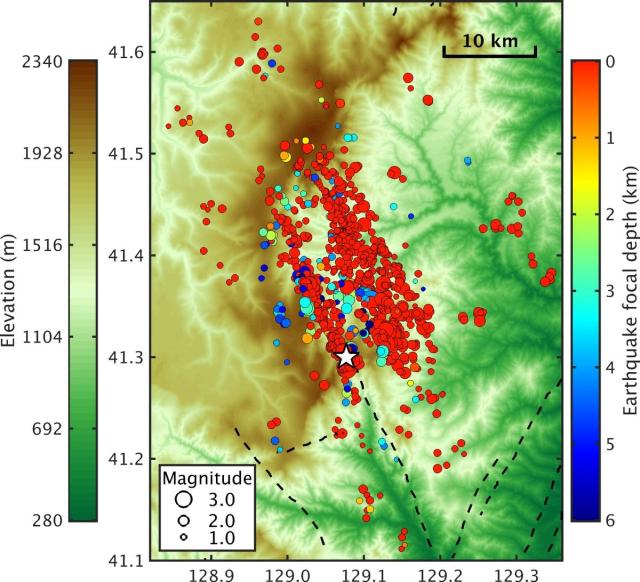
Researchers led by Kim Kwang-hee, a professor of geological sciences at Pusan National University, and Xingli Fan of Chengdu University of Technology analyzed 17 years of continuous seismic data collected in South Korea and northeastern China.
In an extensive study of 1,399 local earthquakes around Mount Mantap between 2008 and 2025, researchers found that seismic activity began increasing about three weeks after North Korea's sixth and largest nuclear test at the Punggye-ri nuclear test site in North Hamgyong Province in September 2017, rather than fading as is commonly seen after underground explosions. The earthquakes then became more frequent and stronger, with most occurring along two fault structures running roughly north-northwest.
Kim estimated that a simultaneous rupture along the roughly 24-kilometer fault system could potentially produce an earthquake of around magnitude 6.4.
The researchers concluded that repeated nuclear explosions progressively damaged the shallow crust and redistributed stress around Mt. Mantap, gradually pushing pre-existing faults that were already close to failure toward renewed movement. Most of the earthquakes occurred at unusually shallow depths, within about a kilometer of the surface.
North Korea carried out six declared underground nuclear tests at Punggye-ri between 2006 and 2017. The tests took place in October 2006, May 2009, February 2013, January and September 2016 and September 2017. The final test was by far the largest, with an estimated yield of 100 to 250 kilotons and seismic signals equivalent to a magnitude 6.3 earthquake.
The researchers said the findings raise a new geological concern for North Korea's nuclear program and could affect nuclear test verification, as earthquakes triggered by underground explosions may continue for years and become difficult to distinguish from natural seismic activity.
The study also suggests that the effects of human activity on existing fault systems should be monitored long after underground construction, energy extraction and other activities that change stress in the Earth's crust have ended.
The latest findings came just days after Kim Yo-jong, the powerful sister of North Korean leader Kim Jong-un, repeatedly vowed this week to expand its nuclear arsenal. She said in an statement released on Friday that Pyongyang would make no change to its course of strengthening its nuclear deterrent, accusing U.S.-led military exercises involving South Korea and Japan of worsening tensions on the Korean Peninsula.
AJP Takeaways
- North Korea's underground nuclear tests at Punggye-ri reactivated dormant faults beneath Mount Mantap.
- Seismic activity intensified after the 2017 nuclear test and has persisted for years.
- Researchers say the findings could affect CTBT monitoring and broader assessments of human-induced seismic risks.
Copyright ⓒ Aju Press All rights reserved.
