
The company said Friday it signed a contract with the Korea Astronomy and Space Science Institute on Sept. 9 to participate in the development of South Korea’s national Space Situational Awareness system, or K-SSA.
The project comes as the rapid growth of satellites in low Earth orbit raises the risk of collisions with artificial and natural objects in space, increasing the need for systems capable of protecting national space assets and predicting potential hazards.
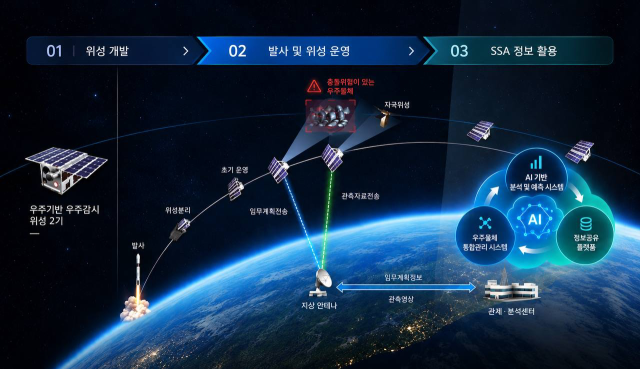
Under the project, Hanwha Systems will develop a space-based surveillance satellite and an AI-powered ground system that will collect, integrate and analyze information on objects in orbit.
The surveillance satellite will be a small spacecraft operating at an altitude of about 480 kilometers. Equipped with an optical camera designed for space situational awareness, it will detect and track artificial and natural objects and gather data needed to assess collision and reentry risks.
“The space industry is rapidly expanding beyond simply developing and operating satellites toward the safe use and management of space,” Song Sung-chan, head of Hanwha Systems’ space business division, said.
AJP Takeaways
- Hanwha Systems is developing an AI-powered space situational awareness system under South Korea’s K-SSA program.
- The project includes a 480-kilometer-orbit surveillance satellite and an AI-based ground system for tracking space objects.
- The system is designed to assess collision and reentry risks and strengthen protection of South Korea’s space assets.

Copyright ⓒ Aju Press All rights reserved.
