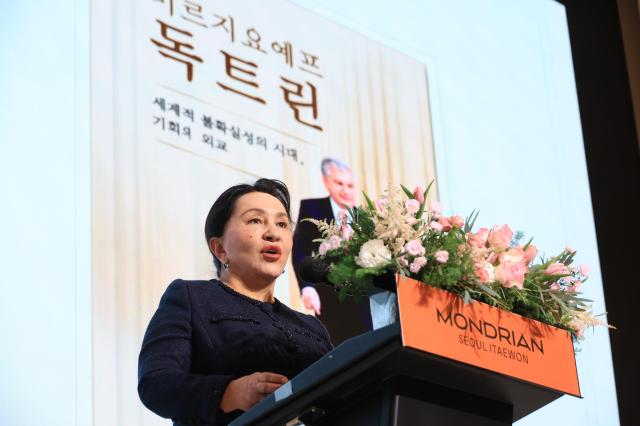
SEOUL, November 10 (AJP) - Two months after President Shavkat Mirziyoyev's state visit to Seoul, Uzbekistan sent its Senate head to launch a Korean edition of a book that frames his foreign policy as a doctrine, and she told the audience she had lived through much of what it describes.
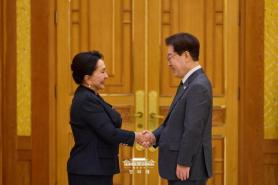
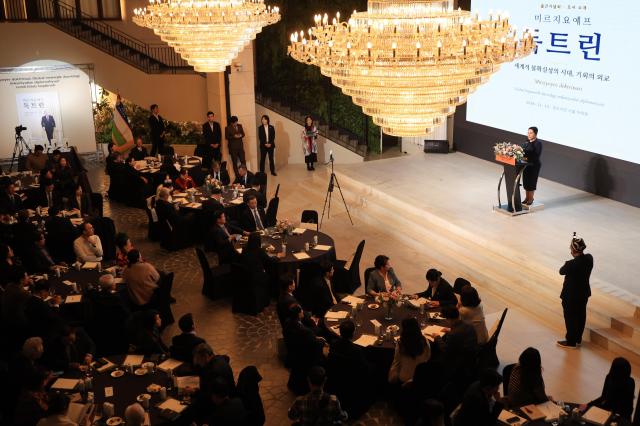
Tanzila Narbayeva, chairperson of the Senate of the Oliy Majlis, Uzbekistan's parliament, presented "The Mirziyoyev Doctrine: Diplomacy of Opportunity in an Era of Global Uncertainty" at the Mondrian Seoul Itaewon hotel on Tuesday. The Uzbek Embassy in Seoul hosted the event, which drew Ambassador Alisher Abdusalomov, former National Assembly Speaker Park Byeong-seug, Central Asian scholars and Uzbek students. Narbayeva was in Seoul on an official visit that included a meeting with President Lee Jae-myung on Monday and talks with National Assembly Speaker Cho Jung-sik on Tuesday morning.
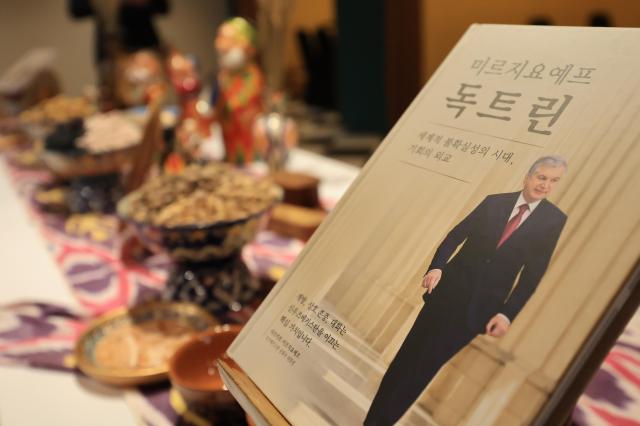
The book is a government product. Its Korean edition, published by Pornals on Sept. 10, lists seven authors drawn from Uzbekistan's foreign policy establishment and names two overseers, Kudratilla Rafikov and Bakhtiyor Saidov, who has served as foreign minister since 2022. Nadezhda Kim, a translation scholar at Chungwoon University's College of Global Convergence, translated it from the Uzbek original. It runs to eight chapters and a glossary.
Its argument is that Mirziyoyev changed Uzbekistan's foreign policy in three ways when he took power in 2016: from strategic isolation to putting Central Asian neighbors first, from equidistance between great powers to open and diversified partnerships, and from protocol-driven diplomacy to an economic diplomacy judged by investment, exports and jobs. The book sets the president alongside Lee Kuan Yew, Mustafa Kemal Atatürk, Charles de Gaulle and Deng Xiaoping, and traces every shift back to a line from his inauguration speech: it is not the people who should serve state bodies, but state bodies that must serve the people. "The foreign ministry and our missions abroad must become the locomotive that pulls our economy," Mirziyoyev is quoted as saying.
Mirziyoyev served as prime minister for 13 years under Islam Karimov, who ruled Uzbekistan from independence in 1991 until his death in September 2016. Mirziyoyev became acting president that month, won election in December and has since overseen a program of economic opening and regional outreach that he calls New Uzbekistan. He won a third term in 2023 under a new constitution.
Narbayeva, who has led the Senate since 2019 and was the first woman to hold the post, told the audience she had worked alongside Mirziyoyev for many years. "I witnessed many of the processes described in this book myself, and in some of them I took part directly," she said. The book, she added, puts the question that she said her own experience answers: "When a country builds trusted relations with other states, what does that change in people's lives?"
Her clearest example was cotton. For decades the Uzbek state met its harvest quotas by sending public employees, students and children into the fields, and from 2011 more than 300 international brands boycotted Uzbek cotton over forced labor. Narbayeva chaired the Federation of Trade Unions of Uzbekistan from 2010 to 2016, and she said Mirziyoyev, then prime minister, put her in charge of coordinating the effort to end the practice.
"I saw how hard it was to change a practice that had taken shape over decades, sending public-sector employees to the cotton fields, sending children, sending the entire population," she said. She credited the president's political will and work with the International Labour Organization (ILO), employers and civil society groups. The ILO concluded in March 2022 that the 2021 harvest was free of systemic child and forced labor, and the Cotton Campaign coalition lifted its boycott the same month. Narbayeva still chairs the national commission on human trafficking and forced labor.
The second example was the border. The book tells of a Kyrgyz man, Furkat Abdullayev, who in 2015 could see his brother across the Uzbek frontier from 50 meters away but could not reach him. Narbayeva said families in the Fergana Valley faced detours of about 200 kilometers to visit relatives on the other side. Mirziyoyev opened direct talks with the neighbors in the autumn of 2016, border crossings reopened in 2017, and Uzbekistan and Tajikistan introduced 30-day visa-free travel in 2018. The first consultative meeting of Central Asian heads of state followed in Astana that year, at Mirziyoyev's initiative.
Uzbekistan is Central Asia's most populous country, with about 38 million people, and shares borders with all four regional neighbors as well as Afghanistan. Narbayeva said its economy had grown from about $68 billion in 2016 to $147 billion last year, that unemployment had fallen from 9.3 percent in 2018 to 4.8 percent, and that the national poverty rate had dropped from 17 percent in 2021 to 3.9 percent as of September. The World Bank put the 2025 poverty rate at 5.8 percent in an assessment published this month, and said 3.7 million people had moved above the national poverty line since 2021.
South Korea occupies its own chapter in the book. "Korea's value lies not in the scale of its investment, but in the practical cooperation and support it offers as Uzbekistan builds a modern industrial ecosystem," the authors write. Seoul was among the first governments to recognize Uzbek independence and established diplomatic relations on Jan. 29, 1992. The two countries upgraded ties to a special strategic partnership in 2019.
Mirziyoyev's state visit from Sept. 13 to 16 produced a joint statement and a package of agreements covering critical minerals, artificial intelligence, high-speed rail and defense, along with an $8 billion cooperation program with the Export-Import Bank of Korea. Uzbek officials described a project pipeline worth about $12 billion. The visit coincided with the first Korea-Central Asia summit, which brought all five regional leaders to Seoul. Lee asked Narbayeva on Monday for the Uzbek parliament's legislative support in turning those agreements into results. She chairs a joint committee that monitors the implementation of bilateral projects.
"If you work with Uzbekistan, you will be working with the whole of Central Asia," Narbayeva told the Seoul audience.
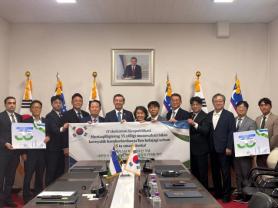
She listed what Korean cooperation had already built: a 280-bed children's medical center in Tashkent that opened in 2020 with Korean financing, where she said more than 100 doctors and nurses had trained in Korea; a national cancer center whose construction was launched during the September business forum; Hyundai Rotem trains on the Tashkent-Khiva line; and Kia assembly in Jizzakh. About 50,000 Uzbeks have worked in South Korea under the Employment Permit System since 2007, and Korean shipyards have begun recruiting Uzbek workers. Narbayeva said Mirziyoyev had ordered on Nov. 2 that migrant workers be trained in language and trade skills before departure. "If our citizens are going to work in Korea, they must also know Korea's laws and rules well," she said. She also thanked the Export-Import Bank of Korea for backing a women's entrepreneurship center in the Aral Sea region.
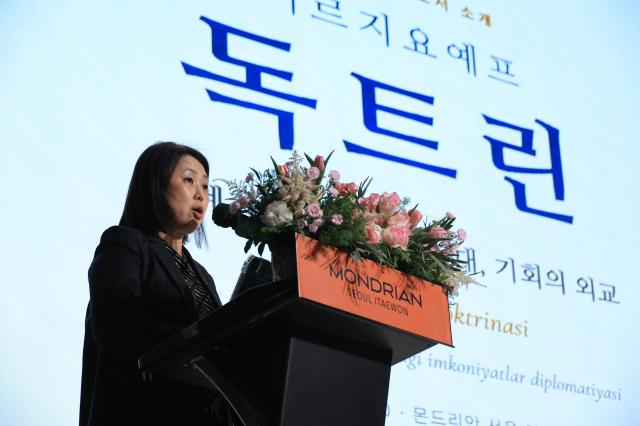
Kim, the translator, said the book had made her think about how one person's manner of communicating could reshape relations between states. "At times, one person's ability to communicate opens the way to change in relations between states that have long been frozen," she said. Oh Eun-kyung, director of Dongduk Women's University's Eurasia-Turk Institute, and scholars from Hankuk University of Foreign Studies and Uiduk University also spoke.
Uzbekistan is home to about 170,000 ethnic Koreans, the largest such community in Central Asia. Their ancestors were among some 172,000 Koreans deported from the Soviet Far East to Central Asia in 1937. Next year marks 90 years since that deportation and 35 years of diplomatic relations between Seoul and Tashkent. Lee proposed on Monday that the two countries mark both anniversaries by building a museum of Koryo-saram history in Uzbekistan, and Cho asked Narbayeva on Tuesday for her support. Narbayeva told the book launch that both presidents had endorsed the idea and that she and the speaker had agreed to aim for an opening next year.
"It would be very fitting to open this museum to mark those two great dates," she said.
Copyright ⓒ Aju Press All rights reserved.