
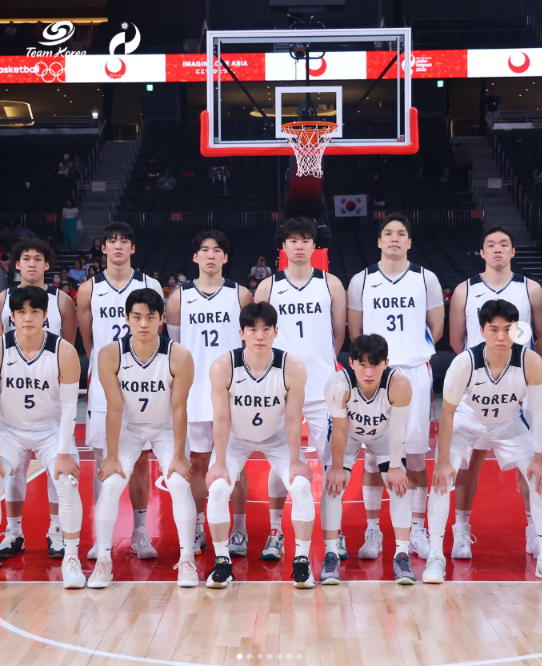
South Korea defeated Japan 67-57 in Sunday's final at Aichi International Arena in Nagoya, completing an unbeaten tournament and winning its fifth Asian Games men's basketball gold medal. It was Korea's first title since the 2014 Incheon Games.
The significance went beyond ending the gold-medal drought. Korea entered the tournament without a naturalized player, long regarded as an important piece for a national team frequently disadvantaged in size against Asia's bigger frontcourts.
Korea reached the top of Asia through a lineup centered on 26-year-old Lee Hyun-jung and a deep group of guards and forwards, while veterans Lee Seung-hyun and Jang Jae-seok absorbed much of the burden inside.
Lee Hyun-jung provided the centerpiece. The former Davidson College forward scored a game-high 27 points and grabbed 18 rebounds in the final, including 13 points in a decisive third quarter in which Korea turned a 28-28 halftime tie into a 55-47 lead. Korea made six of eight three-point attempts in the quarter.
Lee Jung-hyun, the reigning Korean Basketball League most valuable player, added another scoring and playmaking threat, while Lee Woo-suk, Byeon Jun-hyung and Yoo Ki-sang gave Korea multiple perimeter options.
Korea won all six games, defeating Saudi Arabia, Indonesia and Japan in the group stage before beating Jordan 114-80 in the quarterfinals and Iran 77-51 in the semifinals. It defeated Japan for a second time in the final after beating the host 100-83 in their first meeting.
The run also marked a sharp reversal from the 2022 Hangzhou Asian Games, held in 2023, when Korea finished seventh after a quarterfinal exit — its worst Asian Games finish.
This time Korea relied less on a dominant interior presence and more on defensive switching, ball movement and outside shooting, with different players filling gaps when injuries disrupted the roster.
The emergence of Lee Hyun-jung has been central to that change. At 2.02 meters, Lee gives Korea size on the wing while stretching defenses with his three-point shooting, a combination the national team had struggled to produce consistently in previous generations.
Younger players including Moon Yu-hyun and Eddie Daniel also gained their first experience at a major senior international competition, while Moon Jung-hyun, Lee Woo-suk and Yoo Ki-sang added to a core that could remain together through the next international cycle.
Still, the gold medal does not end Korea's debate over naturalization. The physical demands will rise considerably against the world's leading teams in FIBA World Cup and Olympic competition, where Korea's shortage of true international-level centers remains unresolved.
The basketball gold lifted South Korea to third in the overall medal standings with four golds as of Sunday.
AJP Takeaways
- South Korea beat host Japan 67-57 to win its first Asian Games men’s basketball gold medal in 12 years and fifth overall.
- Korea reclaimed the title with an all-Korean roster, overcoming the absence of a naturalized big man through perimeter shooting, defense and depth.
- Lee Hyun-jung led the breakthrough with 27 points and 18 rebounds in the final, emerging as the centerpiece of a new national-team generation.
Copyright ⓒ Aju Press All rights reserved.
