
SEOUL, September 22 (AJP) -South Korea, the United States and Japan reaffirmed their commitment to North Korea's complete denuclearization while keeping the door open to dialogue, as the three countries broadened coordination on supply chains, energy security and critical technologies during talks in New York.
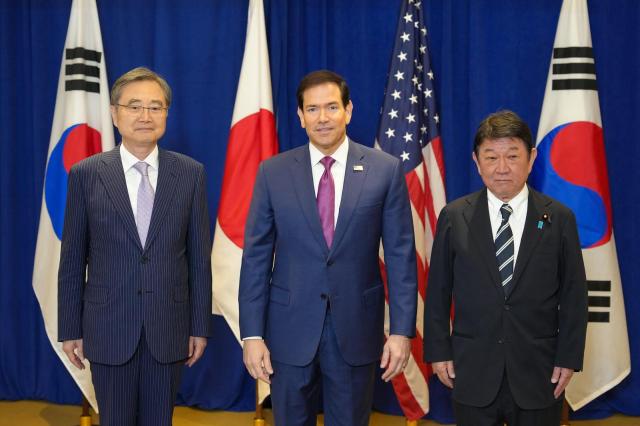
South Korean Foreign Minister Cho Hyun, U.S. Secretary of State Marco Rubio and Japanese Foreign Minister Toshimitsu Motegi met Monday on the sidelines of the 81st United Nations General Assembly High-Level Week and issued a joint statement covering North Korea, economic security, Taiwan and regional defense cooperation.
The three diplomats "reaffirmed their resolute commitment to the complete denuclearization" of North Korea and to blocking revenue used to finance its nuclear and ballistic missile programs in accordance with U.N. Security Council resolutions, according to a joint statement.
They stressed that "the path to dialogue remains open" and urged Pyongyang to return to talks, while pledging continued efforts to advance peace and stability on the Korean Peninsula.
The language maintained the three countries' longstanding denuclearization goal while leaving room for renewed diplomatic engagement with North Korea.
They also welcomed work by the Multilateral Sanctions Monitoring Team on North Korean violations and sanctions evasions and cited progress in countering Pyongyang's cyber threats and illicit revenue generation, including through North Korean information-technology workers.
The ministers reiterated calls for the immediate resolution of issues involving abductees, detainees, unrepatriated prisoners of war and separated families.
Economic security occupied a significant portion of the statement, with the three countries pledging to strengthen their joint response to supply-chain disruptions and what they described as economic coercion and non-market practices.
"Standing firmly against economic coercion and non-market policies and practices leading to harmful overcapacity and market distortion, including arbitrary export restrictions that disrupt supply chains," the ministers agreed to maintain free and transparent trade and secure critical supply chains.
They agreed to strengthen their trilateral Supply Chain Early Warning System and welcomed the launch of a new trilateral consultation on economic security.
The statement did not name China in that section, but came ahead of a planned summit between U.S. President Donald Trump and Chinese President Xi Jinping in Washington on Thursday, where trade and geopolitical issues are expected to be discussed.
Energy security also emerged as a new area of emphasis amid heightened global supply concerns.
The three countries called for stronger regional energy resilience through larger oil stockpiles and closer cooperation between producing and consuming countries.
They also agreed on a plan to implement a memorandum signed July 7 to accelerate the deployment of small modular reactors, or SMRs, in third countries while adhering to nuclear safety, security and nonproliferation standards. The three foreign ministers signed the cooperation memorandum during their July meeting in Turkey.
Cooperation will extend to artificial intelligence, quantum technology, digital infrastructure, biotechnology and semiconductors, with the ministers also expressing interest in greater collaboration among national laboratories.
On regional security, Washington reiterated its "ironclad" defense commitments to South Korea and Japan, backed by U.S. military capabilities including its nuclear arsenal, and reaffirmed extended deterrence commitments to both allies.
The three ministers also emphasized peace and stability across the Taiwan Strait, opposed unilateral attempts to alter the status quo and supported Taiwan's meaningful participation in appropriate international organizations.
They reaffirmed support for freedom of navigation and overflight and unimpeded lawful commerce in the Indo-Pacific and elsewhere under international law, including principles reflected in the U.N. Convention on the Law of the Sea.
The three countries additionally agreed to expand cooperation with the U.N. Office on Drugs and Crime to combat organized crime, particularly scam centers in Southeast Asia, and welcomed the launch of trilateral consultations on international disaster relief.
They pledged continued cooperation under their maritime security and law-enforcement framework and closer coordination on Arctic issues.
The latest meeting was the third trilateral gathering of the foreign ministers since July, following talks on the sidelines of the NATO summit in Turkey on July 7 and the ASEAN Regional Forum in Manila on July 22.
The ministers committed to maintaining trilateral meetings at all levels as the three governments seek to institutionalize cooperation extending beyond traditional security issues into energy, technology and supply-chain resilience.
AJP Takeaways
- Denuclearization, with door open to talks: South Korea, the United States and Japan reaffirmed their commitment to North Korea’s complete denuclearization while urging Pyongyang to return to dialogue.
- Economic security moves higher on agenda: The three countries agreed to strengthen their supply-chain early-warning system and launch a new economic-security consultation, while opposing economic coercion, harmful overcapacity and arbitrary export restrictions.
- Trilateral cooperation widens beyond North Korea: Meeting on the sidelines of the U.N. General Assembly’s high-level meetings in New York, the foreign ministers also reinforced coordination on Taiwan Strait stability, energy security, SMRs, semiconductors, AI and other critical technologies.
Copyright ⓒ Aju Press All rights reserved.
