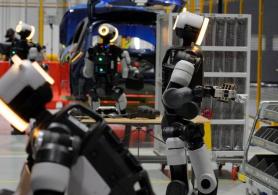
The pair locked together like a Transformer, reared up and trotted off on four legs.
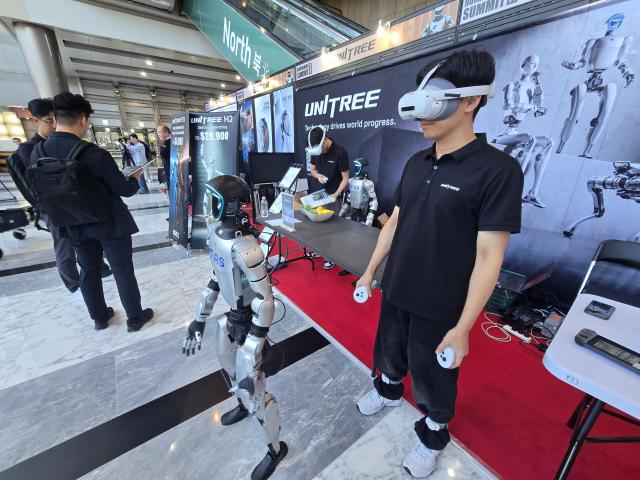
A Unitree R1 humanoid glided forward and held out its hand to an AJP reporter. The grip was stiff and dry, and far stronger than it looked.
The scenes played out at Humanoids Summit Seoul, where Korean companies presented robots as platforms whose promise rests on the software brains inside them. Across the exhibition floor, demonstrations offered glimpses of that promise — and the human help still needed to deliver it.
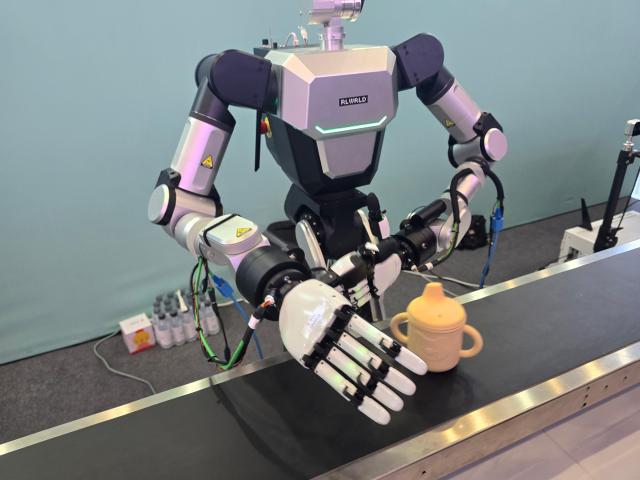
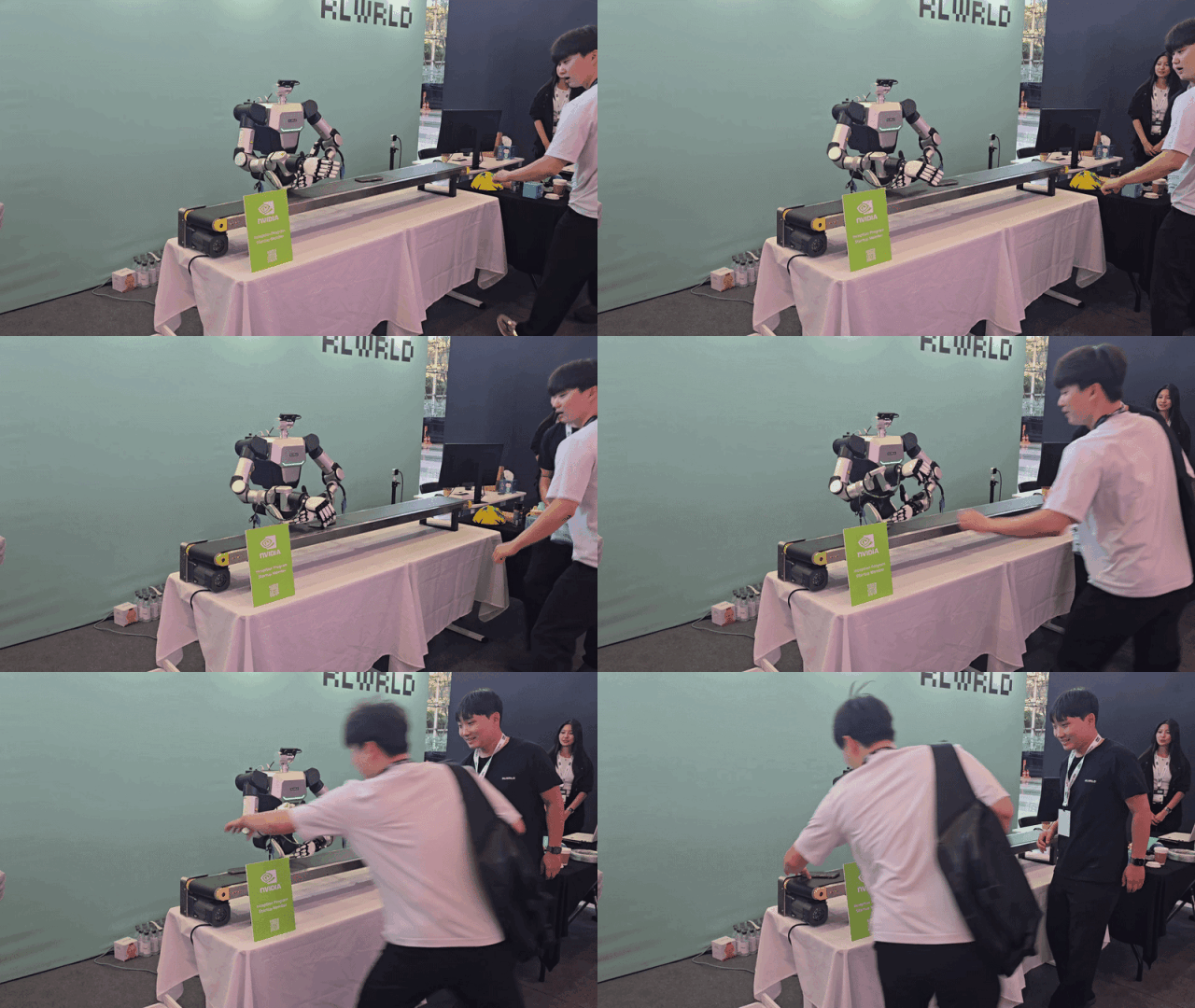
At the booth of Rlwrld, a Seoul-based robotics AI startup, a humanoid stood over a short conveyor belt running at top speed. Assorted objects rolled toward it, and the robot plucked each one cleanly off the belt.
It then handed each item to a person standing opposite. A half-deflated football, a small Bosch power tool and a wooden block calendar still sealed in slippery plastic wrap all made it across.
"We are a company that builds the robot's brain, so it can do work that demands delicate hand movements," said Kim Joon-soo, head of robotics deployment at Rlwrld. "We build robotics foundation models."
The company is training its AI through pilot projects with corporate partners including Lotte Hotel and CJ Logistics, Kim said. Preparing guest rooms and setting up banquets involve the varied, demanding tasks that make hotels useful grounds for collecting training data.
"The longer robots train at industrial sites, the more data they gather and the more tasks they can take on," he said. "We are doing that through government projects, but hardware is expensive and few companies get support."
"Our goal is to build a state-of-the-art open model and run a business on it," Kim said. "Hardly any company actually releases its model, and in Korea or Japan there are virtually none."
Rlwrld released its first model, RLDX-1, in May, along with a technical report, a GitHub repository and model checkpoints on Hugging Face.
Humanoids Summit launched in Silicon Valley in 2024 and has since held editions in London and Tokyo. Its Seoul debut runs Tuesday and Wednesday with backing from the Ministry of Science and ICT and Rlwrld as its exclusive technology partner.
For Robotis founder and chief executive Kim Byoung-soo, the machines' capabilities depend on what people teach them.
"You've probably seen the flashy moves of Chinese robots. We only provide the hardware, and university club students train them on open source themselves, and that makes those moves possible," Kim said in a talk at the summit.
"It all depends on how you train them."
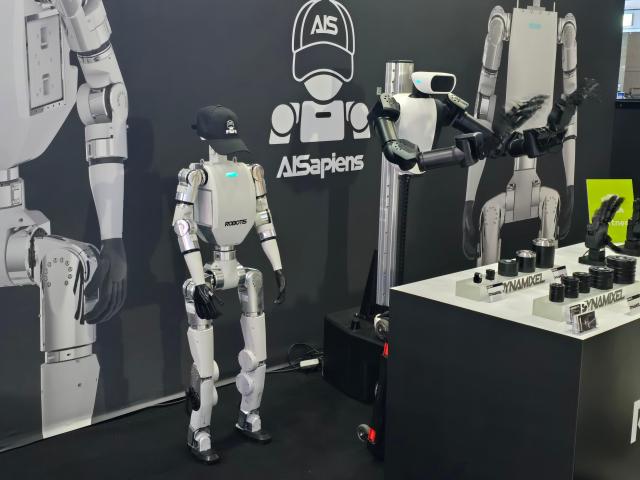
Robotis, founded by Kim in 1999 and listed on the tech-heavy KOSDAQ in 2018, built its name on Dynamixel, a modular actuator that combines a motor, reducer, sensor and controller in a single unit.
In April, it unveiled AI Sapiens, a humanoid powered by 23 in-house actuators, and opened its hardware and software designs to the public.
"I think humanoids will settle in as platforms with many apps on them, much like smartphones did," Kim said.
Dynamixel units have been used in physical AI research by Google DeepMind and MIT. A data factory Robotis is building in Uzbekistan will collect action data to train robots, Kim has said.
"It will be hard to use humanoids by building each detailed function one at a time. In factories, robots can do the job, and dedicated robots show better results," Kim said.
Amazon now operates more than 1 million robots across its operations network, most of them purpose-built machines. Humanoids are better suited to everyday life, Kim said.
On the exhibition floor, even an everyday object could prove a challenge.
The Rlwrld humanoid that had deftly handled the football and calendar later reached for a smartphone lying nearly flat on the belt and came up empty.
The phone skidded toward the edge, sending the startled demonstrator scrambling to catch it before it fell.
Behind the Unitree R1 that had offered the handshake stood an engineer with sensors strapped to both ankles, a remote controller in hand and a Pico VR headset over the eyes.
"Unitree has now started saying VR integration is officially supported, but fully autonomous humanoids practically don't exist yet," said Park Ji-hyeon, head of sales at Roas, Unitree's official distributor in South Korea.
"There is nothing beyond this kind of teleoperation or robots that follow preset commands. Unitree is no exception," Park said.
The firm grip, it turned out, had come from the person behind the robot.
AJP Takeaways
- Rlwrld, a Seoul-based startup that has raised about $41 million in seed funding, demonstrated a humanoid picking objects off a fast conveyor belt and said it aims to build an open robotics foundation model.
- Robotis, founded in 1999, makes Dynamixel actuators and has opened the hardware and software of its AI Sapiens humanoid, arguing open-source training lets university students produce complex robot motions.
- Demonstrations at the summit still relied on human operators or preset commands, and a Roas sales executive said fully autonomous humanoids practically do not exist yet.
Copyright ⓒ Aju Press All rights reserved.