His gift eventually draws him into a struggle over the Joseon throne. After studying the face of Prince Suyang, he sees the makings of a ruthless usurper.
His judgment proves accurate. But knowing what is coming does not mean he can stop it. Despite his efforts to protect the young King Danjong, Suyang seizes power anyway.
The belief that a face can reveal something deeper about its owner remains surprisingly visible in South Korea.
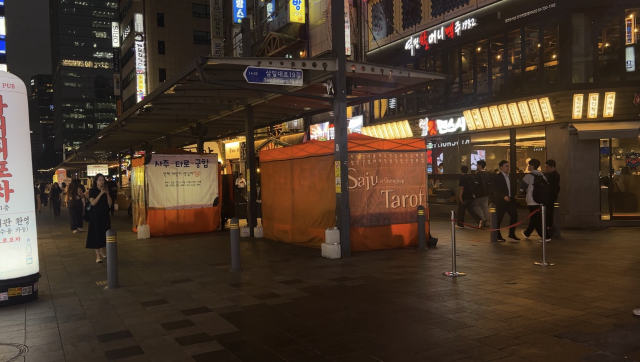
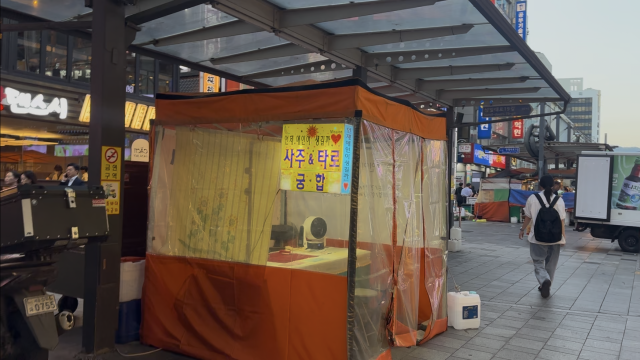
In Jongno, downtown Seoul, a row of small fortune-telling tents sat along the street, offering answers about love, money, careers and the future for prices low enough to tempt a curious passerby.
A face reading cost just 10,000 won ($7).
The practice is known as gwansang, or Korean face reading. Part of a broader East Asian tradition of physiognomy, it rests on the belief that character, fortune and even the course of a person's life can be interpreted through physical appearance.
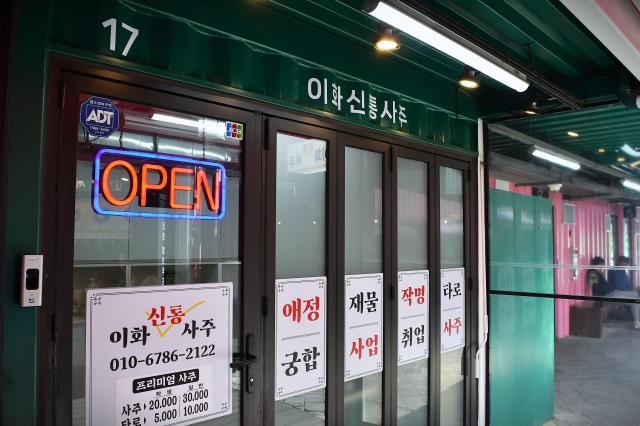
Gwansang has long occupied a familiar place in Korean culture alongside saju, which interprets fortune through a person's birth date and time. It survives in street tents, fortune-telling shops and everyday expressions about whether someone has a "good face," or one associated with wealth, leadership or luck.
It also survives in a society that is otherwise among the world's most technologically advanced — a coexistence of old belief and modern skepticism that helps explain its enduring appeal.
Physiognomy is not regarded as a scientifically validated way to determine personality or destiny, and modern psychology generally treats such systems as pseudoscientific. Yet people continue to seek readings, sometimes out of belief, sometimes curiosity and sometimes simply for entertainment.
To see what the practice looks like today — and how much people still put into it — three AJP reporters had their faces read at two very different places.
One was a neatly furnished face-reading shop near Ewha Womans University, where a session cost 30,000 won. The other was a 10,000-won tent in Jongno.
I tried both.
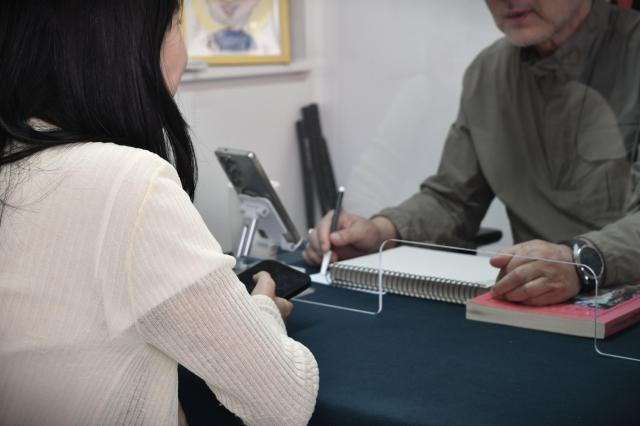
The Ewha reader, in his 70s and introducing himself as Johnny, said he had worked around the university district for 28 years, including about eight years at his current location.
Students from Ewha, Yonsei and Sogang universities had visited him, he said, along with professors seeking advice ahead of important events. Foreign customers, particularly Japanese visitors as well as people from the United States and Canada, also came, though language barriers sometimes made readings difficult.
Sitting across from him, I gave him little to work with.
He asked my age, then began moving methodically from one part of my face to another.
He described me as ambitious and highly driven, someone more inclined to lead than remain in a supporting role.
Experience and credentials would matter, he said, and my work would involve constant movement.
Connections with other people could also play an important role in my career and financial fortune.
Then came one recurring piece of advice: smile more.
According to the reader, smiling would "recharge" my energy, while my tendency to give too much of myself to others could leave me drained. He also described me as impatient, generous toward people I cared about and more likely to internalize criticism than immediately confront it.
Hours later, under a tent in Jongno, the surroundings were different. So was the reading.
For one-third of the price, the Jongno reader focused less on movement or overseas work and more on personality, relationships and money.
The reader said I had a strong sense of my own world and was not naturally someone who moved easily through social relationships, although I had recently been trying to become more open and socially engaged.
Pointing to my nose, eyebrow line and cheekbones, the reader described me as strongly self-directed and said I could do well in a leadership role, even if relationships with others did not always come easily.
I was also capable of earning money, the reader said, but might not be especially good at holding onto it.
There were noticeable differences.
The Ewha reader emphasized networking and the fortune that could come through other people. The Jongno reader placed greater weight on independence and difficulty fitting into groups.
But several themes overlapped. Both described a strong-willed personality. Both linked my future to movement and work beyond a narrow routine.
And both told me to smile more.
The readings of the other two reporters showed how quickly seemingly minor facial details could become broader narratives about personality and fate.
At the Ewha shop, the reader focused on the narrow space between one male reporter's eyebrows, saying it suggested sensitivity to small things and a tendency to be affected by other people's comments.
He told the reporter to stay active, accumulate experience and find a mentor who could keep him on course. He later described him as having a strong need for recognition and advised him not to reveal everything he was thinking.
At the Jongno tent, the third reporter received an even more detailed reading.
The reader described him as strong-minded and unlikely to change course easily once he had made up his mind. His small mouth, the reader said, suggested he might not always look after his own interests, while other features pointed to someone better suited to independent work or an international environment.
When the reporter mentioned that he had spent part of his childhood abroad, the reader said that fit what could be seen in his face.
The reader also compared some of his features with mine, using differences in our mouths, cheekbones and overall face shape to explain why the two of us supposedly possessed different temperaments.
But one piece of advice was becoming strikingly familiar.
Smile more.
Smiling, the reader said, would lift his cheekbones and soften the lower part of his face.
The readings made one thing clear: gwansang can produce a remarkably detailed story from an ordinary face.
Whether people believe that story is another matter.
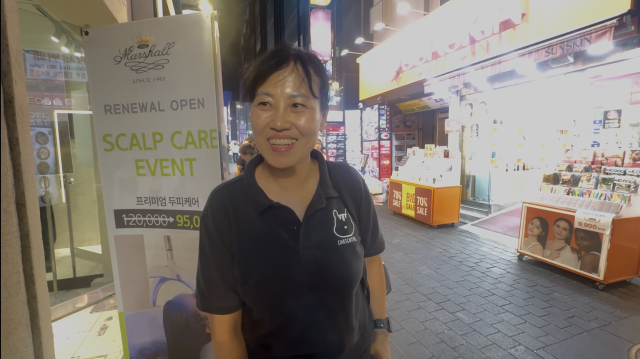
"Once you reach your 50s, you are responsible for the face you have," she said, arguing that expressions and appearance could reflect how a person had lived.
Negative thoughts could show on a person's face, she said, linking the idea to the Korean saying that smiling brings good fortune.
Interestingly, she placed more faith in gwansang than in saju.
Saju was something she might look at for fun, she said, while a person's face and expressions could actually change according to how they lived.
Two men in their 60s encountered on the street offered a very different response.
One said he had never had his face read and did not believe in it.
Why not? "I go to church," he said.
Among foreign visitors approached near the Jongno tents, the cultural distance was more obvious.
Stefano, 35, and Ashah, 25, from California had some familiarity with related practices such as tarot or palm reading, but neither was eager to step into a tent.
One said face readers could simply be studying a customer's expressions and body language, then adjusting their interpretation in response.
"It's a pseudoscience," she said, describing it less as an ability to read destiny than an ability to read people.
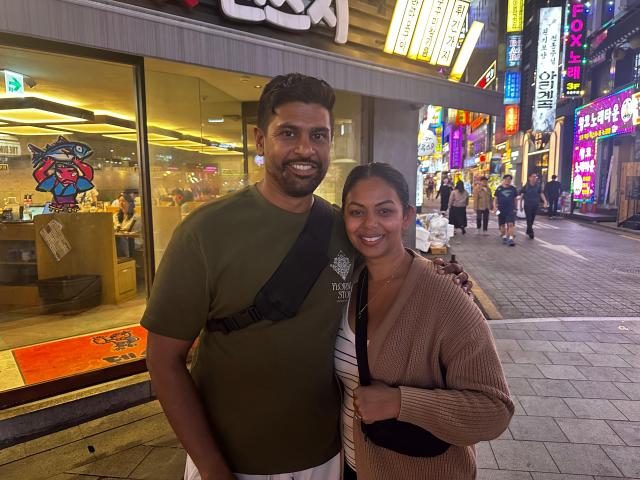
Terrence said he had never heard of it and would not seek out a reading even during a difficult period in his life.
"I don't like the idea that my destiny is determined by something else," he said, arguing that such thinking could weaken a person's sense of control. He compared fortune-telling with gambling and said he would do neither.
His wife took a somewhat different view. She said she believed destiny could exist, but that individuals still chose how to pursue their purpose.
Physical changes could sometimes reflect stress or health, she said, but that did not mean someone else could interpret a person's future from them.
Despite the low 10,000-won price, none of the foreigners AJP approached around the Jongno tents chose to walk in for a reading.
That contrasted with three young Chinese travelers interviewed in Myeongdong. They had only limited knowledge of face reading, but showed greater curiosity. One said she might want to ask about her romantic future and when she might meet a boyfriend.

Belief is no longer necessary for the practice to survive. Familiarity, curiosity and the simple desire to hear a story about oneself may be enough.
Back in Jongno, the tents remained open as pedestrians passed. Eventually, a woman pulled back the entrance flap and went inside. For a while, she was the only customer at the tent where I had sat earlier.
Two face readers, two prices and two very different surroundings had produced different versions of the same face.
But their simplest prescription was identical.
Smile more.

Copyright ⓒ Aju Press All rights reserved.