
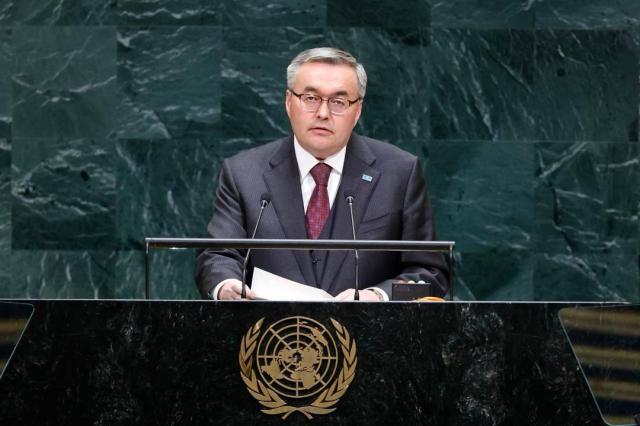
SEOUL, September 29 (AJP) - The country that gave up the world's fourth-largest nuclear arsenal after the Soviet collapse offered on Sept. 25 to host talks among the nuclear powers, months after the last treaty limiting U.S. and Russian nuclear forces expired.
That treaty, the New Strategic Arms Reduction Treaty, or New START, was signed in 2010 and expired on Feb. 5. It capped the long-range nuclear weapons that Washington and Moscow keep ready to strike each other at 1,550 warheads apiece, and it let inspectors from each side check the other's forces.
With the treaty gone, no agreement limits the two largest arsenals in the world. The United States and Russia held nearly 10,500 of the estimated 12,187 nuclear warheads that nine countries possessed at the start of 2026, according to the Stockholm International Peace Research Institute, a Swedish research group that tracks global arsenals.
"Kazakhstan advocates the relaunch of high-level dialogue among nuclear powers and is ready to host one of their next meetings," Foreign Minister Mukhtar Tileuberdi told the United Nations General Assembly in New York, where world leaders gather each September for their annual debate.
His speech also pointed to this year's failed review of the Treaty on the Non-Proliferation of Nuclear Weapons, the pact under which most of the world has agreed not to build nuclear weapons. It allows only the United States, Russia, China, the United Kingdom and France to keep them, in exchange for their promise to work toward disarmament.
Member countries meet every five years to review how the treaty is working. This year's monthlong meeting in New York ended on May 22 without a final statement, which requires every member's approval, and it was the third review in a row to end that way, according to the United Nations.
"Nuclear weapon states must never confuse the absence of agreement with a vacuum of obligation," Tileuberdi said. "They remain responsible until we secure a world free of nuclear weapons."
He did not say which governments would take part, when a meeting could be held or whether any nuclear power had responded.
Kazakhstan's offer draws on its own history. The Soviet Union carried out 456 nuclear tests at the Semipalatinsk test site in the country's northeast between 1949 and 1989, and the site was shut on Aug. 29, 1991.
When the Soviet Union broke apart months later, Kazakhstan was left holding about 1,400 nuclear warheads. It sent them all to Russia by 1995 and joined the Treaty on the Non-Proliferation of Nuclear Weapons (NPT) as a country without nuclear weapons.
Giving up that arsenal "did not weaken our State," Tileuberdi told the assembly, calling disarmament "a responsibility born of national experience" for his country. He noted that this year marks 35 years since Semipalatinsk closed, 30 years since the Comprehensive Nuclear-Test-Ban Treaty, which bans all nuclear test explosions, opened for signature, and 20 years since the region's five countries signed a treaty keeping Central Asia free of nuclear weapons.
Astana has hosted sensitive diplomacy before, including rounds of Syria talks among Russia, Iran and Türkiye starting in 2017. In the eastern city of Oskemen, the International Atomic Energy Agency also keeps a reserve of low-enriched uranium, the kind used to fuel nuclear power plants, which countries can draw on if their regular supply is cut off.
Tileuberdi, who returned as foreign minister on Sept. 2 after three years as ambassador to Austria, also said global military spending hit a record $2.9 trillion in 2025.
He said Kazakhstan would keep pushing its earlier proposal for an International Agency for Biological Security, a body meant to strengthen the Biological Weapons Convention, the treaty that bans germ weapons.
Copyright ⓒ Aju Press All rights reserved.
