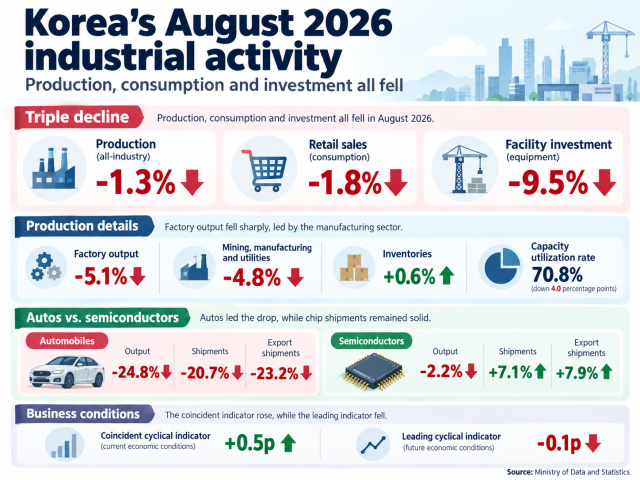
SEOUL, September 30 (AJP) — South Korea’s factory output sank 5.1 percent in August - the steepest monthly decline in 10 months - amid rising inventories, easing external demand and a deepening slump in domestic demand, government data showed Wednesday.
The broader mining, manufacturing and utilities output index fell 4.8 percent from the previous month, also the biggest pullback since October 2025, according to the Ministry of Data and Statistics.
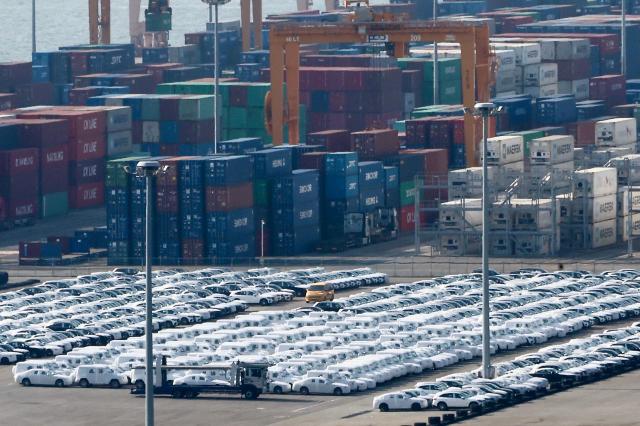
Automaking was the main drag, with output plunging 24.8 percent from July, while semiconductor production fell 2.2 percent.
Lee Doo-won, deputy commissioner for short-term economic statistics at the ministry, said at a briefing Wednesday at Government Complex Sejong that automobile production was hit by fewer operating days as summer holidays, which had previously tended to be spread across July and August, were concentrated in August this year.
"Partial strikes at some automakers that began in July also weighed on production," Lee said.
The decline in vehicle production also spilled over into related industries, reducing demand for products including tires and plastics. Rubber and plastics output fell 11.0 percent from July.
The Ministry of Trade, Industry and Resources had separately said in its monthly automobile industry report released on Sept. 17 that fewer operating days during the summer holiday period and production disruptions from strikes contributed to the decline in automobile production.
Chip shipments remained solid, rising 7.1 percent, with export shipments up 7.9 percent. Automobile shipments fell 20.7 percent, including a 23.2 percent drop in shipments for export.
Across manufacturing, domestic shipments declined 3.9 percent and export shipments fell 3.2 percent. Inventories rose 0.6 percent overall, although stocks of semiconductors and automobiles declined.
The manufacturing inventory-to-shipment ratio rose to 100.9 percent from 96.7 percent in July, while the sector's average capacity utilization rate fell 4.0 percentage points to 70.8 percent.
The all-industry production index fell 1.3 percent from the previous month after slipping 0.1 percent in July. Services output rose 0.5 percent and construction increased 1.9 percent.
Sales of durable goods, including passenger cars and home appliances, fell 4.5 percent, while nondurable goods such as food and beverages declined 1.6 percent.
Passenger-car sales fell 13.6 percent from July, following an 11.1 percent decline in the previous month. The August drop was the steepest since January 2024.
Lee said at the same Wednesday briefing that weaker automobile production affected vehicle sales, while softer demand for home appliances partly reflected purchases being brought forward by promotional programs involving Onnuri gift certificates in June and early July.
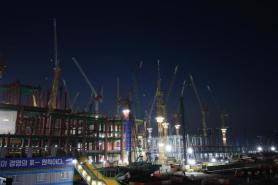
Facility investment dropped 9.5 percent from the previous month, reversing an 8.0 percent increase in July.
Investment in transport equipment sank 32.8 percent, while machinery investment rose 1.6 percent.
The sharp decline in transport equipment followed an 18.2 percent increase in July and reflected lower investment in ships and aircraft.
Despite the monthly retreat, facility investment remained 16.1 percent above its year-earlier level, with machinery investment — owing to brisk chip facility upscaling — up 25.4 percent.
Forward-looking construction orders fell 10.6 percent from a year earlier despite the monthly rebound in completed construction work. Orders for buildings, including factories and warehouses, dropped 14.1 percent.
Broader business-cycle indicators were mixed. The cyclical component of the coincident index, which tracks current economic conditions, rose 0.5 point, while the corresponding leading index, a gauge of the outlook, slipped 0.1 point.
Lee said at Wednesday's briefing that weakness in the automobile sector affected both production and consumption in August and that more data would be needed to gauge the underlying direction of the economy.
AJP Takeaways
- South Korea's factory output fell 5.1 percent in August, led by a 24.8 percent plunge in automobile production.
- Semiconductor output slipped 2.2 percent, but semiconductor shipments rose 7.1 percent and export shipments increased 7.9 percent.
- Retail sales declined for a second month, while equipment investment fell 9.5 percent after rising in July.

Copyright ⓒ Aju Press All rights reserved.