
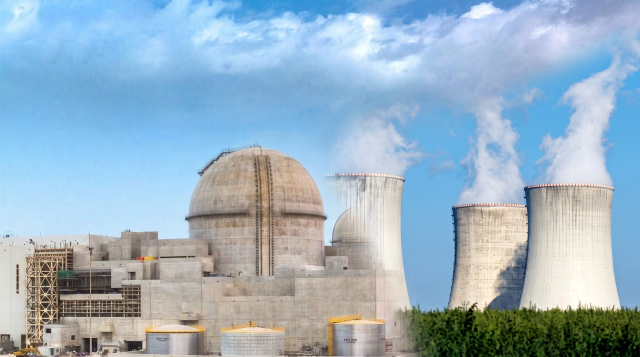
The pupil has learned well enough to become its American teacher's partner. A South Korea-U.S. investment framework unveiled Thursday would bring Korean-designed reactors to America, nearly half a century after American technology helped launch Korea's nuclear industry.
The framework forms part of Seoul's $350 billion investment commitment under last year's trade agreement, which lowered U.S. tariffs on most Korean goods to 15 percent from 25 percent.
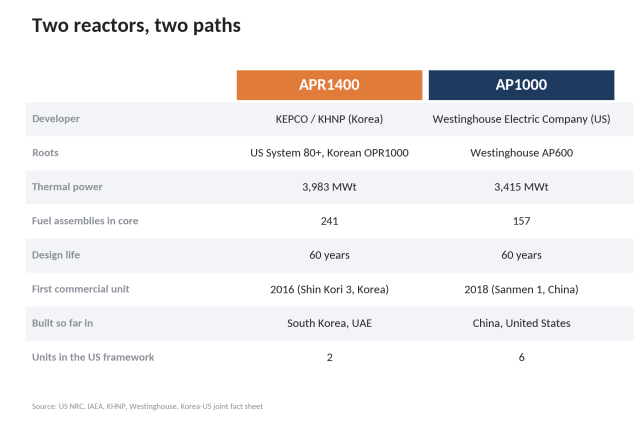
It envisages up to $120 billion in investment to build eight reactors, including two units based on Korea's homegrown APR1400 design. Each has a generating capacity of about 1,400 megawatts, more than twice Kori 1's 576 megawatts. The other six would use Westinghouse's AP1000 design.
The Ministry of Trade, Industry and Resources described the agreement as Korean companies becoming Westinghouse's partners nearly 50 years after Kori 1. It said the cooperation could help pave the way for further Korean reactor exports to Europe and elsewhere.
The joint statement frames the partnership as combining "U.S. technological expertise with Korea's supply chain capabilities."
Korean engineers developed the APR1400 from the domestic OPR1000 and System 80+, a design by Combustion Engineering, a U.S. company later absorbed by Westinghouse.
Four APR1400 units were built at Barakah in the United Arab Emirates under a 2009 contract worth $20.4 billion. All four have been in commercial operation since September 2024.
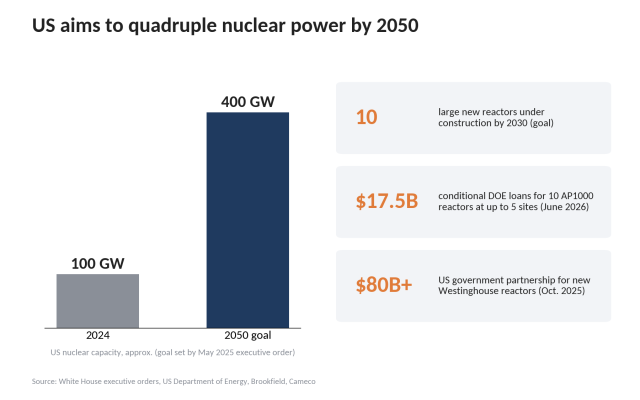
The two reactor designs take different approaches to emergency cooling.
The APR1400 uses powered safety systems, including four independent cooling circuits that inject water directly into the reactor vessel.
The AP1000's passive safety systems rely on gravity and natural circulation. They are designed to function for at least 72 hours under design-basis accident conditions without operator action, according to the U.S. Nuclear Regulatory Commission, or NRC.
"If you go by generations, Westinghouse's AP1000 was developed a generation after ours. There is a technology gap of about 10 years," said Chung Bum-jin, a professor of nuclear engineering at Kyung Hee University.
"The problem is that not many AP1000s have been built, and with no parts or construction market in the U.S., its recent report card isn't good," Chung said.
Georgia's Vogtle units 3 and 4, the only AP1000s completed in the United States, cost more than $30 billion against an initial estimate of about $14 billion.
Chung pointed to the APR1400's NRC design certification in 2019 as a credential for entering the American market. Its European version has also secured European Utility Requirements certification.
"If construction is delayed by eight years, costs go up at least twofold, and as much as threefold," Chung said.
"It's the difference between taking a Grandeur you can drive right now or a BMW that might get more expensive," he added, referring to Hyundai Motor's large sedan.
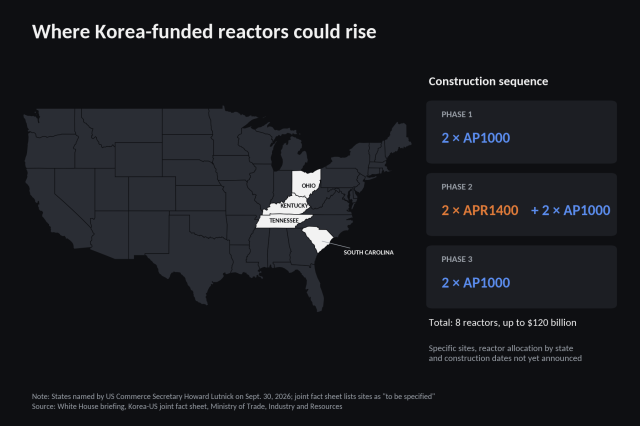
Under the planned sequence, two AP1000s would be built first. The Korean pair would follow in the second phase alongside two more AP1000s, with the final AP1000 pair coming last. Investment from the fund would be capped at $30 billion per pair, with any overruns excluded, the ministry said.
The framework also calls for Korean companies to pursue "a significant minority interest" in Westinghouse to share in the commercial gains from the projects.
Industry Minister Kim Jung-kwan put the prospective stake at 5 to 10 percent, below the 15 to 20 percent and a board seat Seoul had sought.
"The stake is being set below 10 percent because Westinghouse finds Korea's entry into its board burdensome," Kim said.
For Chung, the size of the investment would not necessarily translate into influence over the company.
Japan's Toshiba bought Westinghouse outright for $5.4 billion in 2006. Yet ownership exposed it to the risks of American nuclear construction.
Westinghouse filed for bankruptcy protection in March 2017 after cost overruns at the Vogtle and V.C. Summer projects. The losses helped force Toshiba to sell its memory chip business for about $18 billion. Brookfield acquired Westinghouse in 2018 for about $4.6 billion.
"Investing won't give us a level where we can secure management control, and Toshiba could not be said to have properly secured it either," Chung said.
The reactor sites and individual investment decisions also remain unsettled.
U.S. Commerce Secretary Howard Lutnick said Wednesday that the plants would be built in states including Ohio, Tennessee, South Carolina and Kentucky. The joint fact sheet, however, lists the location only as the United States, with "specific sites to be specified."
Kim said Seoul would scrutinize each U.S. proposal in the fourth quarter, examining ground conditions, access to cooling water, prospective electricity buyers and grid connections.
Kori 1, the Westinghouse unit where Korea's nuclear story began, was permanently shut down in June 2017 and is now being decommissioned. Nearly half a century after its debut, Korea's own reactor design could make the journey back to America.
AJP Takeaways
- The framework envisages up to $120 billion from Korea's $200 billion strategic investment pledge to build eight U.S. reactors, including two Korean APR1400s and six Westinghouse AP1000s. Individual projects remain subject to review.
- Experts see the AP1000 as technologically more advanced but points to U.S. construction costs and delays as a weakness. The APR1400 brings a record of deployment in Korea and the UAE.
- Two AP1000s would lead construction, followed by the Korean pair and two more AP1000s. Investment from the fund would be capped at $30 billion per pair.
- Seoul is pursuing a 5 to 10 percent Westinghouse stake. Chung cautions that the investment would not deliver management control.
Copyright ⓒ Aju Press All rights reserved.
