
SEOUL, October 06 (AJP) -South Korea has wired an initial $2.4 billion under its $200 billion investment commitment to the United States to help fund a $22.3 billion natural-gas power complex in Encinal, Texas, designed largely to supply electricity to an adjacent artificial intelligence data-center campus.
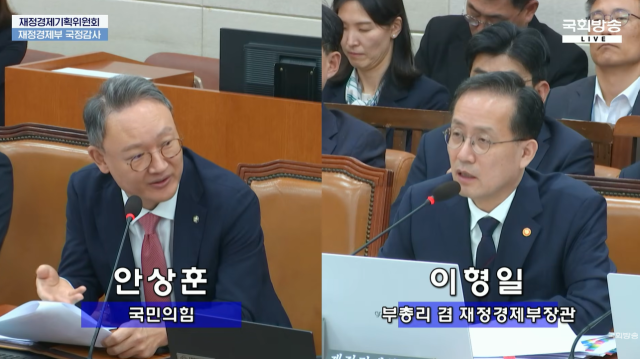
Deputy Prime Minister and Finance Minister Lee Hyoung Il told lawmakers Tuesday that the money was transferred on Oct. 1, the same day South Korea and the U.S. announced their first projects under the strategic-investment pact.
The payment is earmarked for Project Star, a $22.3 billion natural-gas power complex in Encinal, Texas, designed largely to supply electricity to an adjacent artificial-intelligence data-center campus.
Lee’s confirmation provided the clearest indication yet that South Korea’s investment pledge to President Donald Trump has moved beyond negotiations and project announcements and into implementation.
It came the same day the Bank of Korea reported that the country’s foreign-exchange reserves fell by $1.72 billion in September to 440.56 billion dollars, their first monthly decline in four months.
The central bank said the drop reflected several factors, including a decline in foreign-currency deposits held by financial institutions, valuation effects from a stronger dollar and the transfer of assets to the Korea-U.S. Strategic Investment Corp., the government entity created this year to finance and manage the investments.
The September reserve figures don’t include the $2.4 billion payment itself, which was made on Oct. 1. But they illustrate how preparations for the investment program are beginning to affect the management of Korea’s stockpile of foreign assets.
The government has said it intends to use earnings generated from the country’s foreign reserves, rather than draw down the reserve principal itself, to help fund U.S. projects. Proceeds from foreign-currency-denominated Foreign Exchange Stabilization Fund bonds can also be used.
If those sources prove insufficient, Seoul plans to raise additional dollars through government-guaranteed foreign-currency debt rather than tap the reserve principal.
That distinction matters in South Korea, where foreign reserves are closely watched as a buffer against currency and financial-market shocks. The Bank of Korea said the transfer of assets to the investment corporation reduced reported reserves because money committed to longer-term investment no longer meets the liquidity requirements for classification as official reserve assets.
The government has committed to invest as much as $200 billion in U.S. strategic industries under a memorandum signed with Washington last year. A separate $150 billion shipbuilding investment program brings the broader package associated with the bilateral trade deal to $350 billion.
Under legislation enacted this year to implement the agreement, annual strategic investment is capped at $20 billion.
The law also requires projects to meet a standard of “commercial reasonableness” before Korea commits money. That phrase has a specific financial meaning under Korean regulations: expected income distributed to South Korea over the life of a project must be sufficient to cover the principal and interest tied to Korea’s investment.
Lee told lawmakers Tuesday that the Texas project had cleared that test.
“We believe the requirements have been met,” he said after an opposition lawmaker questioned whether the government had sufficiently established the project’s commercial viability before sending the money.
Lee said the project had gone through the required committee reviews and had been reported to the National Assembly before its inclusion in the bilateral announcement.
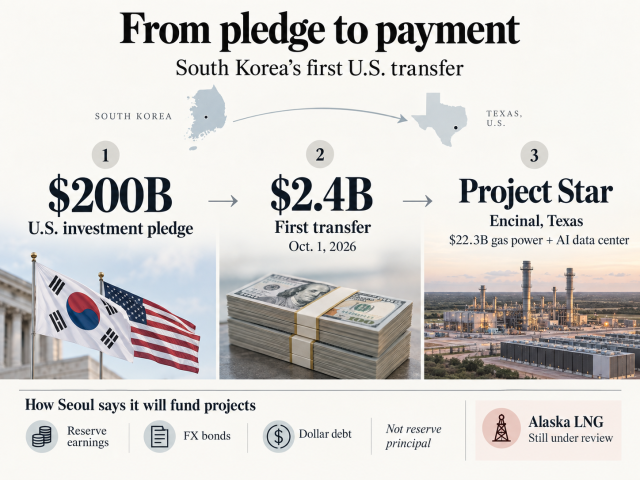
Project Star calls for 6.472 gigawatts of combined-cycle natural-gas generation in Encinal, in South Texas. The plants would directly supply an adjacent data-center complex being developed by Related Digital with as much as five gigawatts of computing capacity.
Related Companies and NextEra Energy Resources are leading development of the generation facilities, while Lewis Energy Group is expected to provide the site, natural gas, water and related infrastructure.
The developers say the power project would also be able to send electricity that isn’t consumed by the data centers into the Texas grid.
Initial generating capacity is expected to enter commercial operation as early as 2029, subject to permitting and regulatory approvals, with the full complex targeted for operation by 2032.
The developers estimate the project could employ about 8,400 workers at the peak of construction and support roughly 170 permanent jobs once operating.
For South Korea, the prospective payoff extends beyond financial returns.
Seoul said the agreement is intended to create opportunities for Korean companies to provide power-generation equipment, engineering and construction work and long-term operations and maintenance services. U.S. officials have also indicated a willingness to open opportunities for Korean-made equipment, including turbines, in other American power projects.
The project is being propelled by one of the biggest changes in the U.S. electricity market in decades: the rapid rise in power consumption expected from AI data centers.
The Korean government said its commercial assessment took into account the participation of established U.S. developers, rising data-center electricity demand in Texas and expected power prices.
The conclusion contrasts sharply with Seoul’s position on another project Trump has championed: Alaska LNG.
Trump said last week that South Korean investment would help finance roughly 54 billion dollars of development in Alaska as part of the $200 billion package.
South Korean officials have been considerably more cautious.
Lee said Tuesday that Project North, as the Alaska initiative is known in the bilateral framework, is only at the beginning of a review.
“We need to examine its commercial viability,” he said, adding that Seoul would continue looking at ways to improve the project’s economics.
South Korea’s industry ministry has likewise said no investment decision has been made and that the project would move forward only if it satisfies the commercial-reasonableness requirements of the investment agreement and Korean law.
The Alaska LNG proposal would transport natural gas from Alaska’s North Slope through an approximately 800-mile, or 1,300-kilometer, pipeline to an LNG terminal in Nikiski on the Kenai Peninsula.
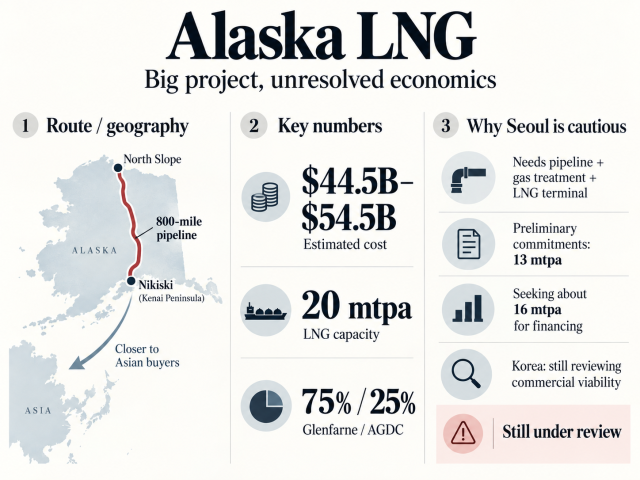
The project is estimated to cost between $44.5 billion and $54.5 billion and would be capable of producing about 20 million metric tons of LNG annually.
Glenfarne Group, which took over as lead developer this year, owns 75 percent of the venture, with the state-owned Alaska Gasline Development Corp. holding the remaining 25 percent.
Its size is one reason the economics have drawn scrutiny.
At the upper end of current estimates, the upfront cost for each million tons of annual LNG capacity would be more than double the average for a number of recently developed U.S. Gulf Coast export projects.
Unlike Gulf Coast LNG terminals that can draw on existing pipeline networks, Alaska LNG would require construction of the long pipeline as well as a gas-treatment facility and the liquefaction terminal.
The developer argues that the comparison understates Alaska’s advantage once transportation is considered.
Glenfarne says shipping LNG from Alaska to Asia could cost at least 65 percent less than moving cargoes from the Gulf Coast, because Alaska is substantially closer to major buyers in Japan, South Korea and other Asian markets.
The company has secured preliminary commitments covering about 13 million metric tons a year and is seeking commitments for roughly 16 million tons to underpin project financing.
Most remain preliminary rather than final long-term purchase contracts.
Vice President JD Vance acknowledged Monday that unresolved issues remain.
“You still got to work out some of the details,” Vance said while discussing South Korea’s role in the project, though he predicted the pipeline would ultimately be built.
Copyright ⓒ Aju Press All rights reserved.
