
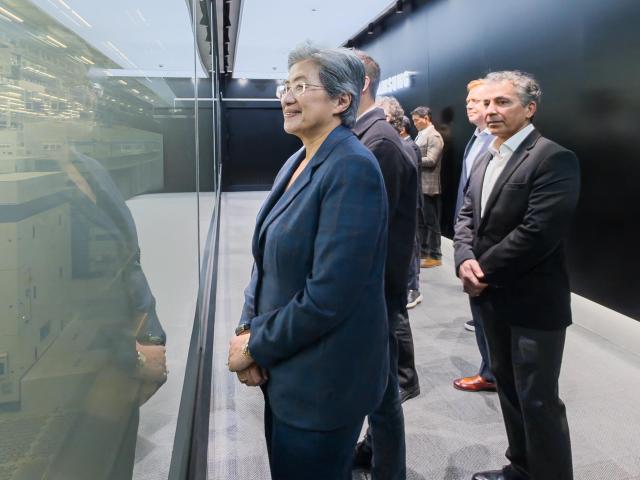
SEOUL, October 06 (AJP) - For decades, the semiconductor industry’s pecking order was relatively straightforward: chip designers and system companies called the shots, while memory makers competed to supply them.
The artificial intelligence boom is starting to turn that relationship on its head.
AMD Chair and CEO Lisa Su is due in South Korea this week, seven months after her previous visit in March, as the U.S. chipmaker seeks the advanced memory and manufacturing partnerships needed to challenge Nvidia in AI computing.
Su will attend AMD Gamer Day 2026 in Seoul on Wednesday alongside Jack Huynh, senior vice president and general manager of AMD’s Computing and Graphics Group. A media Q&A is scheduled for the same day, while meetings with Korean AI chip companies and government officials are expected during the trip.
Behind the gaming event lies a much bigger semiconductor story.
As AI accelerators become more powerful, access to high-bandwidth memory, or HBM, increasingly determines how quickly chip designers can turn their ambitions into products.
Samsung Electronics and SK hynix together accounted for more than 80 percent of global HBM revenue in the second quarter, according to Counterpoint Research figures. That concentration gives the Korean suppliers considerable leverage over the companies competing to build the next generation of AI systems.
“The relationship between the buyer and supplier has changed significantly,” said Kim Deok-kee, a professor of electronic engineering at Sejong University.
“In the past, memory companies were largely in the weaker position,” Kim said. “Now memory has become so critical that you could almost say the memory companies have become the ones holding the upper hand.”
For AMD, the stakes are particularly high.
Its Instinct graphics processors are central to its effort to narrow Nvidia’s commanding lead in AI accelerators. But that requires more than designing faster chips. The processors need increasingly large amounts of advanced memory to deliver data to their computing cores at high speed.
Securing HBM has consequently become a strategic priority.
“The first priority is securing memory,” Kim said. “More than future technology itself, securing allocations of the highest-performance and most expensive HBM is likely the immediate priority.”
There is an irony to AMD’s position: it helped pioneer the technology it now needs to secure.
SK hynix announced the development of its first HBM product using through-silicon vias — vertical connections between stacked memory chips — in December 2013, following joint development with AMD. AMD brought first-generation HBM to its Fiji-based graphics products in 2015, well before the generative AI boom made the technology indispensable to advanced accelerators.
What began as an architectural innovation has become a scarce component sought by the world’s leading AI chipmakers.
Samsung is emerging as an especially important partner in AMD’s response.
During Su’s March visit, she traveled to Samsung’s semiconductor complex in Pyeongtaek and signed a memorandum of understanding with Vice Chairman and CEO Jun Young-hyun to expand cooperation in AI memory and computing.
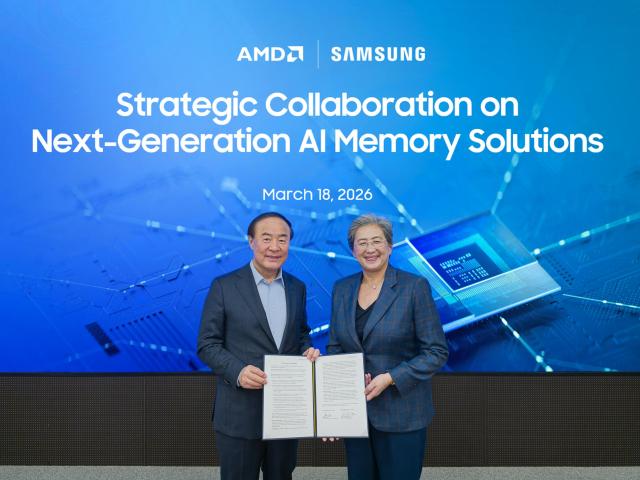
The agreement covers primary HBM4 supply for AMD’s next-generation Instinct MI455X accelerator, alongside advanced DDR5 memory for sixth-generation EPYC server processors and systems built around AMD’s Helios rack-scale platform.
It builds on Samsung’s existing role as AMD’s primary HBM3E partner for the MI350X and MI355X accelerators.
The relationship could extend beyond memory.
Samsung and AMD also agreed to discuss a potential foundry partnership under which Samsung would manufacture future AMD products. Such an arrangement could broaden their cooperation across memory, chip production and advanced packaging, although a manufacturing agreement has not been announced.
For Su, those discussions draw on relationships that predate her AMD career.
She spent more than a decade at IBM, holding senior positions in semiconductor technology development and manufacturing.
“Su had experience working with Samsung Foundry around 2005 while she was at IBM, so she likely still knows people within Samsung’s foundry business,” said an industry source who worked with her at the time.
Su became vice president of IBM’s Semiconductor Research and Development Center in 2005. By 2006, she was heading a joint development alliance involving IBM, Samsung, Chartered Semiconductor and Infineon that worked on advanced manufacturing processes.
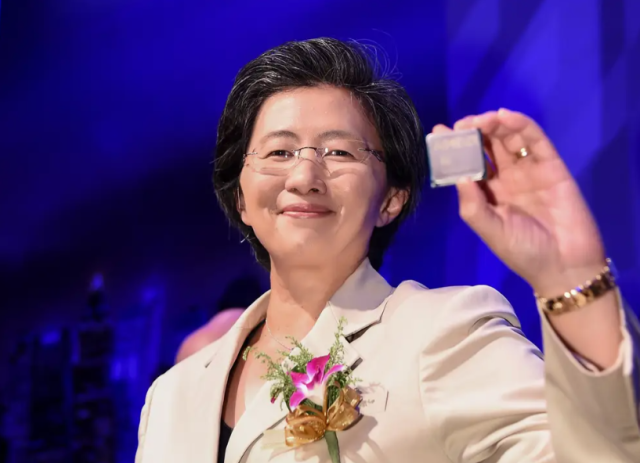
“Su understands not only software and system architecture but semiconductor devices and manufacturing as well,” the source said. “She understands how foundries operate.”
That background could become increasingly relevant as AMD explores cooperation extending from memory supply to manufacturing and packaging.
Su’s return does not establish that another supply deal is imminent. It does, however, come as AMD’s competitive ambitions depend increasingly on technologies concentrated in South Korea.
The country’s role in that strategy has evolved. AMD’s work with SK hynix helped establish HBM’s first generation; its expanding Samsung partnership now reaches into HBM4 and potentially contract chipmaking.
For Korean memory makers, the change is significant. Their products are becoming a constraint around which even the most powerful chip designers must plan.
Nvidia and AMD still wield enormous influence over the AI industry. But without sufficient advanced memory, neither can deliver its fastest processors at the scale customers demand.
That gives Korean suppliers greater bargaining power — and Su a compelling reason to keep returning.
“Securing memory comes first,” Kim said. “After that, there is the question of jointly developing the next technologies — memory, foundry and the overall architecture.”
For AMD, both increasingly lead to South Korea.

Copyright ⓒ Aju Press All rights reserved.
