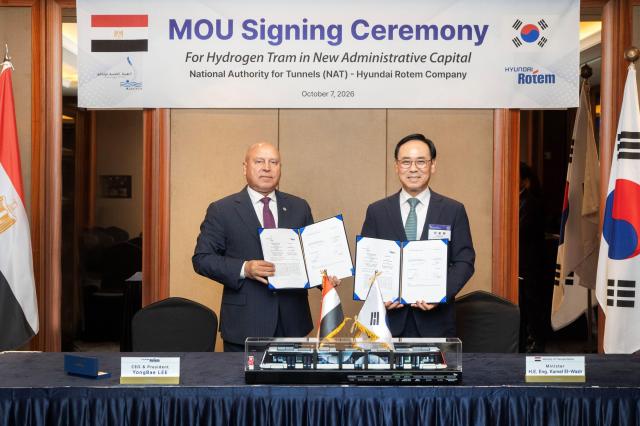
The agreement was signed Wednesday during a Korea-Egypt business roundtable in Seoul attended by Egyptian Transport Minister Kamel al-Wazir, South Korean Industry Minister Kim Jung-kwan, South Korean Ambassador to Egypt Kim Wan-jung and Hyundai Rotem CEO Lee Yong-bae.
Under the MOU, Hyundai Rotem and NAT will continue discussions on introducing hydrogen-electric trams to Egypt’s new capital.
The project is currently undergoing a preliminary feasibility study.
If it moves forward, Hyundai Rotem plans to provide an integrated package covering rolling stock, operations, railway systems and maintenance.
Egypt’s New Administrative Capital is being built about 35 kilometers east of Cairo and is designed to accommodate more than 6 million residents once completed.
Authorities are considering a hydrogen tram line stretching about 28 kilometers and the introduction of 44 trainsets, according to Hyundai Rotem.
The agreement could mark Hyundai Rotem’s first overseas deployment of its hydrogen-electric tram if the project is finalized. The company said it also expects the project to create opportunities for Korean suppliers involved in vehicle production as well as companies providing hydrogen production and refueling infrastructure.
Hydrogen-electric trams generate electricity through onboard hydrogen fuel cells and do not require overhead power lines. Hyundai Rotem said the vehicles emit only water during operation and can also filter fine dust from incoming air.
The company said it plans to combine its hydrogen tram technology with hydrogen-related solutions from HTWO, Hyundai Motor Group’s hydrogen business brand and platform, as it seeks more opportunities in overseas markets.
“Egypt’s New Administrative Capital is a representative future-city project where new rail mobility such as hydrogen-electric trams can be introduced,” a Hyundai Rotem official said.
“We will work closely with NAT to develop a hydrogen tram business model optimized for local operations and continue cooperation until the project is finalized.”

Copyright ⓒ Aju Press All rights reserved.