
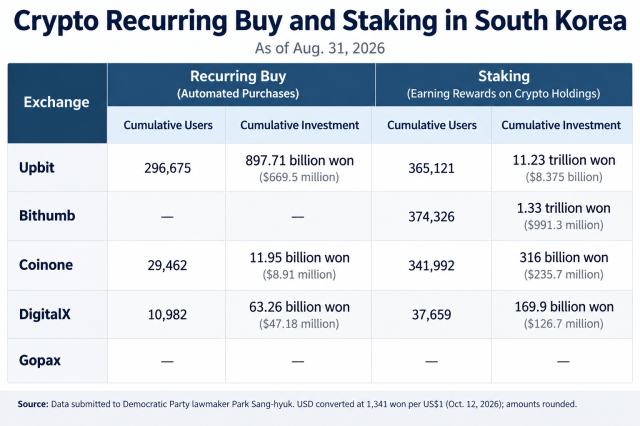
Cumulative investments through automatic crypto purchase programs at three domestic exchanges reached 972.92 billion won ($725.6 million) at the end of August, up 78.9 percent from 543.85 billion won at the end of last year, according to data submitted to Democratic Party lawmaker Park Sang-hyuk.
The figures cover Upbit, Coinone and DigitalX, the three of the country’s five major exchanges that offer recurring-purchase services. Bithumb and Gopax do not offer such programs.
The programs allow users to choose a cryptocurrency and set an amount and schedule for automatic purchases.
Upbit, the country’s largest cryptocurrency exchange, accounted for 92.3 percent of cumulative recurring investments at 897.71 billion won, up 81.3 percent from the end of 2025.
DigitalX recorded 63.26 billion won, an increase of 31.3 percent over the same period. Coinone posted the fastest growth, with investments rising nearly twentyfold to 11.95 billion won from 610 million won.
Participation also climbed. The three platforms reported a combined cumulative user count of 337,119 at the end of August, up 37.4 percent from the end of last year.
Upbit’s user count rose 32.2 percent to 296,675, while DigitalX’s increased 11.4 percent to 10,982. Coinone’s more than doubled to 29,462 from 11,067.
The increase may reflect continued demand from small investors spreading purchases over time to average out buying costs during a weak market.
Recurring purchases grew even as major cryptocurrencies declined. Bitcoin was down 5.3 percent from the start of the year as of 9 a.m. Sunday, while Ethereum, the second-largest cryptocurrency by market capitalization, had fallen 15.7 percent, according to crypto market data provider CoinMarketCap.
Staking services, which allow investors to earn rewards by committing crypto holdings to help operate blockchain networks, showed mixed trends across exchanges.
At Upbit, cumulative staking users increased 20.4 percent from the end of last year to 365,121, while the reported cumulative staking amount fell 4.3 percent to 11.23 trillion won.
At Bithumb, both measures rose, with users increasing 2.1 percent to 374,326 and the cumulative staking amount climbing 24 percent to 1.33 trillion won.
Coinone also recorded gains in both measures. Users increased 11.4 percent to 341,992, while the cumulative staking amount rose 10.9 percent to 316 billion won.
DigitalX saw participation rise 11.3 percent to 37,659, but customer balances in its staking service fell 14.1 percent to 169.9 billion won.
The amounts are not directly comparable across all four exchanges. Upbit, Bithumb and Coinone reported cumulative amounts for fixed-term staking products. DigitalX, which offers only flexible staking, reported customer balances.
User demographics also varied across platforms.
Among Upbit’s recurring-purchase users, people in their 30s made up the largest share at 30.4 percent, followed by those in their 40s at 27.1 percent and those in their 50s at 20.9 percent. Its staking users showed a similar pattern, with people in their 30s accounting for 32 percent and those in their 40s for 30.1 percent.
DigitalX had a higher share of older users. Investors in their 50s accounted for 30.7 percent of recurring-purchase users, slightly ahead of those in their 40s at 30.1 percent. Among staking users, those in their 40s led at 33.8 percent, followed by those in their 50s at 28.4 percent.

Copyright ⓒ Aju Press All rights reserved.