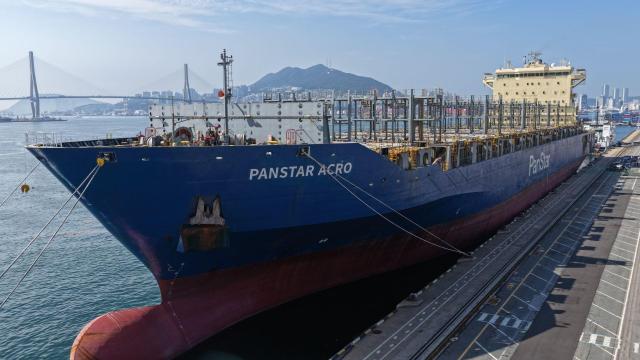
The PanStar Acro returned home after a 50-day voyage between Asia and Europe via the Northern Sea Route without a major incident. But its failure to secure import cargo underscored the difficulty of turning a successful trial into a viable regular service.
The vessel carried only 1,743 twenty-foot equivalent units, or TEUs, of empty containers on its return leg, according to Ministry of Oceans and Fisheries data obtained through the office of People Power Party lawmaker Kang Seung-gyu on Oct. 11. The containers were booked for transport by six domestic companies.
It had departed Busan New Port on Aug. 22 with 737 TEUs of export cargo, including chemicals, used vehicles and auto parts, alongside 202 TEUs of empty containers — a total of 939 TEUs.
The ministry had initially said the return shipment would include about 1,300 TEUs of empty containers as well as import cargo. The ship ultimately secured no import cargo and returned with a larger load of empty containers.
The shortfall has also raised questions over the cargo transport incentive available to the participating shipping company.
The Korea Shipowners’ Association set aside a basic voyage subsidy of 3 billion won and a separate cargo incentive of up to 1 billion won to ease the operator’s financial burden.
Under the incentive structure, combined round-trip container cargo volumes of at least 1,000 TEUs but below 2,000 TEUs qualify for 500 million won. Volumes of 2,000 TEUs or more qualify for 1 billion won.
The ship carried 737 TEUs of loaded export cargo and no loaded import cargo. Whether the empty containers count toward the incentive thresholds will therefore be critical to determining the payout.
The voyage nevertheless marked an operational milestone for South Korea’s Arctic shipping ambitions.
The 2,758-TEU PanStar Acro entered Arctic waters on Aug. 31 and sailed through the Chukchi, East Siberian, Laptev, Kara and Barents seas. It called at Felixstowe in Britain on Sept. 12 and Rotterdam in the Netherlands the following day, before reaching Gdansk in Poland on Sept. 18.
It then returned through the Arctic to Busan, arriving six days later than its originally scheduled Oct. 5 return.
The Northern Sea Route runs along Russia’s Arctic coast and offers a shorter connection between Asia and Europe than conventional shipping routes farther south. Retreating sea ice has encouraged interest in its commercial potential.
South Korean vessels have previously sailed through Arctic waters. In 2013, a Hyundai Glovis-chartered vessel transported naphtha from Russia’s Ust-Luga port to Gwangyang, and another Korean vessel used the route in 2016.
The latest voyage was the first round trip through the Arctic by a South Korean container ship, providing operational data as the government works toward launching a regular service in 2030.
The ministry plans to examine sailing distance, transit time, operating costs and fuel consumption to assess the route’s economic feasibility. The cargo shortfall adds another consideration: whether operators can secure sufficient freight in both directions.
The government also plans to gradually deploy larger container ships, aiming to achieve economies of scale by around 2035.
The initiative forms part of a broader effort to develop Busan into a major maritime hub and strengthen the southern coastal economy. The port lies near the Asian gateway to the Northern Sea Route and could serve as a logistics hub if Arctic shipping expands.
A ceremony welcoming the PanStar Acro is scheduled at Busan Port on Tuesday.

Copyright ⓒ Aju Press All rights reserved.