
SEOUL, October 13 (AJP) - Samsung Electronics shares fell more than 7 percent Tuesday to 232,000 won ($173)
— nearly 40 percent below their June peak of 374,500 won ($279).
The continued slide despite a staggering $80 billion in third-quarter operating profit is unsettling not just shareholders but also chip division employees daydreaming of bigger homes, new cars and early retirement as they await bonuses that could rival the nest egg an ordinary Korean salaried worker spends 30 years building in company stock for this year's chip bonanza.
But one chip division employee said workers dare not complain out loud, reflecting the awkward atmosphere inside South Korea’s tech giant as this year’s spectacular AI riches fall unevenly across businesses spanning semiconductors, smartphones and household appliances.
For some chip workers, the windfall has raised the possibility of early retirement. For colleagues making Samsung’s finished products, it has sharpened demands for a fairer share.
One Samsung employee, identifying himself as a memory chip worker in his early 30s, recently wrote on the anonymous workplace platform Blind that he and his wife, who also works in the company’s memory division, could receive a combined 3 billion won ($2 million) or more in performance bonuses.
The couple, who met at Samsung, had already bought a home and were preparing to move into a more expensive property.
If their calculations prove accurate, the employee wrote, they might be able to leave the company within five years.
For employees in Samsung’s Device eXperience division, which makes Galaxy smartphones, televisions and household appliances, such figures have produced a markedly different reaction.
“Everyone is completely deflated,” a DX worker said.
The worker said frustration had deepened as estimates for semiconductor bonuses continued to rise, with some employees speculating that payouts could climb further if chip profits keep improving.
Samsung’s semiconductor-focused Device Solutions division has introduced a special bonus program allocating 10.5 percent of its operating profit to employee rewards, on top of existing incentives.
Under estimates circulated by the company’s largest union, a memory business employee earning an annual salary in the low 80 million won range could receive about 750 million won in total performance-related compensation before tax, assuming projected earnings materialize.
Corresponding estimates stand at about 530 million won for employees in shared support units and 240 million won for those in the foundry and System LSI businesses, which manufacture chips for outside customers and design non-memory chips, respectively.
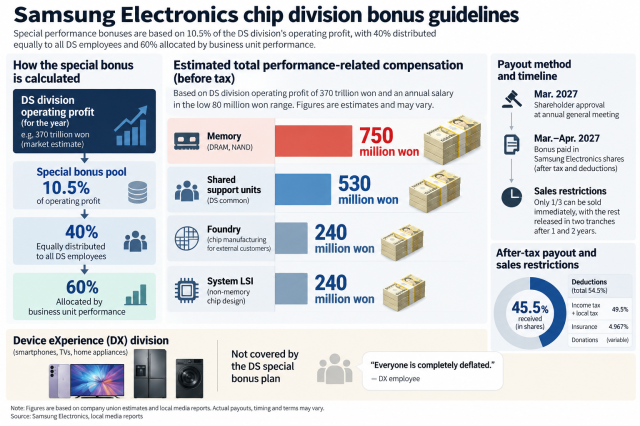
The figures highlight substantial disparities even within the semiconductor division.
Actual payouts have yet to be finalized. The special bonuses are expected to be delivered in company shares next year, subject to shareholder approval, with restrictions on when recipients can sell portions of their holdings.
The prospect of receiving such large awards in stock has made Samsung’s share price a source of anxiety as well as anticipation. Employees may be looking at life-changing sums on paper, but the value they ultimately realize will depend on the award terms and the share price when they are able to sell.
The widening gap comes as demand for memory chips used in AI infrastructure drives an unprecedented earnings surge.
Samsung projected third-quarter operating profit of 107.4 trillion won, its fourth consecutive quarterly record. Higher component costs, meanwhile, have weighed on the consumer-device businesses on the other side of the company.
That imbalance is increasingly becoming a workplace issue.
According to a representative of Samsung’s Donghaeng union, the union and management held an initial meeting on Oct. 10, with further discussions scheduled for later this month.
The representative said the talks would explore additional measures for DX employees. The precise agenda and any potential compensation proposals have not been independently confirmed.
The union is also facing growing pressure from employees seeking a more assertive approach, including renewed collective action, the representative said.
Some DX workers have discussed organizing demonstrations independently of the union, although the scale and timing of any such action remain unclear.
Behind the disagreement over individual bonuses lies a broader question about how Samsung should distribute gains across businesses that share a name but face sharply different fortunes.
The Donghaeng representative argued that Samsung’s consumer electronics operations had helped build the company and should not be left behind during the semiconductor boom.
Yet the argument over how to divide the riches could prove fleeting if the AI bubble bursts and the promised windfall dissolves into a midsummer night’s dream — a fear driving some investors out of the Seoul stock market.
For now, chip workers are glued to stock quotes, recalculating fortunes they have yet to collect. Among colleagues still waiting for a share of the bonanza, their anxiety may find little sympathy.

Copyright ⓒ Aju Press All rights reserved.