
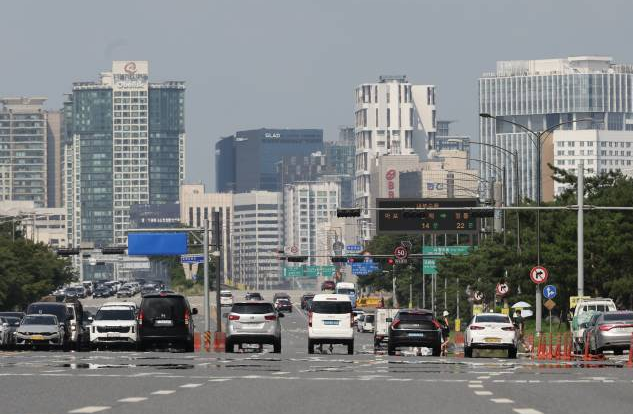
Nearly one in four drivers failed to signal when turning left at intersections in 2025, according to a survey by the Korea Transportation Safety Authority. At 75.7 percent, compliance lagged behind the rates for obeying traffic signals, at 96.7 percent, and wearing seat belts, at 85.4 percent.
From 2023 to 2025, authorities received 1,497,280 public reports of drivers failing to signal, making it the second-most frequently reported traffic violation after disobeying traffic signals or directions, according to the Korean National Police Agency (KNPA).
"It's basic driving etiquette," said Kim Jae-min, a Seoul resident in his 30s. "I wonder how some don't realize that failing to signal could leave them with greater responsibility if an accident happens."
The fines are nothing new. Failing to use a turn signal has carried a penalty in South Korea since 1973. Police are conducting a three-month crackdown from October through December and seeking to introduce a 10-point demerit penalty as early as mid-2027.
Drivers caught failing to signal face a 30,000-won ($22) traffic fine for passenger vehicles, while violations reported by the public can result in a 40,000-won ($30) administrative penalty.
"Too many drivers are still failing to comply," a KNPA traffic safety official said.
The tougher approach, however, has drawn skepticism from a traffic expert who questions whether more enforcement is the best way to change a longstanding driving habit.
"This ultimately comes down to driving habits," said Kang Kyung-woo, a professor of traffic and logistics engineering at Hanyang University.
"Raising awareness is a good thing, but devoting so many officers to enforcement is a waste of manpower," he said. "Those officers could be deployed where they're needed more."
When should drivers signal?
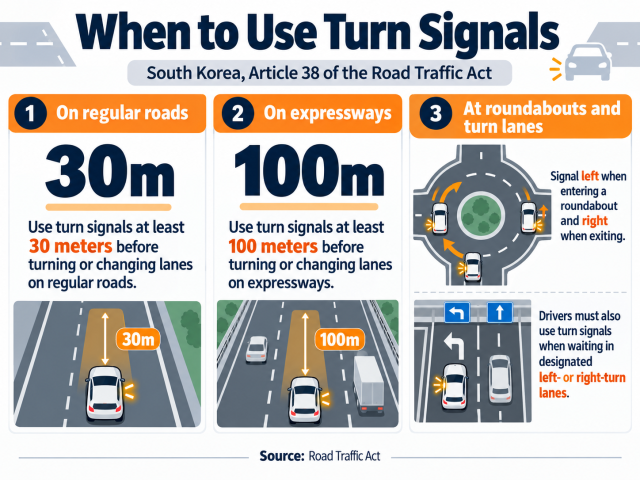
Under Article 38 of South Korea's Road Traffic Act, drivers must signal when turning left or right, making a U-turn or changing lanes.
The law and its implementing rules require signaling to begin at least 30 meters before the maneuver on regular roads and 100 meters on expressways, and continue until it is complete.
The requirement also applies when drivers are waiting in designated left- or right-turn lanes, even when road markings make their intended direction appear obvious. At roundabouts, drivers must signal left when entering and right when exiting.
A 2019 survey of 600 drivers by the Korea Road Traffic Authority found that 40 percent had skipped signaling because no other vehicles were nearby or surrounding traffic was far away. Another 24.3 percent considered it unnecessary when following traffic signals or designated lanes, while 15.1 percent simply found it bothersome.
In other words, many drivers appear to signal only when they think someone else needs to see it.
Kang argued that this distinction mattered when deciding how aggressively to enforce the law.
"Turn signals are essentially a way of warning other road users of your intentions," he said. "Raising awareness is important, but if there is no one else around, do we really need police officers enforcing it?"
The law, however, makes no exception for an empty road. The gap between what drivers consider necessary and what the rules require lies at the heart of the enforcement debate.
A different kind of countdown
Some U.S. states incorporate time or speed into their signaling rules and guidance alongside distance.
California's Department of Motor Vehicles advises drivers to signal at least 100 feet, or about 30.5 meters, before turning — nearly identical to South Korea's 30-meter requirement on regular roads.
For lane changes on freeways, it advises signaling at least five seconds in advance. It also tells motorists to signal even when no other vehicles are visible.
Pennsylvania's driver's manual ties signaling distance to speed. Drivers traveling below 35 miles per hour must signal for at least 100 feet before turning. At 35 mph or faster, the manual specifies at least 300 feet, or about 91 meters.
Kang called for more detailed signaling rules that reflect different driving conditions.
"It would definitely be better to have more specific rules, as some U.S. states do, rather than applying the same requirements in every situation," he said. "The rules should take into account factors such as speed, road type and location."
Technology is already changing how vehicles respond to drivers who neglect their blinkers.
Many newer cars have lane-departure warning or lane-keeping assistance systems that can warn drivers or intervene when they cross lane markings without signaling. Depending on the system, cameras detect lane markings and trigger visual alerts, steering wheel vibrations or corrective steering.
Kang said increasingly sophisticated safety systems raised questions about whether traffic regulations were keeping pace with modern vehicles.
"Technology is advancing faster than traffic regulations," he said. "Cars are becoming more like electronic devices, with systems that can intervene to prevent unsafe movements."
Automated driving could further complicate questions of responsibility when a vehicle fails to signal.
"If a self-driving car fails to use its turn signal, who is responsible?" he asked.
For now, the nationwide crackdown turns on a much simpler question: whether drivers can make a habit of telling others where they are going.

Copyright ⓒ Aju Press All rights reserved.
