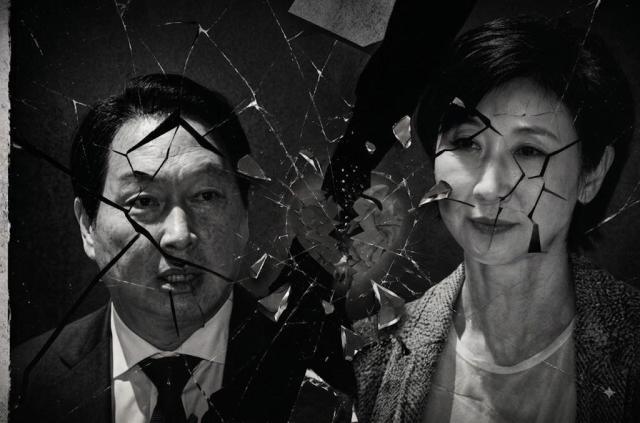
SEOUL, October 14 (AJP) - Roh Soh-yeong, the daughter of former South Korean President Roh Tae-woo, has decided not to challenge a court ruling awarding her 944 billion won ($744 million) in her divorce settlement with SK Group Chairman Chey Tae-won, leaving the billionaire's appeal as the sole challenge before the Supreme Court.
Roh, 65, director of Art Center Nabi, a Seoul-based arts institution, did not file a cross-appeal before the midnight deadline on Tuesday. Her former husband, Chey, 66, had already appealed the ruling in August.
The decision means Roh will not independently seek to increase her share of the couple's assets, although the Supreme Court must still examine Chey's objections to the settlement.
In July, the Seoul High Court ordered Chey to pay Roh 944 billion won in cash after determining that the couple's divisible assets were worth approximately 2.9 trillion won, including 2 trillion won in SK shares.
The court allocated 66.6 percent of the assets to Chey and 33.3 percent to Roh.
Chey, who leads SK Group, one of South Korea's largest family-controlled conglomerates, has since narrowed his appeal. His lawyers said he would not contest 700 billion won of the settlement but would challenge the remaining 244 billion won.
His legal team argues that the court overestimated Roh's contribution to the couple's accumulated wealth, particularly after an earlier Supreme Court ruling excluded alleged financial support from her father.
The latest legal dispute has attracted attention beyond the size of the settlement because it touches on the historically close relationship between South Korea's political leadership and its powerful business conglomerates, known locally as chaebol.
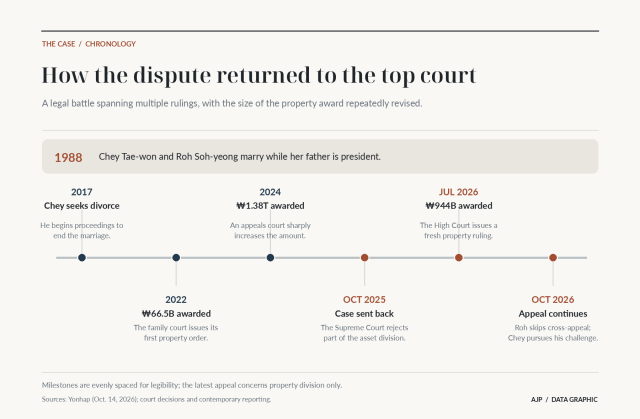
Roh Soh-yeong is the only daughter of Roh Tae-woo, who served as South Korea's president from 1988 to 1993 during the country's transition from decades of authoritarian rule toward democracy.
Her father was a longtime friend and military ally of Chun Doo-hwan, the former army general who seized power following a 1979 military coup and ruled South Korea from 1980 to 1988.
The two men had been friends since high school and attended the Korea Military Academy together. Roh supported Chun's seizure of power, and both were subsequently convicted over their involvement in the military takeover and corruption. Their military regime was also implicated in the bloody suppression of a pro-democracy uprising in Gwangju in May 1980.
The family's political history became central to the divorce litigation because of longstanding questions over whether SK Group benefited from its connections to the Roh administration.
Chey and Roh married in 1988, the year her father became president, establishing a family relationship between the presidential household and the industrial conglomerate then known as Sunkyong Group.
SK expanded its business ambitions during Roh's presidency, particularly in finance and telecommunications, sectors that would become important to its subsequent growth.
In 1992, the conglomerate was selected by the Roh administration as a new mobile telecommunications operator. However, it surrendered the license just one week later amid allegations of preferential treatment arising from its ties to the president.
SK eventually acquired a controlling interest in Korea Mobile Telecommunications, the predecessor of SK Telecom, through a public share auction in 1994, after Roh had left office.
The group has maintained that its expansion was driven by business decisions and competitive bidding rather than political favoritism.
The controversy resurfaced during the divorce proceedings in 2024, when the Seoul High Court initially ordered Chey to pay Roh 1.38 trillion won.
That court recognized the former president's alleged transfer of 30 billion won in secret funds to Chey's father, former SK chairman Chey Jong-hyon, as a contribution to the conglomerate's development and considered the family's political connections when calculating Roh's share of marital assets.
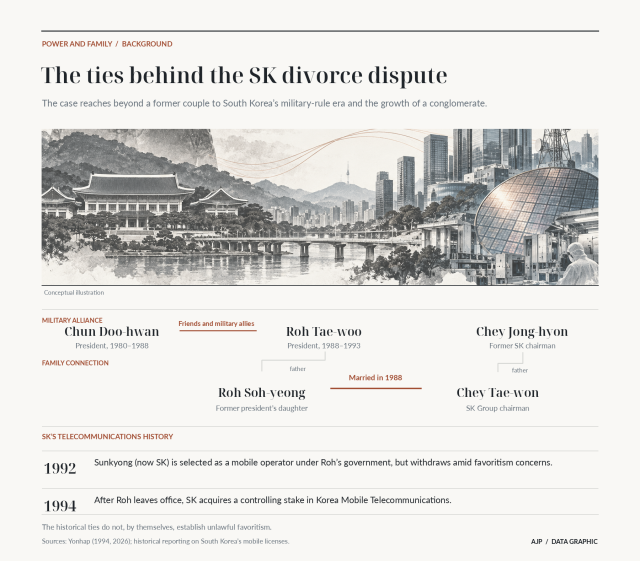
However, in October 2025, the Supreme Court overturned the property division, ruling that funds allegedly accumulated through illegal activities could not be recognized as a legitimate contribution to marital wealth, even if the transfer had occurred.
The top court upheld the divorce itself and a separate order requiring Chey to pay Roh 2 billion won in damages.
When the case returned to the Seoul High Court this July, the judges reduced Roh's share from 35 percent to 33.3 percent, resulting in the 944 billion-won award.
Chey's lawyers contend that the reduction was insufficient given the Supreme Court's earlier rejection of the alleged presidential slush fund as a factor in the settlement.
They have also challenged the way the court accounted for rising SK share prices and its inclusion of shares in SK Siltron, a semiconductor materials company, that Chey acquired in 2017 after the couple's marriage had broken down.
The case dates back to Chey's public acknowledgment in 2015 that he had an extramarital relationship and a child with another woman. He filed for divorce in 2017. Chey and Roh have three children together.
The financial stakes extend beyond the former couple. SK Group controls major businesses including SK hynix, a leading manufacturer of advanced memory chips used in artificial intelligence systems, and SK Telecom, one of South Korea's largest mobile network operators.
Although the latest ruling allows Chey to retain his SK shares, the scale of the cash payment has raised questions about how he would finance the settlement and whether it could affect his control of the conglomerate.
The Supreme Court is expected to assign a justice to the case and begin examining Chey's appeal, extending a legal battle that has exposed the intersection of family wealth, corporate power and South Korea's authoritarian political past.
Copyright ⓒ Aju Press All rights reserved.