
The concern extends beyond the troops and ammunition North Korea has supplied Moscow. Its involvement in Russia’s drone industry could give the isolated state access to manufacturing techniques and weapons refinements shaped by sustained combat.
A joint report released Wednesday by the Washington-based Center for Strategic and International Studies (CSIS) and the Dallas-based George W. Bush Institute identifies the Alabuga drone complex in Russia’s Tatarstan region as a meeting point for Iranian designs, Russian manufacturing, Chinese components and North Korean forced labor.
“North Korean labor also transfers technical know-how,” wrote Victor Cha, CSIS’s Korea chair, and Joseph Kim, the Bush Institute’s global policy program manager.
“Technicians sent to Alabuga will return to Pyongyang with invaluable lessons from working at a mass-production drone assembly line, having observed Russian refinements to the constantly improving Geran drones.”
The Geran is Russia’s version of the Iranian-designed Shahed attack drone. Iran initially supplied completed aircraft before helping Moscow establish domestic production, turning a weapons import into an expanding industrial operation.
Their report, “Human Rights Abuses in Drone Production at Yelabuga,” argues that labor exploitation and military cooperation have become intertwined in an expanding production network whose security implications reach well beyond Ukraine.
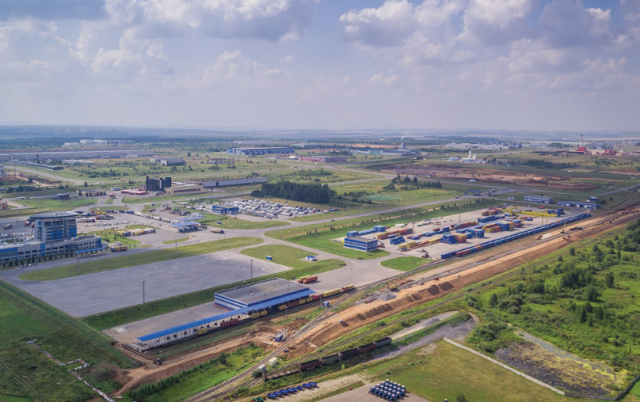
Yelabuga lies in Russia’s Republic of Tatarstan. The nearby Alabuga Special Economic Zone has become a major manufacturing center for Geran attack drones derived from Iran’s Shahed design.
Iran initially supplied Russia with completed drones before helping Moscow establish domestic production. Russia has since expanded the operation and modified the aircraft in response to Ukrainian defenses.
According to the report, the complex has grown to encompass roughly 17 facilities and as many as 116 buildings, with capacity to produce more than 5,500 drones a month. Satellite imagery also shows extensive construction of worker accommodation.
The authors cite Ukrainian military intelligence assessments that the workforce, initially numbering roughly 1,000, was planned to expand to 40,000 and the expansion drew workers from Russian students, foreign recruits and North Korean laborers dispatched under state-controlled arrangements.
The report says Russian teenagers as young as 15 have been recruited through Alabuga Polytechnic under a work-experience program, facing long shifts, production quotas and threats of penalties for disclosing their work.
Foreign women, mainly from Africa and other developing regions, have been recruited with promises of hospitality jobs and educational opportunities, only to find themselves assigned to weapons assembly. The report describes passport confiscation, deductions from wages and restrictions on movement.
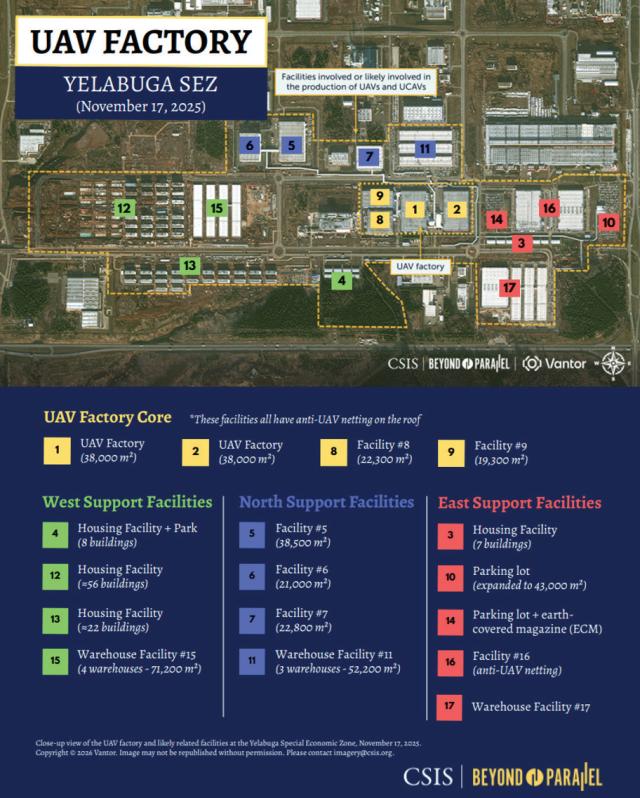
North Korea’s role is distinct because the state itself supplies and controls the workers while retaining most of their earnings, the authors argue, claiming North Korean laborers face surveillance by minders and the withholding of 70 to 90 percent of their wages. The arrangement extends a longstanding system of overseas labor that has sent North Koreans to factories, logging camps and construction sites abroad.
The report cites a figure of up to 12,000 North Koreans assigned to Alabuga. The underlying Ukrainian military intelligence announcement in November 2025 described plans to recruit roughly that number by year-end, rather than confirming that all had arrived.
China’s contribution runs through the production and supply chains. Chinese companies provide engines and engine parts, batteries, electronics and navigation equipment, including systems designed to resist electronic jamming, according to the report. Chinese machinery has also supported drone-body manufacturing, while trading networks route components through China and Hong Kong.
These contributions allow Russia to turn an imported weapons design into a continuously evolving domestic industry. For North Korea, factory experience would add to the military knowledge accumulated through its broader support for Moscow.
Pyongyang’s contribution to Russia’s war has already expanded from arms shipments to direct military involvement. It has supplied millions of artillery rounds and short-range ballistic missiles, while thousands of North Korean troops have served in Russia’s Kursk region against Ukrainian forces.
The relationship rests on a strategic partnership treaty signed by Kim Jong-un and Vladimir Putin in June 2024 that includes mutual military assistance. North Korea has portrayed its deployment as support for a treaty partner, while gaining exposure to drone warfare, electronic warfare and modern battlefield coordination.
There are indications that its weapons have benefited, too. An August analysis by 38 North found credible evidence that North Korean KN-23 missiles used against Ukraine had become more accurate, potentially through Russian assistance in overcoming electronic interference. It cautioned, however, that the precise modifications and the extent of improvements to North Korea’s own arsenal remained uncertain.
Drone production adds another potential channel for learning.
The CSIS–Bush Institute report describes North Korean workers as subject to state control, restricted movement and the withholding of 70 to 90 percent of their wages. The authors argue that the arrangement finances the regime while exposing its technicians to a rapidly evolving weapons industry.
The report cites a figure of up to 12,000 North Koreans assigned to Alabuga. The underlying Ukrainian military intelligence announcement in November 2025 described a plan to recruit roughly that number by year-end, rather than a verified count of workers already present. It put the proposed pay at about $2.50 an hour for shifts lasting at least 12 hours.
Iran’s experience illustrates how the military benefits of such cooperation can travel back to the original supplier.
After acquiring the Shahed design, Russia repeatedly modified its navigation, communications and other systems in response to Ukrainian defenses, according to a separate CSIS study published in September.
Improved navigation equipment sought to counter electronic jamming. Communications modules and cameras gave some variants the ability to transmit information and allow operators to redirect attacks in flight, features strengthened through battlefield learning.
Early models followed programmed routes without reporting whether they reached their targets. Connected variants can provide information about their progress and surroundings, helping operators assess losses and adjust subsequent missions. CSIS describes an adaptation cycle in which successful changes move into production within weeks.
Cha and Kim argue that confronting this risk requires action against the labor and procurement networks sustaining Russian production, alongside efforts to restrict weapons transfers. Their recommendations include sanctions against trafficking intermediaries and a multinational investigation into conditions at Alabuga.
“A North Korea with a more sophisticated and growing drone program poses a new order of military challenge for South Korea, Japan, and U.S. forces in the Indo-Pacific,” they wrote.
Copyright ⓒ Aju Press All rights reserved.
