SEOUL, October 15 (AJP) - South Korea has agreed with Japan to extend their US$10 billion currency swap agreement for another three years, as the two neighboring countries seek to maintain a financial safety net and strengthen bilateral cooperation, the Ministry of Finance and Economy said on Thursday.
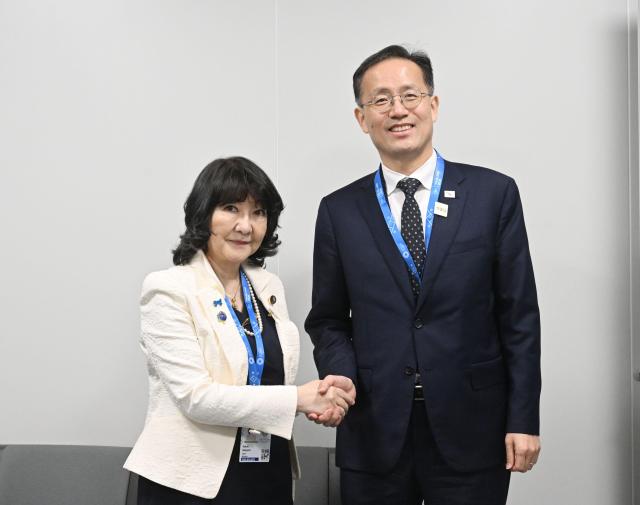
Deputy Prime Minister and Finance Minister Lee Hyung-il met with his Japanese counterpart Satsuki Katayama on the sidelines of the annual meetings of the International Monetary Fund (IMF) and the World Bank Group in Bangkok, where the two sides agreed to extend the deal, which was set to expire next month.
A currency swap allows one country to deposit its own currency in the reserves of another in return for currency from the other in case of a liquidity shortage. Under the renewed arrangement, which will now remain in effect through November 2029, South Korea can provide won in exchange for U.S. dollars held by Japan, while Japan can provide yen in exchange for U.S. dollars held by South Korea.
Despite having sufficient foreign-currency liquidity, the two countries agreed to maintain the arrangement as a precautionary measure and a symbol of bilateral financial cooperation.
The two countries first signed such a deal in 2001 and expanded its size to $70 billion in 2011 amid the global financial crisis. However, the agreement was gradually scaled back as bilateral relations soured over lingering historical disputes. The remaining $10 billion swap deal expired in February 2015, bringing the arrangement to a halt. The two sides then agreed to revive the mechanism in June 2023, and the Bank of Korea and the Bank of Japan signed a new $10 billion deal in December that year, restoring it after an eight-year suspension.
Meanwhile, the two countries also agreed to hold their next finance ministers' meeting as soon as possible in Seoul, with the exact date to be determined through further consultations.
Deputy Prime Minister and Finance Minister Lee Hyung-il met with his Japanese counterpart Satsuki Katayama on the sidelines of the annual meetings of the International Monetary Fund (IMF) and the World Bank Group in Bangkok, where the two sides agreed to extend the deal, which was set to expire next month.
A currency swap allows one country to deposit its own currency in the reserves of another in return for currency from the other in case of a liquidity shortage. Under the renewed arrangement, which will now remain in effect through November 2029, South Korea can provide won in exchange for U.S. dollars held by Japan, while Japan can provide yen in exchange for U.S. dollars held by South Korea.
Despite having sufficient foreign-currency liquidity, the two countries agreed to maintain the arrangement as a precautionary measure and a symbol of bilateral financial cooperation.
The two countries first signed such a deal in 2001 and expanded its size to $70 billion in 2011 amid the global financial crisis. However, the agreement was gradually scaled back as bilateral relations soured over lingering historical disputes. The remaining $10 billion swap deal expired in February 2015, bringing the arrangement to a halt. The two sides then agreed to revive the mechanism in June 2023, and the Bank of Korea and the Bank of Japan signed a new $10 billion deal in December that year, restoring it after an eight-year suspension.
Meanwhile, the two countries also agreed to hold their next finance ministers' meeting as soon as possible in Seoul, with the exact date to be determined through further consultations.
Copyright ⓒ Aju Press All rights reserved.