
SEOUL, October 20 (AJP) - Few children like going to school, but for a six-year-old girl in rural Mongolia the reason can be more straightforward as going to one costs her time with her family for much of the year.
For rural herders, sending children to school often means sending them away.
More than 36,000 children in Mongolia live apart from their families for up to nine months of the school year, according to UNICEF.
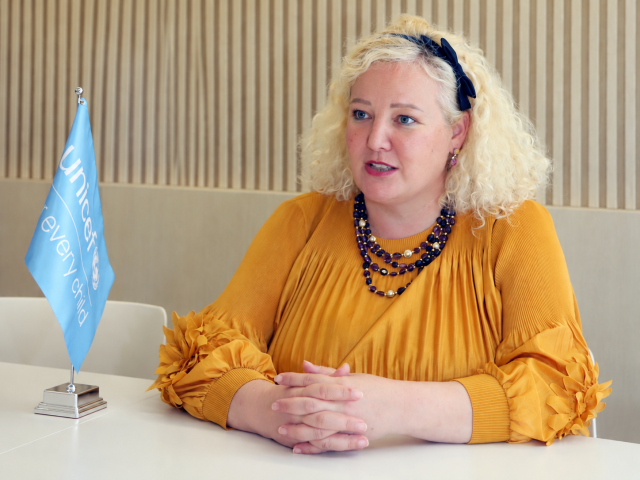
"The price they are paying for good education is a very high price," Beate Dastel, UNICEF representative in Mongolia, told AJP during an interview at the UNICEF Korea Committee headquarters in Seoul.
The Austrian national, who assumed her post in February after more than two decades in international development, is working to secure the essentials of childhood in a country where distance and climate deprive children of basic necessities like education, warmth, clean water and healthcare.
Mongolia's population is scattered across enormous distances. Some nomadic families live hundreds of kilometers from the nearest school, leaving their children little choice but to move into dormitories or stay with relatives.
Separation can begin as early as six when children enter school. Dastel worries that its consequences can follow them into adolescence and adulthood.
"They could be neglected, they could live in isolation, and they could experience mental and psychological trauma," she said.
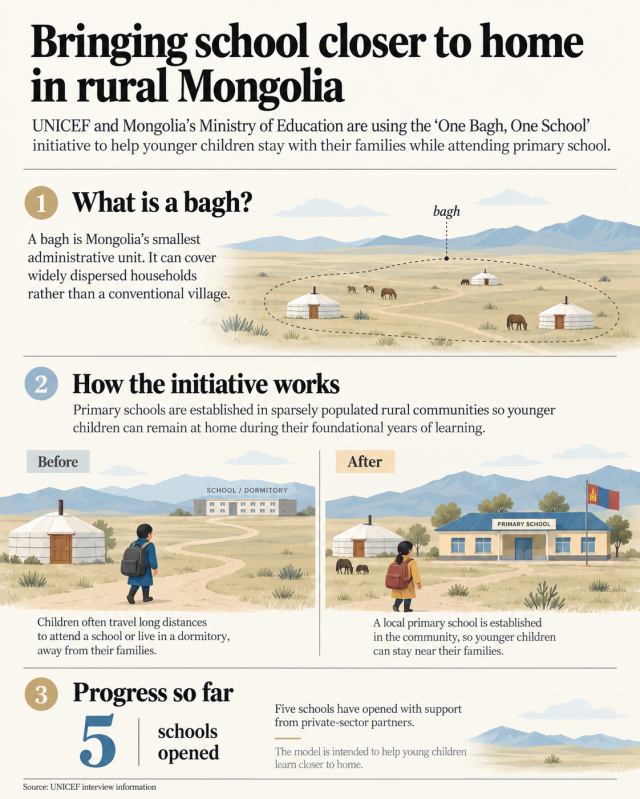
UNICEF and Mongolia's Ministry of Education are trying to bring the classroom closer to home through the "One Bagh, One School" initiative. A bagh is the country's smallest administrative unit, sometimes encompassing widely dispersed households rather than a conventional village.
The initiative establishes primary schools in sparsely populated rural communities so younger children can remain with their families during their foundational years of learning.
Five schools have opened with support from private-sector partners. Dastel said UNICEF hopes to expand the network to 65 within five years and potentially 200 within a decade.
But public budgets for education and healthcare are stretched, and expansion will require substantial investment from richer neighbors like Korea.
The schools are nevertheless intended to become part of Mongolia's regular education system, with the government taking responsibility for teachers, training and long-term operations.
For children who can stay at home, other hardships await.
Winter temperatures in parts of Mongolia can plunge to minus 50 degrees Celsius or lower. Families living in gers — traditional circular tents — often depend on a central coal stove to heat their shared living space and cook their meals.
In Ulaanbaatar's densely populated ger districts, smoke from thousands of households feeds the city's winter smog.
According to UNICEF, more than 800,000 children in Mongolia are exposed to harmful levels of air pollution. Research cited by the agency has found substantially lower lung function among children in heavily polluted urban areas than among their rural counterparts.
Dastel described a threat that reaches beyond respiratory illness to children's education and long-term development.
One response has come from South Korea.
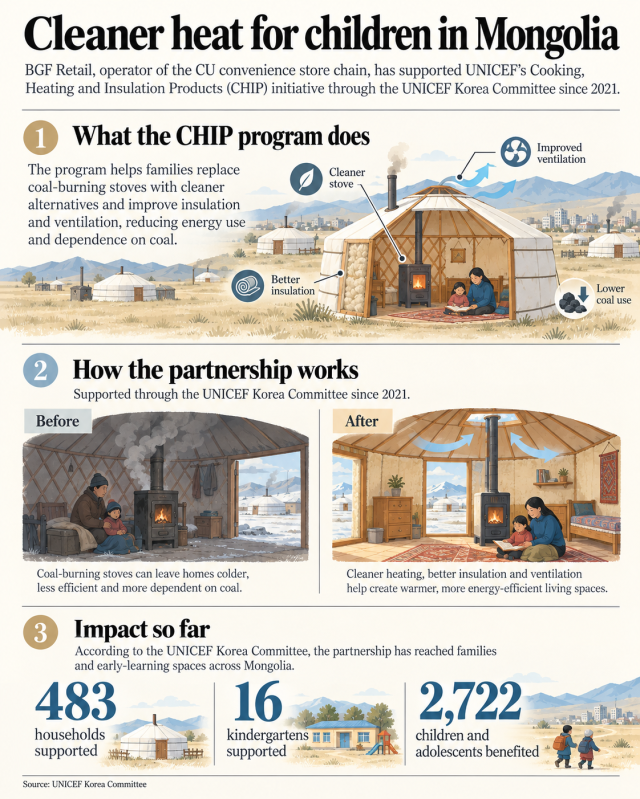
BGF Retail, which operates the CU convenience store chain, has supported UNICEF's Cooking, Heating and Insulation Products (CHIP) initiative through the UNICEF Korea Committee since 2021.
The program helps families replace coal-burning stoves with cleaner alternatives and improve insulation and ventilation, reducing energy consumption and dependence on coal.
According to the UNICEF Korea Committee, the partnership has supported 483 households and 16 kindergartens, benefiting 2,722 children and adolescents.
"We are really grateful to our private-sector partners for their tremendous support, especially the people of Korea and the companies," Dastel said.
But a warmer, cleaner home cannot shut out the air around it.
A UNICEF assessment published in January 2026 documented improvements in household comfort, energy efficiency and some measures of indoor air quality. It also found persistent exposure to fine particulate pollution from contaminated outdoor air.
Asked about those findings, Dastel acknowledged that improvements in individual homes cannot resolve the wider pollution crisis without much broader adoption.
"We are still at a point where we need to see how we can scale up from this pilot," she said.
The upfront cost of replacing heating systems remains prohibitive for many low-income families, making financial support essential.
"Only when this reaches a certain point will we have a real impact on air pollution," she said.
UNICEF is also working with Mongolia's environment and energy authorities to extend cleaner technology to schools, hospitals and other public institutions.
Beyond the capital's smog, a different environmental pressure is building.
Falling groundwater levels threaten access to safe drinking water in remote communities, where households, livestock owners and extractive industries increasingly compete for limited supplies.
In August, Ulaanbaatar hosted COP17, the 17th Conference of the Parties to the United Nations Convention to Combat Desertification, drawing international attention to land degradation, drought and water security.
For Dastel, keeping countries at the negotiating table mattered at a time of considerable strain on multilateral cooperation.
"For me, the key achievement was that countries were able to communicate with each other," she said.
For UNICEF, the gathering was also an opportunity to connect the debate over dwindling water resources with children's daily needs.
The agency has supported smart water kiosks that dispense drinking water through automated systems. These can shorten the journeys families make to collect water, although expansion requires infrastructure investment and sustainable financing.
"Since groundwater levels are shrinking, this dialogue for the benefit of children will become much more important," Dastel said, referring to cooperation among competing water users.
For herding families, climate extremes can also wipe out the means to support a child.
Mongolia periodically experiences dzud, a severe winter disaster in which extreme cold, snow and ice make it difficult for livestock to survive. Some families can lose half their herds or more, Dastel said.
"As soon as this livestock is lost, it's like losing your bank account," she said.
The losses can undermine children's nutrition, schooling, healthcare and security.
Alongside emergency assistance, UNICEF is working with the Mongolian government to strengthen social protection programs that support vulnerable children before disaster strikes.
Reliable energy offers another layer of protection.
In Arkhangai Province, UNICEF has supported solar-powered healthcare facilities that can maintain essential services during electricity outages. Dastel said dependable power is particularly critical for maternity wards and facilities treating infants and young children.
"Without power, a hospital cannot function. No health center can function," she said.
Technology may also help narrow the educational divide that forces so many children to leave home.
UNICEF has been working with Mongolia's AI education initiatives and engaging teachers in discussions about the technology's potential. Digital learning could help communities where qualified teachers are difficult to recruit.
Dastel estimated that Mongolia faces a shortage of about 5,000 qualified teachers, compounded by low salaries and the difficulty of attracting educators to isolated regions.
But technology has limits.
"A teacher, with a heart, soul and hands to take care of a child, cannot be replaced by AI," she said.
Nor are digital opportunities evenly distributed. Many children in remote communities lack reliable internet access or the money needed to use advanced technology.
"Rural Mongolia and urban Mongolia are two different environments," she added.
She urged donors and Korean partners to direct investment toward children in underserved communities, helping lift them out of poverty rather than concentrating opportunities where infrastructure is already more developed.
"We have to invest in bringing education to children and not the other way around," Dastel said.
Copyright ⓒ Aju Press All rights reserved.
