
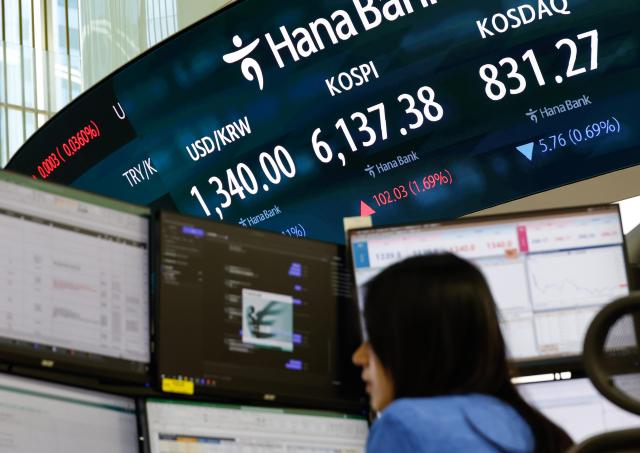
"When stocks rise sharply, a correction is inevitable," President Lee Jae Myung told reporters at the Chunchugwan press center of Cheong Wa Dae on Monday. "Unlike in the past, it is difficult for the government to intervene directly in financial and securities markets. Nor is it desirable."
The KOSPI went from the best performer in the first half (nearly 100 percent from the beginning of the year) to the worst performer this month. It has lost nearly 20 percent so far this month. It is still around 32 percent higher from the 2025 year-end, but lost almost 70 percent of its first-half gains.
Policymakers have limited power to arrest a correction. Intervention may numb the pain, but the relief can be brief and the aftereffects bitter.
"If the government could control the market, things would be much easier," a trader said on condition of anonymity. "I wouldn't read too much into the remarks. They sounded more like a general statement."
Another analyst, however, questioned whether the scale of the retreat could be dismissed as a routine correction, given the earnings strength behind the rally.
"I do agree that corrections are inevitable, but much of the rally was driven by strong semiconductor earnings, and the market has become heavily dependent on the sector," he said. "Still, I would not consider a decline to this level a normal correction."
The chipmakers that powered the market's ascent are now bearing the brunt of foreign selling as investors reassess the spending boom behind their profits.

Lee nevertheless remained upbeat about valuations.
"South Korea's stock market remains significantly undervalued," he said.
He identified lingering distrust in corporate governance as a central reason for the discount.
"What remains is a lack of trust in the market," Lee said. "I don't think concerns over corporate governance have been fully resolved. Respect for shareholders and the abuse of management control remain issues that need to be addressed."
The government's response, he suggested, would focus on restoring that confidence.
"We are continuing to review what needs to be done through policy to normalize the stock market," Lee said. "We will soon receive a comprehensive report and take the necessary measures."
Foreigners retreat as retail investors raise the stakes
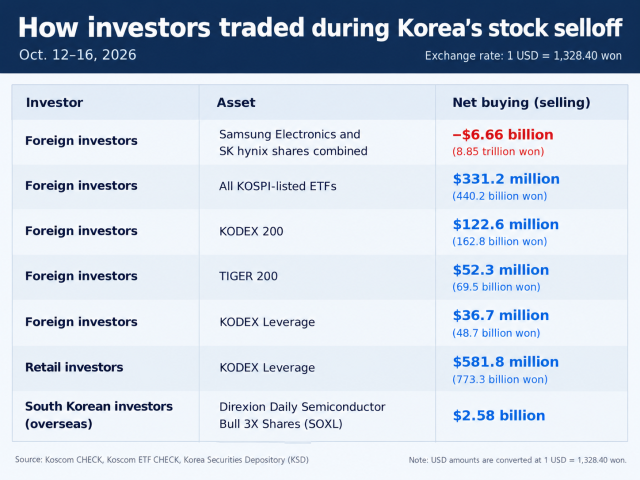
For now, foreign and retail investors are taking sharply different positions on the selloff.
Foreign investors sold a net 8.85 trillion won ($6.64 billion) of Samsung Electronics and SK hynix shares during the week of Oct. 12 to 16, according to data released Monday by Koscom CHECK, a financial information service.
They offloaded 5.36 trillion won of SK hynix and 3.49 trillion won of Samsung Electronics, accounting for the bulk of their 11.24 trillion won in net selling across the main KOSPI market.
Samsung Electronics lost 17.75 percent that week, while SK hynix plunged 24.33 percent.
Retail investors are the lone buyers in a market deserted by foreigners and domestic institutions.
Foreign investors did buy a net 440.2 billion won of ETFs listed on the main market, including 162.8 billion won of KODEX 200, 69.5 billion won of TIGER 200 and 48.7 billion won of KODEX Leverage.
But a market researcher cautioned against treating those purchases as a vote of confidence when far larger sums were leaving individual stocks.
"What matters is that foreigners are selling," the researcher said.
Earlier in the year, domestic liquidity had absorbed foreign selling and kept the rally alive. That support has since weakened, the researcher said.
"Before June, foreign selling was actually not a decisive factor because domestic liquidity absorbed it and the market continued to perform well," he said. "Now without foreign buying, it is a tough environment for the market."
Retail investors are nevertheless raising the stakes on a rebound.
Individuals bought a net 773.3 billion won of KODEX Leverage during the same week, making it their most heavily purchased ETF, according to Koscom ETF CHECK data. The fund seeks to deliver twice the daily return of the KOSPI 200 Index.
It accounted for nearly a quarter of their 3.26 trillion won in total net ETF purchases. Buying also extended to leveraged funds tracking the KOSDAQ 150 and semiconductor stocks.
The appetite for amplified returns reached overseas. South Korean investors bought a net $2.58 billion of Direxion Daily Semiconductor Bull 3X Shares, known by its ticker SOXL, according to the Korea Securities Depository. The fund targets three times the daily performance of a U.S. semiconductor index.
The losses have been amplified, too. KODEX Leverage fell 30.6 percent during the week, underscoring the cost of getting the timing wrong.
Retail investors are betting on a recovery even as the foreign buying that could help sustain one remains elusive.
Governance reforms face a global test
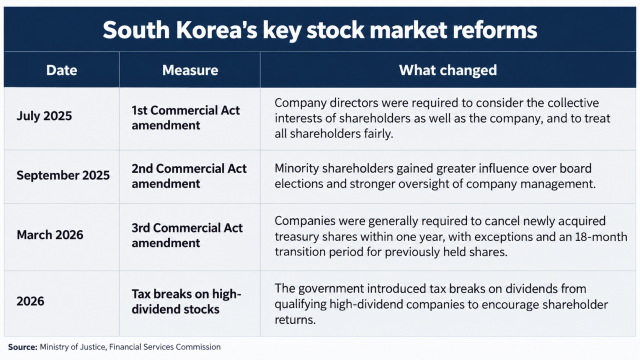
Lee's assurances build on a series of measures aimed at narrowing the "Korea discount," the persistently lower valuations of Korean stocks relative to their global peers.
A July 2025 amendment to the Commercial Act required company directors to consider the collective interests of shareholders alongside those of the company and to treat shareholders fairly.
A second amendment, enacted in September 2025 and effective from September 2026, gave minority shareholders greater influence over board elections and strengthened management oversight.
A third, effective from March 2026, generally required companies to cancel newly acquired treasury shares within a year, subject to exceptions, with an 18-month transition period for previously held shares.
The government also introduced tax breaks on dividends from qualifying high-dividend companies in 2026, while financial regulators stepped up efforts against stock manipulation and other unfair trading practices.
As shares plunged last week, the Financial Services Commission convened an emergency meeting on Oct. 15, chaired by Lee Eog-weon, to assess market conditions and foreign selling. Authorities pledged closer monitoring, action against illegal trading and preparations for contingency measures.
Those efforts address longstanding weaknesses in governance and market confidence. The latest selloff also poses a question that domestic reforms alone cannot answer: whether the global AI spending boom will earn enough to justify its mounting cost.
Kwon Nam-hoon, an economics professor at Konkuk University, said that uncertainty would help determine the direction of Korean equities.
"There is enormous uncertainty. The fundamental issue globally is the AI boom, and opinions differ over whether AI investment will translate into future profitability," Kwon said.
Large cloud and technology companies, often called hyperscalers, are expanding their investment in data centers and computing infrastructure, increasingly drawing on outside financing.
"Until now, hyperscalers have largely funded AI investments with their own money," Kwon said. "But as investment costs continue to rise, they are increasingly turning to external financing. Investors differ on how much profit these investments will generate and how quickly those returns will materialize."
The International Monetary Fund highlighted similar concerns in its October 2026 Global Financial Stability Report. It identified 14 publicly disclosed AI-related financing deals since 2023 involving about $300 billion in equity investments, $650 billion in related debt and $1.4 trillion in commitments to purchase future services and chips.
The IMF warned that those interconnected arrangements could spread risks across companies and lenders if AI investments failed to generate expected revenues.
S&P Global raised similar concerns Monday, warning that major technology companies could face greater AI-related financial obligations than currently known, potentially straining their credit ratings if profits fell short.
For South Korea, the stakes are especially high. The semiconductor giants delivering the AI windfall are also the market's main exposure to doubts about its durability.
Kwon said even small changes in expectations could produce outsized swings.
"Even a slightly negative signal can send markets sharply lower, while a positive one can push them higher," he said. "This pattern is likely to persist for some time."

Copyright ⓒ Aju Press All rights reserved.
