
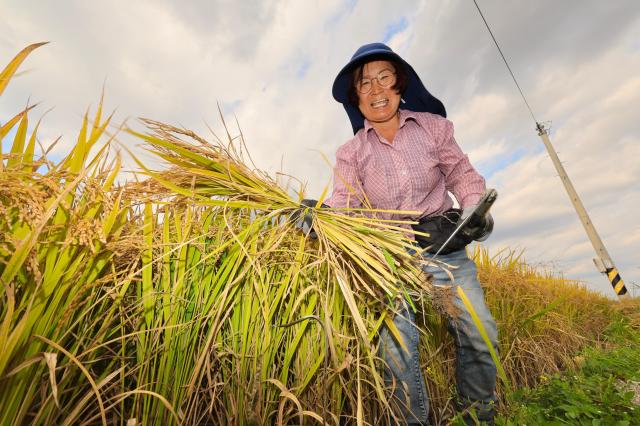
Yet the farmers sustaining that legacy face a difficult squeeze: aging hands, costly machinery and a changing appetite for the grain they grow.
In Icheon, a city in Gyeonggi Province famed for its premium rice, autumn brings both the harvest and a festival celebrating it. Beyond the festival grounds, the work offers a less comforting picture of an industry trying to carry its heritage forward.
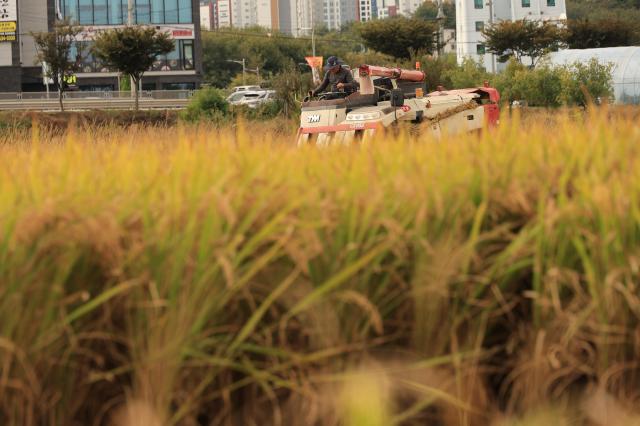
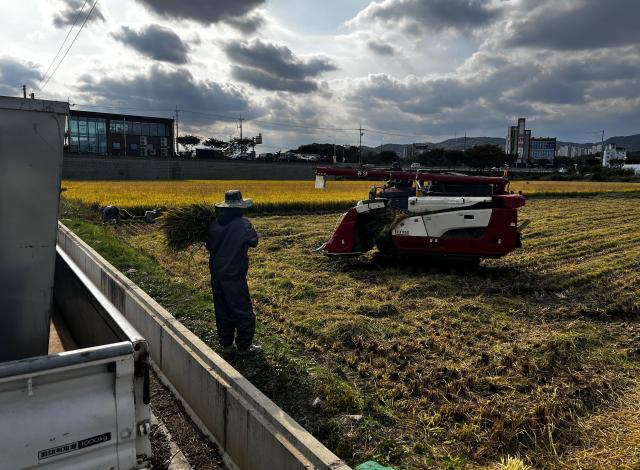
At a paddy in Jinri-dong on Oct. 15, a family of three arrived with a truck and a tractor carrying their harvesting machine. The father unloaded the equipment while his wife and son took up sickles, cutting stalks along the edge of the field to clear a path for it.
Even a mechanized harvest began by hand.
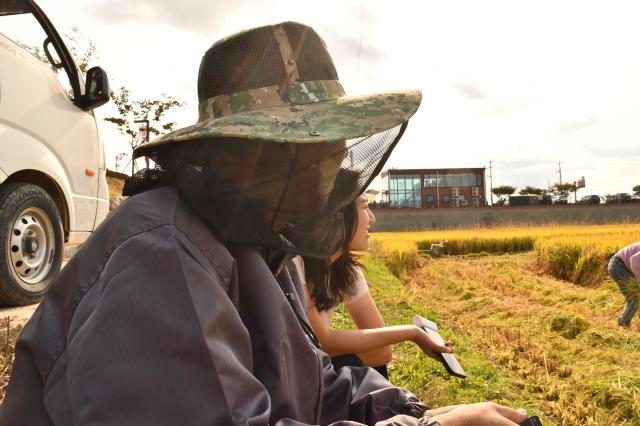
“Last year was better,” he said, blaming excessive rainfall for the weaker crop. A field that yielded roughly eight loads last year might produce only six this season, he estimated.
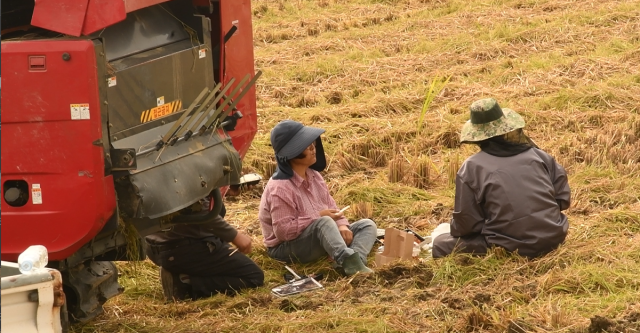
Then the harvesting machine broke down.
After a succession of phone calls, the family sat down for a meal beside the field, waiting for work to resume.
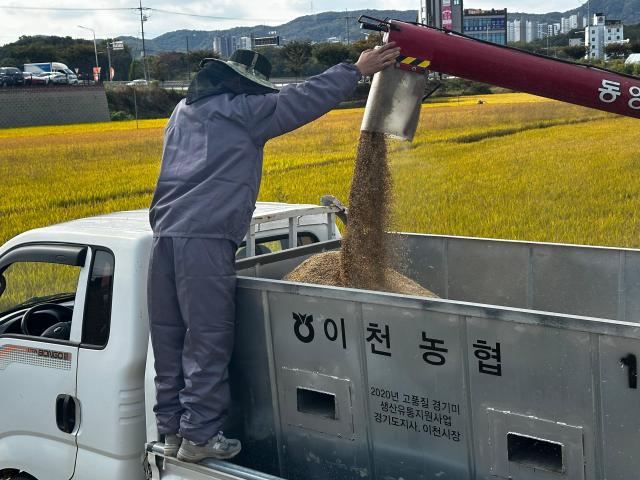
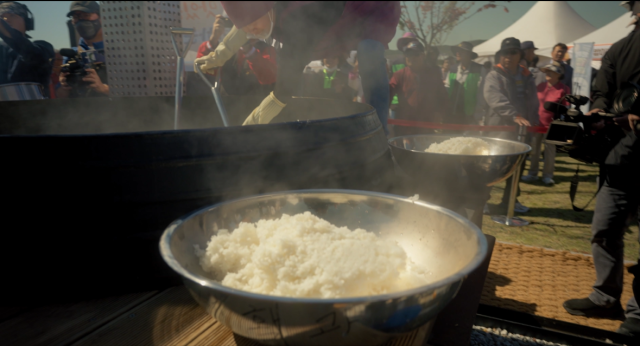
At the nearby Icheon Rice Cultural Festival, the grain was a source of pride.
“Icheon rice is the best,” said Kim Mu-sang, a women’s association leader in her 80s from Daewol-myeon who was taking part in the event.
The region markets its grain as Imgeumnimpyo Icheon Rice, or King’s Table Icheon Rice, drawing on its association with the royal table.
According to local tradition, King Seongjong tasted Icheon rice during a visit in 1490 after paying respects at King Sejong’s tomb. Impressed by its flavor, he reportedly ordered it supplied to the palace. The story remains central to the region’s identity as a producer of premium grain.
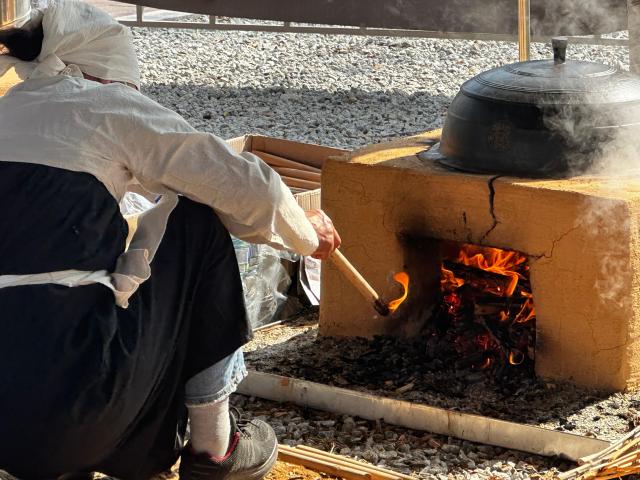
Rice also carries memories of a more laborious kitchen routine. Before electric rice cookers, families cooked it in a gamasot, a large iron cauldron heated over a wood fire.
Getting it right meant tending the flames, then reducing the heat and leaving the rice to steam beneath a closed lid.
The crisp layer left at the bottom, called nurungji, became a treat of its own. Hot water poured over it made sungnyung, a toasted-rice drink often served after a meal.
The festival drew visitors eager to explore that culture.
Lee Ho-geun traveled from Guri, Gyeonggi Province, with his Japanese girlfriend, Sokono, who had spotted the festival on Instagram.
She described rice as a versatile companion to Korean side dishes.
For Noorie Bajaj Womack, a 37-year-old American who moved to South Korea last year, the visit was another opportunity to sample the country’s regional varieties. Her spouse serves with U.S. Forces Korea.
“The rice from the border has been really good, and so I wanted to try this rice too,” she said, referring to rice grown near the Demilitarized Zone.
But a reputation built over centuries does not make the next harvest easier to finance.
Back in Jinri-dong, the son described equipment prices that were difficult to justify for a small family farm.
“A good piece of farming equipment can cost more than 200 million won. That’s a lot of money for farmers like us,” he said.
The family uses a harvesting machine about eight years old and a tractor that has been in service for many years. Japanese machinery is highly regarded, he said, but beyond their budget.
“The really good machines are Japanese, but they’re too expensive for us to buy,” he said. “We only use them during planting and harvesting seasons anyway, so we haven’t felt the need to buy newer or better equipment.”
For some farmers, making the investment pay means taking on work beyond their own paddies.
“Machines are so expensive these days that you can’t make back the cost by using them only on your own fields. That’s why people also work other farmers’ fields,” he said.
Keeping the equipment running is another burden. Repair technicians are scarce, he said, and a breakdown during the short harvest window can leave farmers stranded as favorable weather slips away.
“If a machine breaks down these days, you can lose an entire day’s work,” he said.
"There just aren’t enough technicians who can repair these machines. Once you call someone, it can take forever for them to arrive.”
“Sometimes, all you can do is sit beside the rice field and wait until the technician comes,” he added.
New technology offers less help when the farm is too small to justify the expense.
“We don’t farm on a very large scale, so we don’t use things like drones,” he said. “But people farming 100,000 or 200,000 pyeong do use them.”
Those holdings would cover roughly 33 to 66 hectares.
National figures show the rising cost of cultivation, though they also caution against assuming every farmer’s returns are deteriorating.
Average paddy-rice production costs rose 4.4 percent in 2025 to 921,395 won per 1,000 square meters, according to the Ministry of Data and Statistics. Labor costs increased 6.6 percent and fertilizer expenses 6.9 percent.
Gross revenue over the same area, however, rose faster, climbing 17 percent to about 1.35 million won.
The pressures extend beyond the field. Farmers must also adapt to how—and how much—people eat.
At the festival, Kim Young-jun, a third-generation farmer who runs Icheon Dodram Rice, had a succinct explanation for why fewer consumers were buying large bags of uncooked rice.
“It’s because of Hetbahn,” he said, referring to CJ CheilJedang’s ready-to-eat rice brand.
For someone living alone, a 10-kilogram sack can be a burden, he explained. Packaged rice offers a single portion without the need to cook a pot or store a large supply.
The shift is visible in household data. Annual per capita household rice consumption fell 3.4 percent to 53.9 kilograms in 2025, the lowest since comparable records began in 1962, according to the Ministry of Data and Statistics. It was barely half the 106.5 kilograms recorded in 1995.
Single-person households reached 8.24 million in 2025, accounting for 36.6 percent of all general households, up from 23.9 percent in 2010.
Food manufacturers are adapting the rice bowl accordingly, offering smaller portions alongside multigrain and other specialized products.
In September, CJ CheilJedang introduced a 110-gram Hetbahn serving, nearly half the size of its standard 210-gram pack. Products weighing 130 grams accounted for about 16 percent of the domestic instant-rice market in the first half of 2026, up from around 9 percent two years earlier, according to Nielsen data cited by the company.
For farmers and local brands selling directly to households, the change means competing for a smaller place in the pantry. But the rise of packaged rice also creates another buyer for their grain.
CJ CheilJedang bought about 65,000 metric tons of South Korean rice in 2025 for Hetbahn and other rice-based products, according to an August report by Money Today. It plans to purchase 60,000 to 70,000 tons in 2026.
The company has operated contract-farming arrangements since 2010 and works with about 2,500 farmers across 14 regions, including Asan, Jincheon and Iksan.
Those arrangements give participating growers an established buyer and the company a stable supply.
In Asan, CJ CheilJedang planned to expand contracted cultivation of Donghaeng, a rice variety developed for Hetbahn, from about 1,111 hectares for the 2025 crop to 1,420 hectares for 2026. The expanded area was projected to yield about 12,000 tons.
A dedicated rice-processing center provides drying, storage, milling and processing services, linking the farms to the company’s manufacturing network.
The market is substantial. CJ CheilJedang sold about 771 million Hetbahn products worldwide in 2025, up 31.6 percent from 586 million in 2021, according to company figures analyzed by DataNews. The brand held about 66 percent of South Korea’s instant-rice market by retail sales value in 2025, according to Nielsen Korea data cited in the company’s business report.
Demand from food manufacturers also extends well beyond microwaveable rice. Businesses used about 1.07 million metric tons of rice in 2025, up 22 percent from a year earlier, government data showed. That figure includes food and beverage production, notably rice cakes.
The question for small growers is how readily they can enter those supply networks—and how much of the value will reach them. An expanding market for branded rice products does not, by itself, guarantee better farm incomes or ease the cost of bringing in the crop.
In Jinri-dong, that distance between a growing food business and a farmer’s immediate needs was measured in idle machinery and an unfinished harvest.
“Farm machinery costs around 100 million won. For people like us, it’s just...” the farmer’s mother said, trailing off with a sigh.

Copyright ⓒ Aju Press All rights reserved.
