
SEOUL, October 21 (AJP) - Samsung Electronics excels at making memory and smart devices for the hand, home and office, and screens big and small. But one element of its sprawling electronics empire called for a richer pedigree: sound.
Its biggest acquisition to date brought that heritage into the family. The $8 billion deal to buy Harman International completed in March 2017 added the storied American audio brand JBL alongside a major automotive electronics business. Posh Britain audio brand Bowers & Wilkins joined the family last year through Harman’s purchase of Sound United.
Their adoptive Korean parent has thrown a birthday bash for the family’s elder members as JBL turns 80 and Bowers & Wilkins marks its 60th anniversary.
“Sound Legends,” running from Oct. 24 to 31 at Project Space Line in Seoul’s Gangnam district, brings together vintage speakers, recording equipment and contemporary audio devices to trace how sound developed for cinemas and studios found its way into homes and everyday life.
“This year we're celebrating three very important milestones — the 60th anniversary of Bowers & Wilkins, the 80th anniversary of JBL and ten years being part of the Samsung family,” David Glaubke, a communications director at Harman International, told reporters Wednesday.

The Samsung milestone dates from the acquisition announcement; the transaction closed the following March.
The exhibition reaches back much further, opening with a Jackson-Bell radio from 1929 fitted with a speaker developed by Lansing Manufacturing, the company audio engineer James B. Lansing founded in 1927.
Lansing went on to establish JBL in 1946, giving the company his initials. Its early work in cinema and professional sound laid the foundations for a business that would eventually reach living rooms around the world.
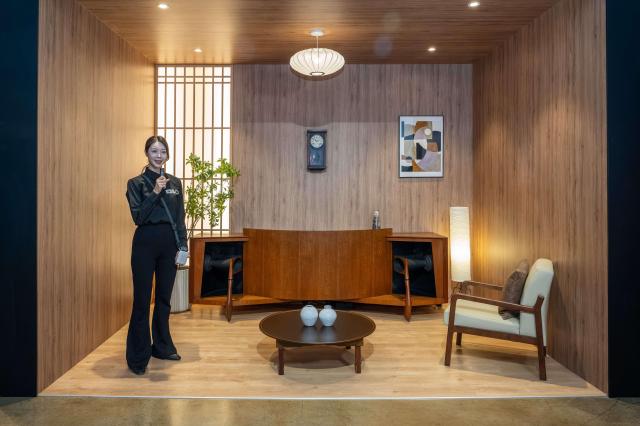
One of the exhibition’s centerpieces is the JBL Paragon, a sweeping wooden stereo speaker that looks as much like a finely crafted sideboard as a piece of audio equipment.
Introduced in 1957, according to the exhibition guide, it housed the left and right channels in a single cabinet. Each required roughly 100 hours of skilled woodworking, and only about 1,000 were made before production ended in 1983.
The scale and craftsmanship belong to an era when a sound system could command an entire room.
A more compact milestone followed in 1970 with the L100 Century, a home speaker derived from JBL’s 4310 studio monitor. Its distinctive foam grille helped make it one of the brand’s most recognizable consumer products, bringing a piece of the recording studio into the home.
The display continues through to the JBL Summit K2, a high-end speaker being shown in South Korea for the first time, alongside portable speakers and headphones. Together, the exhibits chart the journey from imposing cabinets built for dedicated listening to devices that carry music almost anywhere.
On another floor, Bowers & Wilkins tells a parallel story with a distinctly British accent.
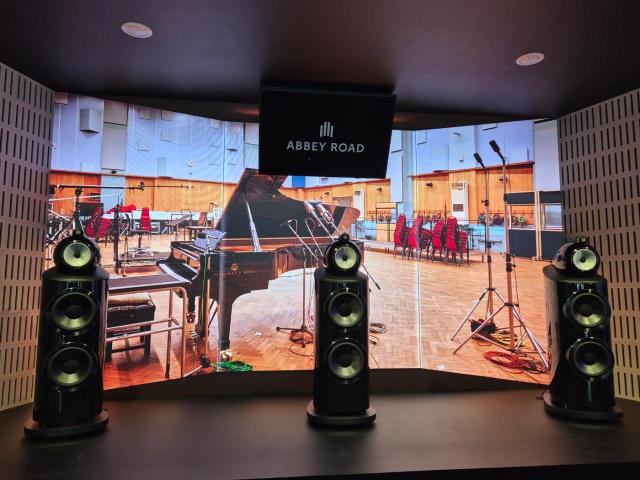
Founded in England in 1966, the company built its reputation on reproducing recordings as faithfully as possible. Its speakers have been used at London’s Abbey Road Studios, where generations of musicians and producers have recorded and mixed their work.
Its most arresting exhibit is the Nautilus. Introduced in 1993, the speaker resembles a sea creature, with a shell-like body and tapered tubes extending behind its drivers. The unusual form serves an acoustic purpose: controlling unwanted sound from the rear of the drivers.
More than three decades later, the model remains in production on a made-to-order basis, according to the exhibition guide.
Visitors can also listen to the latest 800 Series Diamond D5 speakers, whose synthetic diamond dome tweeters are designed to reproduce high frequencies with greater precision.
For Samsung, the display of audio history also showcases a business that has grown substantially under its ownership.
Harman’s reported annual revenue rose from 7.1 trillion won in 2017 to 15.8 trillion won in 2025, according to Samsung, while operating profit reached a record 1.5 trillion won last year. The comparison begins with the year Samsung completed the acquisition.
The portfolio has grown, too. Harman’s $350 million acquisition of Sound United last year brought Bowers & Wilkins, Denon and Marantz into the group, extending its reach across premium home audio.
Samsung plans to explore further applications for Harman’s audio technologies across smartphones, televisions and soundbars, although it has not specified products or launch dates.
The Seoul exhibition forms part of a global JBL anniversary tour that has visited Amsterdam, Los Angeles, New York and Tokyo.
For a company more readily associated with memory chips and Galaxy phones, it offers a different kind of family portrait: wooden cabinets, sculptural speakers and decades of engineering devoted to what comes out of a device, rather than what appears on its screen.

Copyright ⓒ Aju Press All rights reserved.