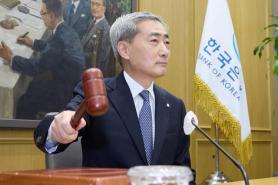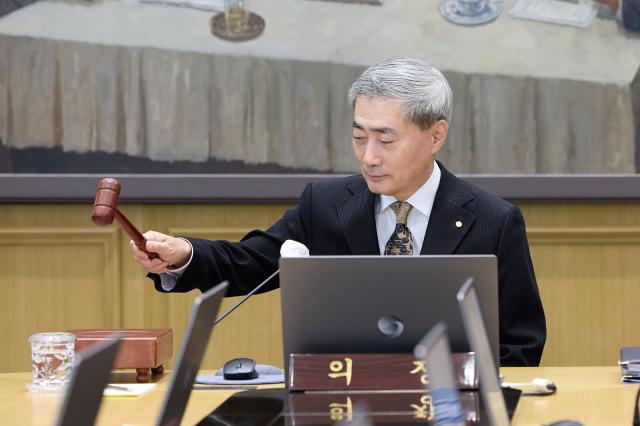
SEOUL, October 22 (AJP) - The Bank of Korea (BOK) on Thursday kept its key rate steady at 3.00 percent to assess the effects of a half-percentage-point increase across its last two summer meetings, while maintaining a clear restrictive bias.
“Since growth and inflation data appear stronger than predicted in August, we should keep up tightening policy stance,” Governor Shin Hyun-song said at a post-meeting briefing, adding the bias would remain until annual inflation rate comes down to the target range of around 2 percent.
He projected that goal would be reached in 2027, indicating rates could stay above 3 percent through next year.
The economy has kept up a robust growth pace on strong exports and investment, with inflation running around 3 percent, but policymakers unanimously decided to wait it out as upward price pressure from accumulated inflationary factors and downside risks to growth from geopolitical tensions coexist, according to the post-meeting statement.
The BOK started lifting the key rate held at 2.50 percent since May last year in July and delivered the second in August.
Government bonds rose as investors read hawkish tone from the governor. The two-year government bond yield fell 1.2 basis points to 3.771 percent, while the 10-year yield declined 1.2 basis points to 4.148 percent.
The benchmark KOSPI and junior KOSDAQ both fell more than 3 percent on the prosect of higher rates. The won also remained resilient, trading at 1,323.9 per U.S. dollar.
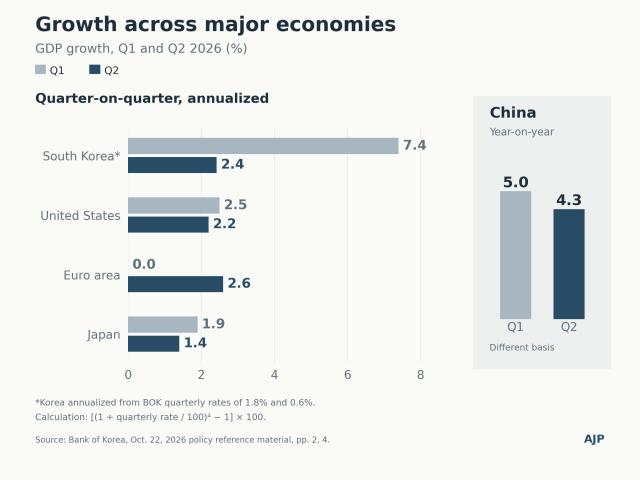
The pause follows a stronger assessment of the economy.
Shin said the July and August hikes had given the central bank more room to maneuver, allowing it to focus on domestic economic conditions rather than react to market volatility.
He described Thursday’s pause as “the payoff” from the BOK’s earlier preemptive tightening.
Growth this year and next is expected to “substantially exceed” the BOK's August forecasts of 3.3 percent and 2.9 percent, respectively, as the semiconductor boom is expected to stretch and support exports and investment.
Improving incomes should gradually broaden the recovery in consumption, the bank projected.
Exports surged 83.7 percent from a year earlier in September, accelerating from 68.9 percent in August. Exports adjusted for working days more than doubled, rising 105.0 percent.
The staggering external demand has yet to warm the local economy.
Retail sales fell 1.8 percent from the previous month in August, while facilities investment dropped 9.5 percent and manufacturing output declined 5.1 percent. Employment rose by 113,000 from a year earlier in September, with the BOK describing job growth as modest and concentrated in services.
Inflation remains a constraint on how long policymakers can wait. Consumer prices rose 2.9 percent from a year earlier in September, easing from 3.1 percent in August. Core inflation, excluding food and energy, slowed to 2.8 percent from 3.4 percent. Households’ expectations for inflation over the next year held at 2.7 percent.
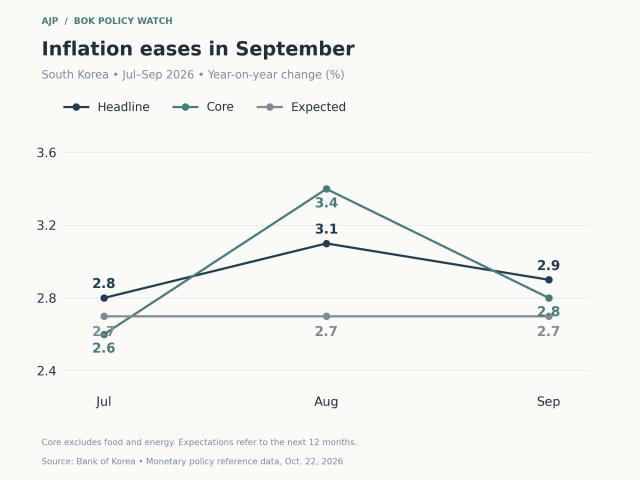
This year’s headline and core inflation rates are expected to broadly match the August forecasts of 2.7 percent and 2.5 percent. Next year, however, both are likely to exceed the previous projections of 2.3 percent and 2.5 percent, respectively.
Escalating Middle East tensions are pushing up energy costs and disrupting supply chains, even as resilient artificial intelligence investment supports global growth.
Financial stability concerns also argued against declaring the tightening cycle over. Household lending had turned lower as repayments of other loans outweighed new borrowing, but housing-related lending continued to grow and home-price gains in the Seoul metropolitan area had accelerated again, the bank noted.
Policymakers would continue to watch the housing market and household debt closely as they weigh when, and how quickly, to raise rates further, the bank added.
Kim Yeon-jae
Kim Yeon-jae is a journalist at AJU Press (AJP's English platform),
covering macroeconomics, international finance, and geopolitics.
He closely tracks central bank monetary policies, global energy supply chains,
and the Korean defense industry.
Copyright ⓒ Aju Press All rights reserved.