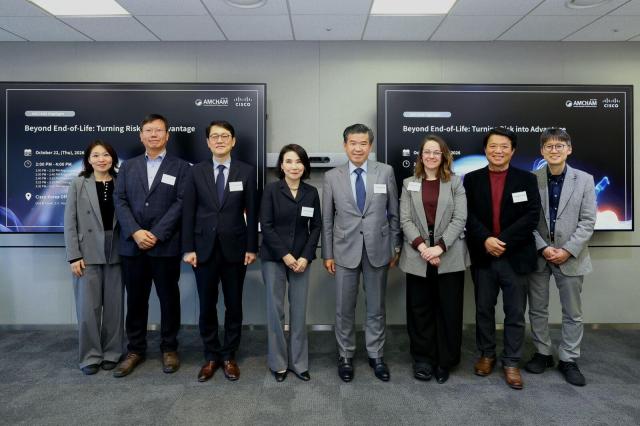
The AMCHAM said Friday that it held a closed-door roundtable with the U.S. technology company at its Seoul office the previous day, bringing together business executives and cybersecurity experts to discuss risks associated with outdated technology that has reached the end of its operational life.
The discussions focused on so-called end-of-life (EOL) equipment, including hardware and software that no longer receives security updates or technical support from manufacturers. Such systems can become vulnerable to cyberattacks, particularly as artificial intelligence accelerates the discovery and exploitation of security weaknesses.
The event featured opening remarks from AMCHAM Chairman and CEO James Kim and Cisco Korea President Ji Hee Cathy Choi, followed by a keynote address from Jin Young Oh, vice president of the Korea Internet Security Agency (KISA).
"Modernizing aging systems is part of that effort," said Kim, emphasizing the importance of strengthening digital infrastructure to support Korea-U.S. technology cooperation and long-term business competitiveness.
"As businesses transition into the AI era, leaving EOL equipment in place after official security updates and technical support have ended can pose a critical threat to business continuity," said Choi.
She stressed that companies should identify vulnerable systems and adopt phased modernization strategies that take into account their budgets and operational priorities.
The meeting also examined findings from a Cisco-sponsored report published by the Australian Strategic Policy Institute (ASPI) in July.
The report, titled "Past its use-by-date: Turning end-of-life technology risk into national advantage," examined aging technology risks in Korea, India and the Philippines, as well as Australia.
It identified South Korea's rapid digitalization and government technology mandates as factors that can contribute to dependence on legacy systems, making replacement difficult and costly.
The report proposed a five-part framework addressing technology lifecycle visibility, risk-based standards, procurement reform, accountability and transition planning. It argued that unsupported systems should not remain in operation without clearly assigned responsibility, documented safeguards and a funded replacement plan.
Sarah Sloan, Cisco's head of cybersecurity policy for Asia Pacific, presented the report's findings and led a scenario-based exercise in which participants considered how to prioritize technology upgrades while maintaining essential business operations.
Jae Bom Ok at Cisco Korea also outlined approaches to modernizing aging infrastructure and improving IT asset management.
AMCHAM said it would continue facilitating discussions among businesses, technology experts and policymakers to address emerging cybersecurity threats and support South Korea's digital competitiveness.
Copyright ⓒ Aju Press All rights reserved.