SEOUL, October 28 (AJP) - Sitting on cash riches of 115 trillion won ($86.8 billion) from a record-setting earnings streak over the last six quarters, SK hynix is sharing its extraordinary AI dividends with shareholders and employees like no other company and defying worries about excessive AI spending by bulldozing ahead with facility expansion.
SK hynix is doling out about 100 trillion won in shareholder returns this year alone, including a 40 trillion won buyback completed earlier this month, while setting aside another 10 trillion won worth of shares for executives and employees.
The company has plenty of reason to feel generous. Its operating margin is approaching 80 percent, cash is piling up and a severe memory shortage could stretch through 2030. SK hynix says its HBM and DRAM output is “effectively sold out” through 2029, counting existing supply agreements and customer demand still under negotiation.
That gives the chipmaker confidence to open its coffers on three fronts — rewarding shareholders, sharing the spoils with employees and building the factories needed to power its AI chip design and datacenter clients.
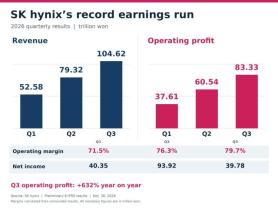
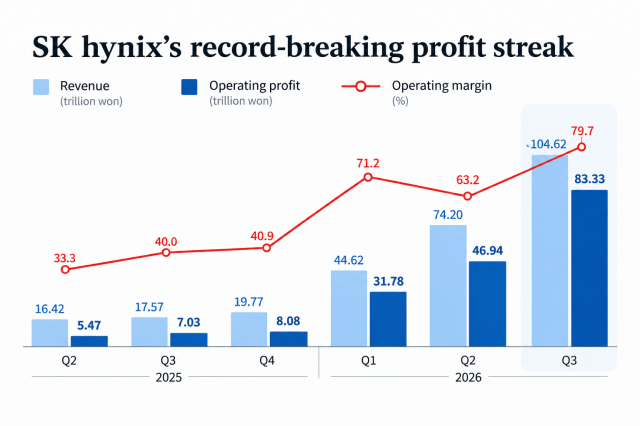
SK hynix reported a record operating profit of 83.33 trillion won for the July-September quarter, up 632.1 percent from a year earlier, on revenue of 104.62 trillion won.
Its operating margin approached 80 percent as demand for HBM, server DRAM and enterprise solid-state drives continued to surge. For the first nine months, operating profit reached 181.49 trillion won on revenue of 236.51 trillion won.
The earnings streak has completely changed its financial firepower. Cash and cash equivalents stood at 114.46 trillion won at the end of September, up 26.50 trillion won from three months earlier, while borrowings fell by 2.79 trillion won to 15.80 trillion won.
That left net cash of about 98.7 trillion won, giving the company ample room to reward investors and employees while funding its next round of expansion on confidence that the memory upycle has at least three more years to run.
The shareholder return plan comprises at least 30 trillion won in cash dividends and at least 60 trillion won in share repurchases and cancellations. The annual buyback figure includes the 40 trillion won program completed on Oct. 21, with those shares scheduled for cancellation.
The board also approved a further 20 trillion won in repurchases. Half will be canceled to enhance shareholder value, while the remaining 10 trillion won will be reserved for executive and employee compensation and excluded from the shareholder return total.
The third-quarter cash dividend will total 14 trillion won, or 20,000 won per share. Half of the per-share payment reflects improved earnings; the other half is a special dividend tied to gains from the company’s investment in Japanese chipmaker Kioxia.
SK hynix plans to distribute most of its realized Kioxia investment gains to shareholders, with the remaining special dividend to be included in the year-end payout once the results are finalized.
“We believe our share price today is undervalued,” an SK hynix executive said, arguing that the stock does not adequately reflect the company’s earnings and cash flow.
The payouts come alongside plans to increase capital expenditure significantly in 2027 as SK hynix expands advanced manufacturing capacity and ramps up its first fabrication plant in Yongin, south of Seoul.
The company aims to bring its M15X facility to maximum production capacity by the end of this year. HBM4, its next-generation memory for AI processors, is expected to overtake HBM3E in both shipment volume and revenue in the fourth quarter.
Long-term agreements with 14 major customers already cover more than half of planned production capacity for 2027 and 2028. Customer requests for HBM exceed available supply by more than twofold, executives said.
Still, the company sought to distinguish its expansion plans from the indiscriminate capacity building that has fueled previous memory downturns.
“More investment or more fabs does not necessarily mean more supply,” the company said.
SK hynix plans to build manufacturing infrastructure ahead of demand, then phase in equipment installations and production increases according to market conditions and profitability. It will assess customers’ financial health, funding capacity and supply-chain readiness alongside their spending plans before committing additional capacity.
The company has also shelved consideration of an initial public offering for its NAND flash memory subsidiary Solidigm.
CEO Kwak Noh-jung said the listing had been intended to raise outside funding for Solidigm’s manufacturing expansion. Recent financial market conditions, however, made it difficult to achieve the anticipated benefits.
SK hynix said it would continue supporting the subsidiary’s growth while exploring financing options that would enhance the value of both companies.
With AI infrastructure spending spreading beyond major technology companies to businesses and government-backed projects, SK hynix expects tight memory supply to persist through 2030. Its challenge is to meet that demand while maintaining the spending discipline needed to avoid another boom-and-bust cycle.
Shares traded at 1,490,000 won as of 2:30 p.m., their highest level in more than two weeks but still just under half their June peak of 2,987,000 won.

Copyright ⓒ Aju Press All rights reserved.