Flush with cash after six consecutive quarters of record earnings, SK hynix on Wednesday pledged about 100 trillion won ($75.5 billion) in shareholder returns this year. Attention now turns to Samsung Electronics, which releases its detailed third-quarter results Thursday, for signs of how it plans to share its own windfall.
Behind those riches lies a vast financing requirement.
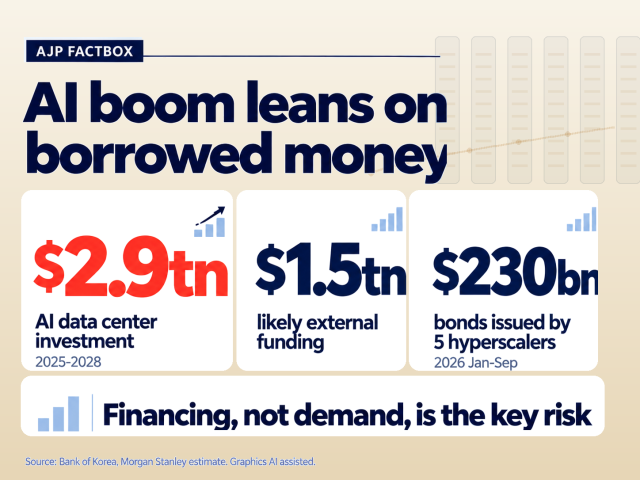
About $2.9 trillion in data-center investment is expected between 2025 and 2028, with roughly $1.5 trillion likely to require external funding, according to a Morgan Stanley estimate cited in a Bank of Korea report released Tuesday.
The concern is that the companies buying Korea’s chips must commit enormous sums long before their AI investments generate enough revenue to pay for themselves.
Five major hyperscalers — Alphabet, Microsoft, Amazon, Meta and Oracle — issued about $230 billion in corporate bonds in the first nine months of this year, more than double their issuance for all of 2025. Their share of outstanding U.S. investment-grade corporate bonds rose to 4.8 percent in September from 2.0 percent a year earlier.
“The current correction in AI-related stocks is driven more by concerns over the sustainability of financing than by weakening demand,” said Kim Jae-seung, an analyst at Hyundai Motor Securities.
Kim said credit risks at data-center companies could eventually curb capital expenditure and weigh on semiconductor shares. Part of the strain reflects a timing mismatch: the spending comes first, while the revenue and cash flow arrive later.
For South Korea, the more immediate vulnerability lies in the orders that borrowing supports.
If tighter financing forces AI companies and data-center developers to scale back investment, demand for servers and computing equipment could weaken, reducing purchases of high-bandwidth memory, or HBM, and server DRAM.
The BOK said financial vulnerabilities were more concentrated among heavily indebted neocloud operators — specialist providers of AI computing capacity — AI developers and financing vehicles than among the largest hyperscalers, which retain stronger cash flows and higher credit ratings.
The maturity of their debt also offers some protection. About 61 percent of outstanding hyperscaler bonds have more than 10 years remaining before repayment, limiting immediate refinancing pressure.
Yet AI infrastructure financing increasingly extends beyond conventional corporate debt into joint ventures, project financing, leases and other arrangements tied to data centers and computing equipment. These structures make it harder to assess where risks ultimately sit.
The weaker links are more likely to emerge among borrowers dependent on outside capital than among the biggest technology companies themselves.
“We are seeing customers' AI investment actually leading to greater adoption of AI services and producing business results,” the chipmaker said during its third-quarter earnings call Wednesday.
Major hyperscaler customers reported cloud revenue growth of about 30 to 80 percent from a year earlier, while cloud backlogs expanded two to five times and the number of paying AI users continued to rise, SK hynix said.
Long-term agreements already cover more than half of its total production capacity for 2027 and 2028. Taking additional customer demand into account, its DRAM and HBM capacity is close to sold out, while customers are requesting more than twice the HBM it can supply.
The company said it assesses customers’ financial health, funding capacity and supply-chain readiness before committing investment, and phases equipment installations and production increases according to actual demand.
Those orders provide reassurance. They also identify where to watch for trouble: a slowdown in data-center spending followed by weaker HBM and server DRAM orders would signal that financing stress was reaching Korean manufacturers.
The BOK researchers warned that the financing arrangements supporting AI investment could magnify a downturn. Weaker spending could depress the value of graphics processing units and other assets pledged as collateral. Falling collateral values could then restrict borrowing and force further investment cuts, deepening the pressure on asset prices and credit conditions.
A separate study published Tuesday by the Bank for International Settlements raised similar concerns about the growing use of long-term debt and complex arrangements that keep financing off corporate balance sheets. Spillovers into U.S. Treasury and investment-grade bond markets have so far been small and short-lived, the study said, but sustained issuance at the current pace could change that.
South Korea’s domestic corporate bond figures present a different picture.
Financial Supervisory Service data for September showed that repayments of general corporate bonds continued to exceed new issuance. Refinancing accounted for 68.2 percent of issuance, and no bonds rated BBB or below were issued during the month.
Those figures offer little evidence of a comparable borrowing surge among domestic companies, although they do not isolate AI-related financing.
Korea’s exposure is more likely to become apparent first through exports and semiconductor demand. Strong cloud revenue, long-term supply agreements and crowded order books still point to a market hungry for Korean memory chips.
The harvest is real. The question is whether the financing behind the next crop can hold up long enough for today’s investment to deliver its promised returns.
Copyright ⓒ Aju Press All rights reserved.