
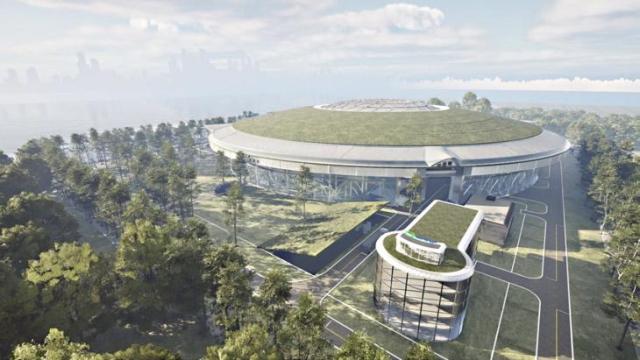
The government is moving to close that gap as artificial intelligence (A) drives up electricity demand.
It named the safe development and demonstration of SMRs as one of three core nuclear policy goals at the International Atomic Energy Agency's (IAEA) International Ministerial Conference on Nuclear Power, held in Incheon from Tuesday to Thursday.
Deputy Prime Minister and Science Minister Bae Kyung-hoon, who chaired the conference, said AI, data centers and advanced industries were creating new electricity demand far faster than expected.
"[South Korea] looks forward to these discussions leading to tangible international cooperation and advancing the safe and peaceful use of future nuclear technologies, including SMRs, around the world," Bae said.
"Now is the time to make concrete progress in delivering nuclear power," IAEA Director General Rafael Grossi told the conference by video. The agency projects global nuclear capacity will rise from 377 gigawatts at the end of 2025 to between 641 and 1,045 gigawatts by 2050.
SMRs, typically rated at 300 megawatts or less, are built from factory-made modules and can be placed closer to where power is used. Their round-the-clock output makes them a candidate to power AI data centers directly, and Bae has said the two should be designed together.
The country's data centers are set to consume about 18 terawatt-hours of electricity in 2030, more than double the 8.2 terawatt-hours of 2025, and 30 terawatt-hours by 2038, according to the Ministry of Climate, Energy and Environment.
The extra 10 terawatt-hours expected by 2030 equals the annual output of about seven modules of Korea's homegrown 170-megawatt Innovative SMR (i-SMR), assuming the 89 percent utilization rate Korea Hydro & Nuclear Power targets for its reactors.
The grid is already strained.
Developers in the greater Seoul area sought grid impact reviews for data center projects totaling about 33.6 gigawatts by March, but only 10 projects with about 1 gigawatt won final approval, according to CBRE Korea's analysis of KEPCO data.
Matching the output of one i-SMR module with solar power would take more than 1 gigawatt of panels, based on the 14.5 percent average utilization rate the Korea Energy Agency logged for solar in the first quarter, and the panels go dark at sunset.
The i-SMR applied for standard design approval on Feb. 27. Its first unit, planned for Gijang County in Busan, is not due to start commercial operation until 2035, and detailed design work is set to begin only in 2027.
Doosan Enerbility, meanwhile, builds for nearly every major Western design, including key components for TerraPower's first Natrium reactor and equipment for NuScale and X-energy. A dedicated SMR factory in Changwon aims to turn out about 20 reactors a year by 2031.
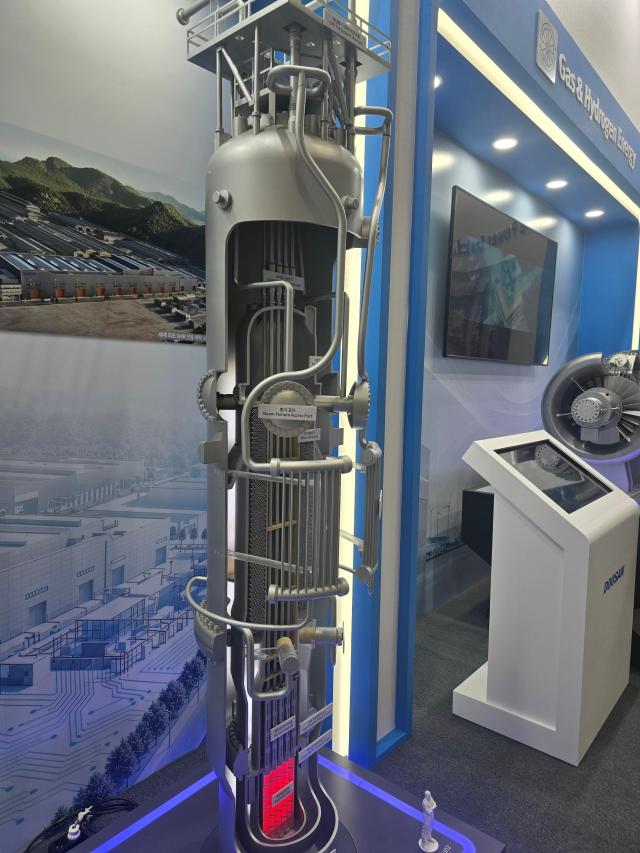
"The design has to come out first. From there we get our lead time and work to the schedule. We are waiting on KHNP."
SMART, the 100-megawatt reactor approved in 2012, never found a domestic site, and the Moon Jae-in administration's 2017 nuclear phase-out froze new reactor projects.
Renewables remain the centerpiece of the climate ministry's agenda, with a target of 100 gigawatts of capacity by 2030. Minister Kim Sung-hwan said on Oct. 1 that Korea stands just under 40 gigawatts.
If the first i-SMR starts up on schedule, it will arrive 23 years after SMART won its approval, and well after Doosan’s Changwon plant has shipped its first modules overseas.
AJP Takeaways
- South Korea named the safe development and demonstration of small modular reactors (SMRs) as one of three core nuclear policy goals at the IAEA International Ministerial Conference on Nuclear Power, held in Incheon from Oct. 27 to 29, 2026, the first hosted by Korea.
- South Korea's data center electricity use is projected to rise from 8.2 terawatt-hours in 2025 to about 18 terawatt-hours in 2030 and 30 terawatt-hours in 2038, according to the Ministry of Climate, Energy and Environment.
- Greater Seoul data center projects totaling about 33.6 gigawatts sought grid reviews by March 2026, but only about 1 gigawatt won final approval.
- South Korea's i-SMR design applied for standard design approval on Feb. 27, 2026, and the first unit in Gijang, Busan, is slated for commercial operation in 2035.

Copyright ⓒ Aju Press All rights reserved.
